I didn’t come to Lincoln County looking to start over. I was already here.
By early June of 2025, I had moved to Jefferson and begun building a life—writing, volunteering, settling into a rhythm. Three weeks after moving in with my partner, our relationship ended abruptly. Overnight, I was without housing or stable income, staring down peak season.
I loved this place too much to leave. I needed work.
Before Maine, I’d spent years as a content writer in tech. When my company was acquired, my job disappeared, and I struggled to reenter an industry already shifting under the weight of AI.
I reached out locally and was met with openness. A conversation with Anne Rundle at the Damariscotta Region Chamber of Commerce helped me see where I might fit. That small generosity mattered.
I had been drawn to the water from the start. There is something honest about maritime work—the hours, the weather, the lack of pretense.
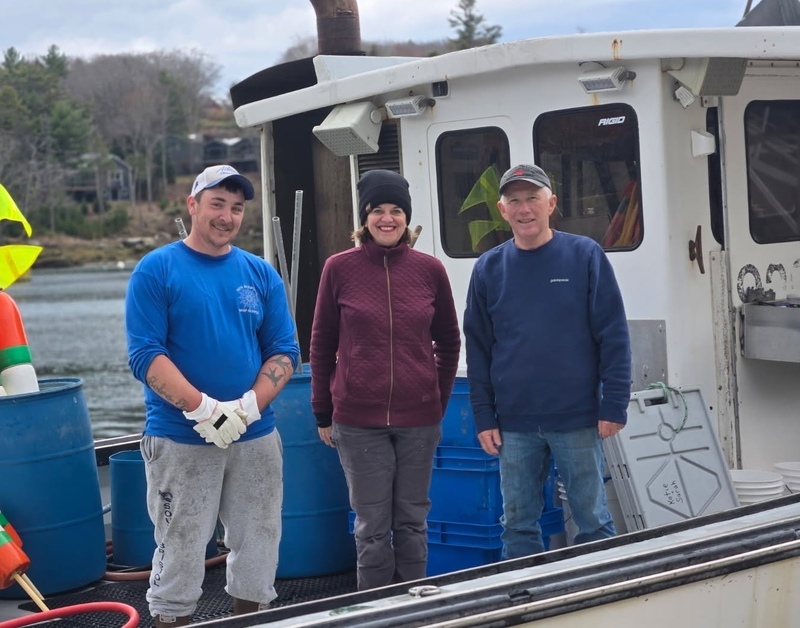
I found my way to the South Bristol Fishermen’s Co-op, initially helping with bookkeeping and pitching in wherever needed, from serving shore dinners during the busy season to whatever the day required.
The work wasn’t complicated; it was real. No glamour—just early mornings, long days, and people doing what they’ve always known how to do, often alongside family members, across generations.
Early on, my boss, Laura Hughes, commented as I put a half dozen lobsters into the cooker: “Bet you never thought you’d be doing this at 60.”
What struck me immediately was the humility of the place. No one was performing. The crew and staff never once gave me the hairy eyeball, even though it was clear I was a city girl—wearing lipstick. One fisherman even gave me the nickname “Lipstick.”
After months of grief and uncertainty, something shifted. I found myself spending more time down on the floats as the boats came in, first taking pictures of the water and the light, then focusing on the boats and fishermen themselves.
I was drawn to the rhythm of their labor—hours in heat, wind, and freezing cold—and to the quiet pride they carried in their work.
I started posting short videos on the Co-op’s Facebook page, and the response came immediately from fishermen’s families, the community at large, and summer residents away for the winter. Crews unloading crates. Sternmen moving in practiced coordination. Faces relaxed once the work was done.
Families shared the posts—a way of life reflected back to them. People in town mentioned it—to Laura, to Danny, our dock manager, and to the fishermen themselves.
And it’s not just men doing the work. Women on the dock work the crates and scales, drag-hook lobsters into bins, lower them into the water, run the hoist. During the summer months, there are women sternmen too—strong, capable, and fully part of the work. It matters.
What I was seeing was not novelty, but visibility. This work happens every day, largely unseen. I realized I wanted to help reflect it back—not to rebrand it, not to dress it up, but to show it as it is, for the people who depend on it and the community it sustains.
Over time, my role deepened. I began using the skills I’d built over decades—writing, visual storytelling, communication—in service of something tangible and local. I even took on payroll so Laura could take a much-deserved vacation. The work felt earned, grounded in trust and responsibility.
For months, nothing felt certain. I bounced between temporary housing in Nobleboro and Bremen. I watched my savings thin. I made plans to leave Maine, then changed my mind. What kept me here was the work—showing up, being needed, doing my part, and reflecting the fishermen’s work back to the community.
Eventually, I found housing near the water, close to the Co-op. My commute takes me past farms, Capes, trees, and fields. It’s quiet. It’s steady. I live alone now, and that aloneness feels earned, not empty.
The working waterfront didn’t rescue me. It didn’t fix my life. What it gave me was structure, dignity, and a reason to show up each day. It reminded me that belonging isn’t something you’re granted; it’s something you build through contribution.
The Midcoast is full of people who work hard, often without recognition, and keep showing up anyway. I’m grateful to stand alongside them. The lifeline I found here wasn’t dramatic. It was practical. And sometimes, that’s exactly what saves you.
Lisa Mae DeMasi is a creative professional and storyteller whose work centers on the people behind Maine’s working waterfront. With a background in editorial and communications roles at EMC Corp., VMware, and Dell Technologies, she brings a people-first lens to every narrative she crafts. Her recent creative nonfiction appears in the UK’s Funny Pearls, and she will self-publish her memoir, The Baggage Claim, this summer.