The good news is that Maine has more varied and sophisticated ways to measure the lobster population than ever before. The bad news is that data shows declines in larval, juvenile, young of the year, and sublegal populations, perhaps signaling a drop in landings in coming years.
Nine scientists from the state Department of Marine Resources spoke to a standing-room only audience at the Maine Fishermen’s Forum in Rockport on March 6, each reporting on a component of data gathered last year. DMR has expanded its surveys of lobster to include commercial catches, ventless traps, trawls, and even divers examining lobster.
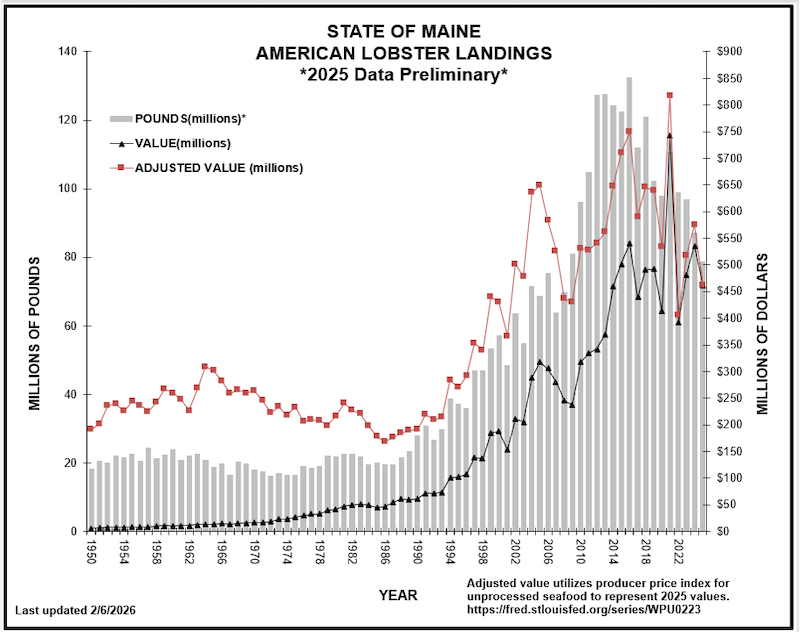
Earlier in the day, DMR released numbers from 2025 showing that Maine lobster harvesters landed 78.8 million pounds, topping other fisheries with an overall landed value of $461 million. Boat price—that paid to individual captains—was $5.85 per pound, the third highest on record.
The total weight of the state’s lobster landings has now been trending downward for a decade.
In 2024, lobster fishermen landed 86 million pounds, which was down from 2023’s 96.9 million pounds. Landings totaled $528.4 million in 2024 and $464 million in 2023.
The catch had hovered around 100 million pounds earlier in the decade, with 97.9 million pounds landed in 2020, 110.7 million pounds in 2021, and 98.9 million pounds in 2022.
Despite the strong numbers for 2025, inflation took its toll, DMR Commissioner Carl Wilson noted.
“When adjusting for inflation, the overall value of lobster in 2025 was more in line with the value earned in 2008,” he reported in a press release. The industry saw bail, fuel, and crew costs all increase last year.
Opening the March 6 session, DMR’s Kathleen Reardon said the fishery’s abundance was not depleted, but data suggested populations are below targets.
“The trend has been downward,” she said, with “a really strong spatial dynamic,” meaning data “signals” show the population is stronger in eastern areas.
DMR’s Marissa DeCosta noted that landings numbers have showed “more stability” in the areas south of Penobscot Bay, while the eastern coast initially recorded higher catches, then saw declines over the last 10 years.
The surveys do not mean changes in management are called for, Reardon said, but DMR recommends continued review.
Water temperatures measured on the bottom were cooler last year than in 2024, she said, a preferred condition. Lobster began appearing in traps later than in 2024, with Reardon characterizing last year’s catch as “patchy and unpredictable.”
Fishing boats were less active than usual in the summer months, she added. Factors for that trend include retirements, fewer new licenses being issued, and fishermen perhaps waiting for others to begin reporting success before heading out.
Maine lobster harvesters took more than 21,000 fewer fishing trips in 2025 than in 2024, a nearly 10 percent decline in fishing effort.
DMR’s Heather Glon and Robert Russell presented information on the populations of lobster up to a year old. While “2024 was a fairly typical year for larvae,” Glon said, “in 2025, we saw larvae later in the year.”
Russell said larvae were seen as late as mid-December: “That’s kind of crazy.”
Research found that settlement of young lobster—the point in their life cycle when they take shelter on the bottom—came later than usual and showed low numbers.
Staff concluded there is no consistency in recent patterns to suggest a coming boom or bust.
DMR’s Robyn Linner reported the results of an inshore trawl survey counting the number of sublegal lobster, conducted along the New Hampshire and Maine coasts out to the 12-mile limit. Only the Penobscot Bay region showed increases.
Ventless trap surveys showed similar results for sublegal-sized lobster, according to DMR’s Kristyn Kleman.
“We did see a slight drop in sublegal in all zones,” she said.
In answer to an audience question, DMR scientists said they don’t yet know the cause of the decline in larval and juvenile lobster.
Tom Groening is a former editor of The Working Waterfront. He may be contacted at thomasjgroening@gmail.com