Seaweed is having a moment—well, actually, more like an era. Attention to algae has been growing for many years now, led by environmentalists and entrepreneurs. While their goals might at times clash, both groups focus on this coastal mainstay: the weeds in the water.
Another cohort taking notice—artists—is becoming increasingly visual in its celebration and championing of these diverse species. In Holdfast! A Seaweed Exhibition, Celeste Roberge and Ian Ellis have assembled 30 artists—sculptors, photographers, painters, mixed media-tors, printmakers, quilters, et al.—for a tribute to seaweed of all sorts. The title of the show does double duty, as a description of an anchoring marine organism and as a declaration of solidarity, if you will, with the contested aquatic algae.
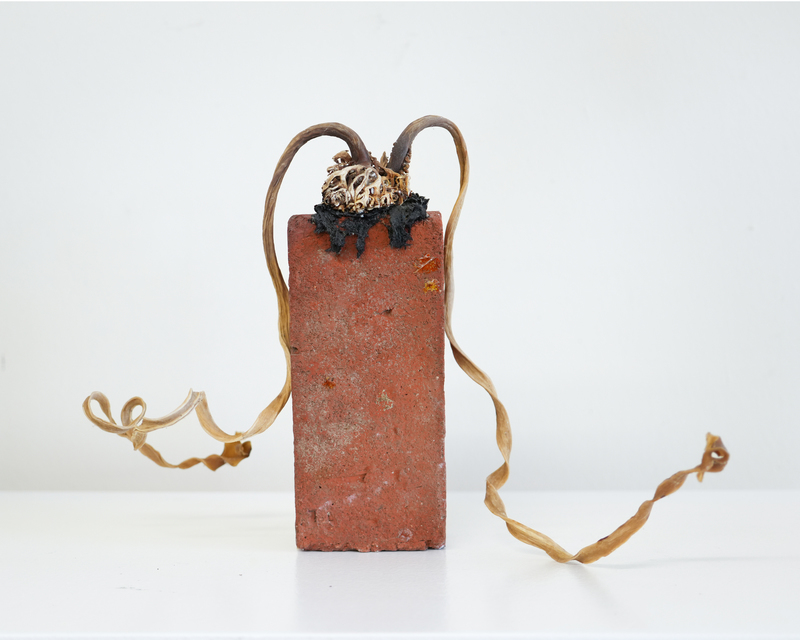
Ron Leax’s “Holdfast” might serve as the centerpiece. What appears to be a found sculpture features an orange-red brick stood on end with a dried kelp holdfast and stem attached at the top—a sea-spirited piece that highlights the grip of nature. Likewise does Suzanne Demeo’s watercolor “Holdfast Study #3” demonstrate the weed’s ability to grasp, in this case a mussel.
Jordan Chalfant presses seaweed, a skill she situates “at the crossroads of art and science.” She floats the specimens in a shallow tray of water over herbarium paper to create colorful organic designs. Pressings in the show include dumontia and protomonostroma undulatum. Chalfant and fellow College of the Atlantic graduate Glen Mittelhauser co-lead the Maine Natural History Observatory’s Seaweeds of Maine project whose goal is to create a guide to the weeds.
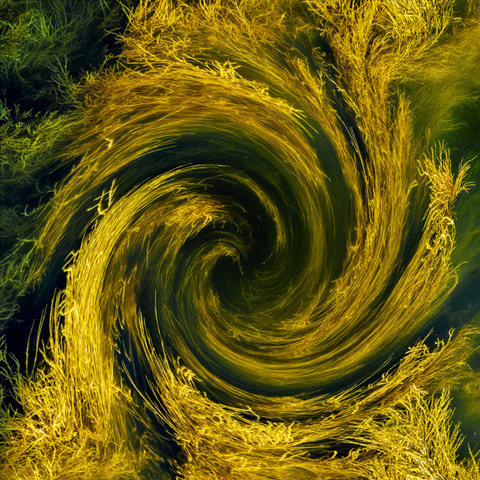
Dave Wade’s photograph “New Swirl” captures the whirlpool motion of seaweed in tidal surges. The movement of seaweed also enlivens paintings by Krisanne Baker and Elizabeth Awalt, both of whom snorkel and dive to find their underwater subjects. (Awalt has curated Water Proof at the Wendell Gilley Museum in Southwest Harbor this summer, with a number of artists overlapping, including herself, Baker, Roberge, Michel Droge, and Posey Moulton.)
The range of mediums in the show is remarkable. Lisa Tyson Ennis contributes several cyanotypes from her “Ocean Garden” series, using the vintage photographic printing technique to highlight the shapes of her algaic subjects. Karen Adrienne offers a monotype titled “Sugar Kelp Shimmy.” Barbara Putnam and Josie Iselin draw on science in their seaweed-inspired textile pieces.
In her 2018 book Seaweed Chronicles: A World at the Water’s Edge, Blue Hill-based writer Susan Shetterly warned of the impact of the seaweed gold rush on the chain of coastal ocean life. “A functioning ecosystem is a living mosaic,” she wrote, “as strong as we can make it.” The Holdfast! artists take this to heart in their creations.
Rich MacDonald, successor to the late, great Ruth Grierson as nature columnist for the Mount Desert Islander, ended a post titled “Is seaweed really a weed?” with this advice: “Next time you walk along the shoreline, look at the seaweed and ponder its vital role in the natural and human world.”
The art in this remarkable show compels us to consider seaweed in new and different lights and forms. Look and wonder.
Holdfast! A Seaweed Exhibition is on view at The Warehouse, 20 Winter Street, Rockland, Aug. 1-Sept. 13. The show is open Friday, Saturday, and Sunday, 11 a.m.-5 p.m. The exhibitors are hosting a series of noontime talks at the venue. Among the offerings: “Tide Pools Instead of Babysitters,” with Seraphina Erhart, manager of Maine Coast Sea Vegetables in Ellsworth (Aug. 8); “Josie Iselin: Art & Algae: An Artist’s Journey into the Science of Seaweed and the Drama of the Kelp Forest” (Aug. 9); and “The Natural History of Seaweeds through the Holdfast! Exhibition” with Jessica Muhlin, professor of marine biology and chair of the Corning School of Ocean Studies at Maine Maritime Academy (Aug. 15). A complete list of talks is available on Instagram at @holdfastseaweedexhibition.
Carl Little curated Francis Hamabe’s Maine: A Life in Art for the Castine Historical Society (through Oct. 12, 2026). His article on how two vintage Steinway pianos ended up on Sutton Island appears in Island Journal.