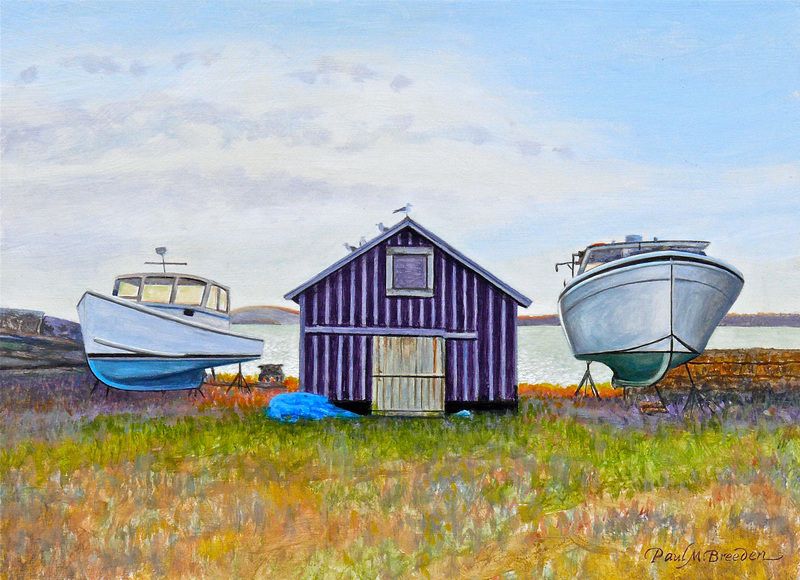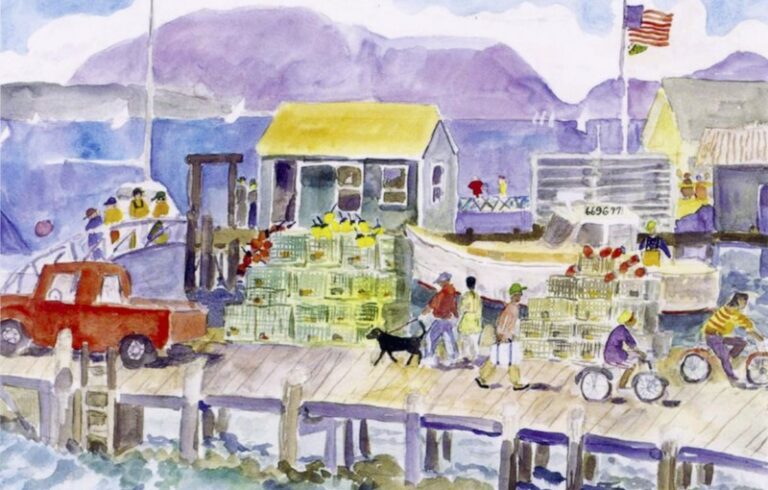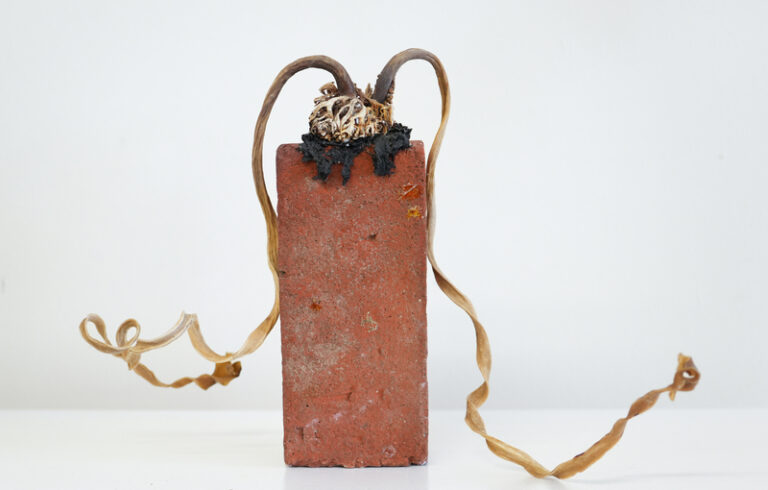
“I have always been attracted to worn and well-weathered waterfront structures,” writes painter/photographer Paul Breeden. “They seem to tell a story of endurance and tenacity in the face of the vagaries of the seasons and heavy use.”
Over the years, Breeden has painted and photographed working waterfronts before they were “replaced, remodeled, or demolished by winter storms.” The structures spoke to him of earlier days of wooden boats, lobster traps, and buoys, “inefficient gas engines,” hard work, and care for the community. “The dignity, pride, and personalities of fisher folk,” he writes, “seemed to rub off on the old sun-bleached shacks and wharves.”
Breeden found the subject for his painting “Cannery Row” in the “off-the-beaten track” harbor of South Gouldsboro. “It touched me to see how two family-owned lobster boats were neatly placed on opposite sides of what was once a small cannery,” he explains, adding, “The visually balanced scene speaks of confidence and implied trust, since in many other communities the boats would be the targets of vandalism, if not outright theft.”

In 40-plus years living in Sullivan, Maine, Breeden has visited Downeast harbors and made friends among the fishers of the sea while admiring their vessels. He points to Merle Beal of Beals Island and his island-built boat, the Silver Dollar, Leamon Chipman with his “cute old” Jennie Kay, Bud Kilton with his “sweet” Marita K., and many others.
Breeden was especially fond of the late Jean Symonds of Corea and her modern fiberglass lobster boat Finest Kind. “She was tough as nails but sweet as honey,” he states. He admired her courage as a woman lobster fisher.
Born in Millville, New Jersey, by his own account Breeden decided to be an artist the second his Sunday school teacher told him his drawing of a tree looked like a “bunch of scribbles.” At 5 years old, he relates, “my determination to succeed overcame her insult.”
At the same time, Breeden’s parents supported his artistic efforts. His father brought home lead pencils and stacks of used blueprints from the factory where he worked. “They stunk of ammonia,” the artist recalls, “but were free and plentiful.” Later on, his high school art teacher and his parents encouraged him to go to art school. “I lasted three miserable months,” he reports, “and stayed untamed.”
After working as a janitor and typist, Breeden landed his first art-related job at J. H. H. Turner & Co., sign painters to the White House in Washington. While raking in a “whopping” $60-per-week salary, he taught himself calligraphy. Years later, he worked as a calligrapher at the White House.
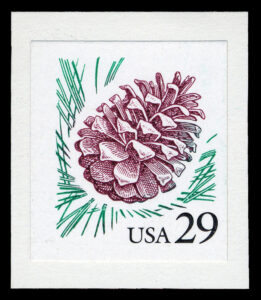
Breeden’s first published illustration appeared in a 1967 National Geographic: a black-and-white scratchboard drawing of an ancient bottle recovered from the ocean floor. He became a regular at Nat Geo and began painting full-color illustrations in gouache, which led to commissioned illustrations in many major magazines, including Audubon and Smithsonian. He also designed the pinecone postage stamp, the first self-stick, which was issued in 1993.
Among Breeden’s illustrated books is Peter Jenkins’ classic A Walk Across America. His work appeared in prestigious exhibitions, among them 100 Years of Illustration. Museum collections include the Hunt Institute for Botanical Documentation.
Breeden, his wife Ann, a painter, and their family moved to Maine in 1983 after years of tenting at a campground on Southport Island. After “foolishly” buying an old captain’s house, they built a “woodsy” home and “cozy” gallery. Four of their five children are artists.
On a break from painting, Breeden says he will be back at the easel soon (he has two waterfront works in mind). In the meantime, he is working on his 82nd creative short story—“just another means of artistic expression,” he says, with words replacing brush strokes.
After showing in Santa Fe, Taos, Rockland, Ellsworth, D.C., Connecticut, and elsewhere, Breeden now exhibits exclusively at Spring Woods Gallery in Sullivan.
Carl Little lives and writes on Mount Desert Island. He and Catherine Schmitt received the first Chatwold Awards from the Writers Guild of Acadia this past August.