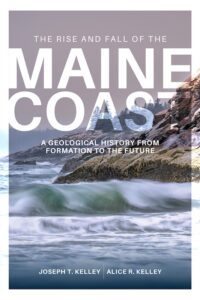
The Rise and Fall of the Maine Coast: A Geological History from Formation to the Future
By Joseph T. and Alice R. Kelley (2026, Down East Books)
Anyone familiar with Maine’s coast knows to head south for big sandy beaches. North of the Kennebec River, the swimming areas tend to be fewer, smaller, and wedged between the sheer rocky outcrops for which Maine’s shoreline is better known.
After reading The Rise and Fall of the Maine Coast, I now know why. Long ago, the area around Penobscot Bay also had large sandy beaches. But when glaciers covered Maine some 20,000 years ago, then retreated, they left many profound changes, including “deranging” some of the largest rivers, or shifting their flow.
The most dramatic case was Moosehead Lake, which used to drain into the Penobscot River, but now flows into the Kennebec after the headwater area rebounded from the glaciers and tilted in a new direction. That starved the Penobscot River of much of its sand, allowing mud to fill its delta.
That was one of many interesting things I learned from this book, in which Joseph and Alice Kelley condense more than 500 million years of planetary, tectonic, and glacial history into an accessible volume of just under 200 pages.
The longtime University of Maine geology experts have generally produced a compelling and insightful narrative about the big forces that shaped this corner of the planet. Some of their writing does veer into dryer, reference book territory, though that may appeal to any readers seeking a more thorough understanding.
They first recount the tectonic activity that pushed up the mountainous East Coast, followed by hundreds of millions of years of “running water and grinding ice” that wore it down. They cover the impacts of the last ice age, including the dramatic shift of the coastline as the glaciers melted, first inward to the Katahdin region as the ocean filled back up, then outward as the land rebounded from the ice sheets, then inward again as seas kept rising.
They close their narrative with the arrival of people in Maine, first describing the earliest Wabanaki communities, then getting to the interventions that Europeans settlers made on the landscape and the dire challenge we now face from accelerating sea level rise.
They succeed at conveying the broad sweep of geologic history while also translating the science and zooming in on entertaining bits of trivia, like the derangement of the big rivers after the last ice age, and the fact that what’s now Maine started as a series of small tropical islands.
The authors describe the detective-like efforts by scientists to solve the mysteries of earth’s history, especially when it came to glaciers and the discovery of ancient seashells, mammoth tusks, and spearpoints that helped fill in the record since they melted.
One mystery that hasn’t been conclusively solved, but I found especially fascinating, is why smaller earthquakes occasionally shake the Downeast coast, when Maine no longer sits near any active fault zones. The Kelleys offer a few hypotheses along with a fun bit of local lore: an older Lubec resident once informed them that “no girl from that town inherited her grandmother’s china because earthquakes always hurled the dishes from a shelf and smashed them first.”
If I could have offered any feedback to the Kelleys, it might have been to step out more from behind the camera. It’s clear from the footnotes that they’ve produced much of their own research, but they rarely switch to the first person to narrate their own role in building the historical record, which might have been interesting, or offer other colorful anecdotes like that one from Lubec.
When it comes to the big stuff, they do stick their landing, ending the book with straightforward warnings about the need for Mainers to learn how to live with rising sea levels—a type of progress that has usually come too late, such as the groundswell of response to the devastating coastal storms of 2024.
As they warn, “Given the inertia of our society, change will likely come not in a planned, managed fashion, but in episodes associated with damaging storms.”
We should trust the Kelleys on this one. They understand the epic natural forces that got us here.
Charles Eichacker is the editor of The Working Waterfront and Island Journal. He may be contacted at ceichacker@islandinstitute.org.