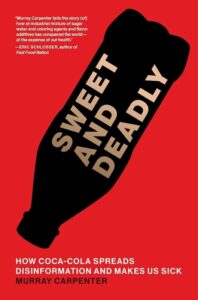
Sweet and Deadly: How Coca-Cola Spreads Disinformation and Makes Us Sick
By Murray Carpenter (2025, MIT Press)
The most revealing passage in Murray Carpenter’s book Sweet and Deadly appears toward the end, almost as an aside.
At that point, the reader has been through about 250 pages of high-quality facts, quotes, anecdotes, and summaries of things you for the most part wish you didn’t have to know about sugar-sweetened drinks, the soft drink industry, and the Coca-Cola Co. in particular. We eventually get to the current decade, when the company considers—then rejects—reporting out on the public health effects.
The plot alone is so familiar and predictable it almost makes you sick.
Carpenter, of Belfast, takes us expertly and readably through a roughly chronological overview of the soft drink industry, focusing on Coke. We learn from his visit to the World of Coca-Cola museum in Atlanta that in 1884 John Pemberton devised the French Wine Coca drink, an imitation of a popular patent medicine, blending alcohol, caffeine, and a coca extract. Carpenter likens it to “a Jägerbomb with a small bump of cocaine.” By 1888 alcohol was replaced with carbonated water so it could be marketed as a temperance drink renamed Coca-Cola.
Within a few years, the cocaine was replaced by “decocainized coca-leaf extract,” which remains today. Early on, an 8-ounce serving contained 80 milligrams of caffeine, comparable to that of Red Bull today. A century of formula tweaks eventually led to a reduction in caffeine content, too. (For more fascinating information about caffeine, which is lethal in surprisingly small amounts, see Carpenter’s 2015 book Caffeinated.)
From practically the beginning, Coke’s marketing strategies were ambitious and wildly successful. By the 2020s, annual revenues were around $46 billion. Billions of people drink billions of Cokes every year.
What is not widely known is that there have been questions about the healthfulness of Coke practically the whole time. The company was sued in 1911 by the precursor to the U.S. Food and Drug Administration for allegedly being addictive, laced with caffeine, and marketed to children. The company settled at the Supreme Court, admitting no wrongdoing. In 1942, the American Medical Association backed off a 1930s statement validating Coke as probably a health food, instead stating that the sheer quantity being drunk by Americans, with its significant amounts of sugar, was “definitely undesirable.”
After World War II, the game was on, so to speak, between health advocates and Coca-Cola’s marketing department. As research began pointing to sugar consumption’s role in diabetes, obesity, and kidney and heart disease, the soft drink industry pushed back with marketing strategies designed to deflect attention from science-based analyses. Players who had worked on tobacco company campaigns to counter damning facts about smoking were brought in to help keep Coke and Pepsi from suffering similarly bad press.
There were efforts to discredit the scientific studies, and efforts to divert attention, such as the spurious “calories in, calories out” theory of sugar metabolism which led to another spurious claim about obesity being due to physical inactivity instead of diet. There were efforts to muddy information by hiring the company’s own scientists.
In episode after skillfully investigated episode, researchers and scientific groups that backed Coke’s marketing claims turn out to be directly or indirectly funded by the company itself.
Meanwhile credible, authoritative research showing sugary soft drinks pose serious health risks piled up for decades.
Toward the end of the book, Carpenter reports on the Coca-Cola Co. shareholders’ meeting of 2019, where it was boasted that in the previous 11 years the company’s management had returned $91 billion to shareholders. One of the questions up for consideration at the meeting was a request that the company’s directors recognize the swelling evidence of sugary soft drinks’ adverse effects by issuing a report on sugar and public health.
The shareholders loved their money more than they cared about disease, suffering, and death. They voted 3 billion shares to 152 million shares to issue no report.
Avarice won again.
This readable, eye-opening book reveals Coca-Cola’s decades-long efforts to sidestep troubling facts inconvenient to the sales of its drinks. Sweet and Deadly is, unfortunately, a reporting parable of our times.
Dana Wilde is a former newspaper editor and college professor who lives in Waldo County.