
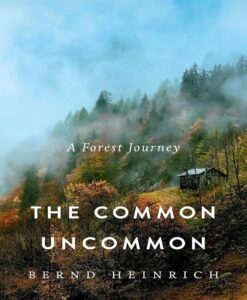
The Common Uncommon: A Forest Journey
By Bernd Heinrich (2026, W. W. Norton & Company)
In the foreword to his new book, Bernd Heinrich explains the reasoning behind its title. “Ensconced for forty years in the Maine woods,” the famed biologist and author writes, he has explored his forest retreat, focusing on the “common uncommon,” natural phenomena that have “not been sufficiently noticed.”
The spirit of the writing is generous, the sense of place, intimate and compelling. Every encounter with the natural world expands our wonder. Spiders, beetles, chestnut trees, eastern phoebes, woodcock, swallows: thanks to Heinrich’s empathetic guidance, we see these and other flora and fauna with the clarity of someone who possesses a power of observation that seems almost preternatural.
In a section on arachnids, Heinrich highlights the precision of their webs as structures and traps. His devotion to these brilliant spinners leads him to comment on Charlotte’s Web: “I’d have preferred E. B. White to show what spiders really do, not what we might dream they do or what people might like to hear about them.” Point taken.
Here and there, Heinrich references his early life. He got to know his “first love,” beetles, in the Hahneheide forest “while we were eating crows and mice when we could get some as we arrived as refugees in Germany after our flight from Poland with nothing.” Noting that there are about 350,000 species, he cites British evolutionary biologist J. B. S. Haldane as declaring that if God created all living organisms, then he must have had “an inordinate fondness for beetles.”
On a rare occasion, Heinrich lays on the language of biology. Writing about leaf shedding in the fall, for instance, he notes that it is likely influenced by “photoperiods and circannual biorhythms, which trigger the production of abscission enzymes that dissolve the cell layers….” That mouthful aside, his explanation of autumn colors will lead this reader to look at those autumnal glories with a new respect.
Heinrich is not only observing nature, he is rescuing it. His successful efforts to revive the wild American chestnut tree have attracted worldwide attention. Since planting a few saplings around his cabin in Weld, the chestnuts have spread and now number more than a 1,000. In the video “The Wild American Chestnut: A Giant Returns” posted by the Global Justice Ecology Project in December 2025, Anne Petermann, the project’s executive director, visits Heinrich to talk about his resurrection of this endangered tree. At one point in the clip, the 80-something-year-old author-biologist climbs one of the trees with a nimbleness some of us will never possess.
Speaking of rescuing, in his inimitable style Heinrich relates the story of a merganser trapped in a pool in a nearby brook, unable to take off. After jumping in, he grabbed the duck on a “swim-by” and tossed into the air as high as he could, “which was high enough for it to leave without a crash in the forest.”
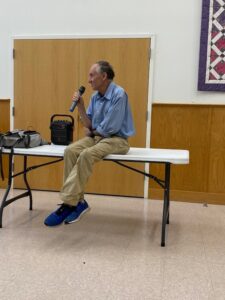
In some ways, The Common Uncommon is Heinrich’s Walden, a study of a specific place where he finds everything he needs—and which is now secure under a Maine Forest Society easement. “I’m not sure how one should own land, or air or water, except to love and respect it for what it is,” he writes.
For all his geniality, Heinrich can be urgent in his delivery. “When will we wake up,” he asks at one point, “open our senses to the community of this great superorganism that was created over a period of untold millions of years, of which we have seconds?”
Toward the end of The Common Uncommon, Heinrich writes, “Feeling the beauty and wonder of nature is a prelude to loving it and achieving a state of grace by the knowledge of being a part of something beyond ourselves, being linked to every other organism.” In the final sentence, he declares his ultimate goal: “I want to join the party of the greatest show on Earth, life everlasting.”
Carl Little curated Francis Hamabe’s Maine: A Life in Art for the Castine Historical Society (through Oct. 12, 2026). His article on how two vintage Steinway pianos ended up on Sutton Island appears in Island Journal.