The last time I drove Island Institute’s boat, a 25-footer with an outboard motor, I used about 16 gallons of gas per hour. That’s the standard measure of a boat’s fuel consumption, and being out on the water for much of the day, it added up to 74 gallons—enough gas to drive my car from Rockland to Key West, Florida. In addition, the outboard engine was so loud that I had to strain to hear my colleagues, who were talking just a few feet away.
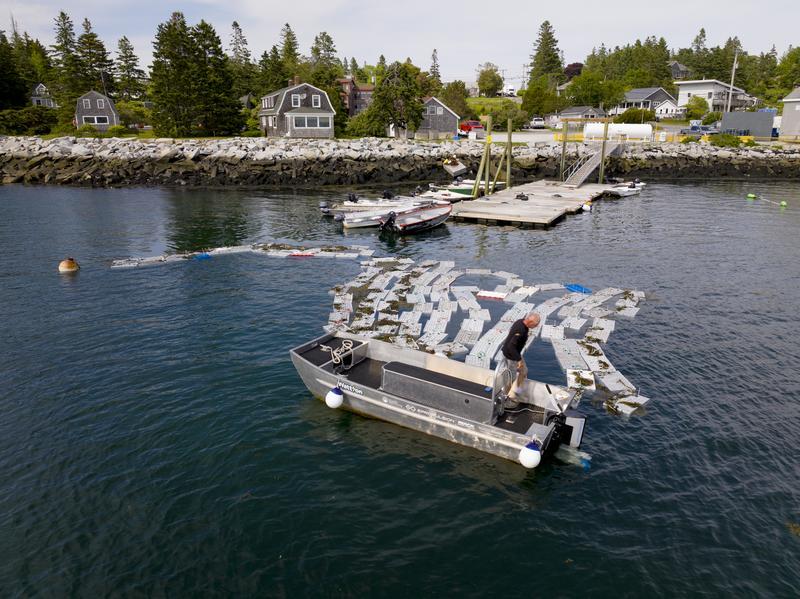
This was in sharp contrast to a ride I just took on Heron, a boat powered by two electric outboards that Maine Ocean Farms uses on its oyster farm based in South Freeport. Twelve people were on board, including staff from multiple state agencies and a few others active in statewide policy.
Cruising down the bay at 16 knots, we had a normal conversation about the benefits of electric-powered workboats, the current challenges facing the industry, and the opportunities for state policy change to support this emerging industry.
Maine Ocean Farms, the Spruce Head Fishermen’s Co-op, Pendleton Yacht Yard, and other coastal businesses using electric engines for workboats are at the forefront of a new innovation in traditional Maine industries. They are taking risks with emerging technology, using custom or semi-custom systems that require fine-tuning. These businesses actively gather data, share experiences, and provide feedback to partners such as Island Institute and the manufacturers of boats, engines, and batteries.
At the state level, Maine supports this work through the Maine Technology Institute (MTI). MTI is a critical partner, fostering innovation and helping both Island Institute and the businesses developing electric outboards reduce risk. The state’s Blue Economy Task Force also identified electric outboards and marine propulsion as key areas, representing early opportunities for Maine’s Center for the Blue Economy at MTI.
A municipality purchasing a boat powered by an electric outboard is eligible for state funding through the Community Resilience Partnership. Replacing or re-powering small skiffs used by harbormasters for daily work around the harbor, or pump-out boats, present potentially interesting use cases for communities to consider.
On Heron, one area of discussion was that Maine Won’t Wait, our state climate action plan, calls for state agencies to identify opportunities to “lead by example.” With this mandate, state agencies have shifted their vehicle fleets to include EVs or made significant weatherization and energy efficiency upgrades to their physical buildings. With a couple of the coordinators of this state approach on Heron, we talked about identifying the right places where an agency owns and operates a boat that provides a good use case for electric outboards.
Based on Island Institute’s work, conversations with industry partners, and state agency staff, it is clear that more is needed to help advance the development and deployment of this technology. Three key areas for additional support from the state are:
- Ensuring businesses, towns, and other entities have support and technical assistance to operationalize these vessels: Because these are custom or semi-custom designs and projects, they require a lot of problem-solving—from the boats, batteries, systems, and engines to the infrastructure needed on shore to charge them.
- Funding to support the innovative businesses in Maine that build these boats: Heron and the work skiff at the Spruce Head co-op, Wattson, were made in a Maine boatyard. Funding to support innovation and equipment at businesses such as these boatyards will help the sector grow and keep Maine at the forefront of these conversations nationally.
- Funding or subsidies to mitigate risk for vessel operators: Currently, these systems carry high upfront capital costs and a level of risk for operators. All of the boats mentioned in this article were the result of leveraging multiple sources of funding from public, philanthropic, and nonprofit sources, as well as from the multiple businesses involved.
As Maine heads toward a new governor and the start of a new legislative session, the Island Institute team is looking forward to advancing policies that help our partners—businesses, communities, and the state—begin to address these needs.
Nick Battista is chief policy and external affairs officer for Island Institute, publisher of The Working Waterfront. He may be contacted at nbattista@islandinstitute.org.