Reflections is written by Island Institute Fellows, recent grads of college and master’s programs who do community service work on Maine islands and in coastal communities through the Island Institute, publisher of The Working Waterfront.
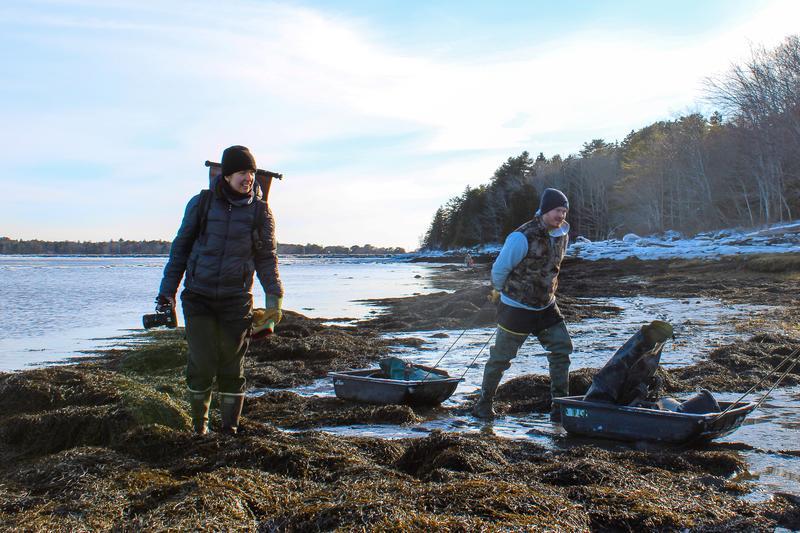
Phippsburg is a slim place of mudflat, deep coves, strong currents, and diverse fishing histories. A few days ago, during a heavy rainstorm, I met with two lobstermen who told stories about their lives on the water. One reminisced about boyhood skiff rides on summer evenings, visiting Cundy’s Harbor for a burger. The other recalled a fisherman who had wrapped a line around his hand, with a tuna hooked on the other end. When the tuna decided to run, the fisherman was hauled overboard. He lived, but was dragged down pretty deep before figuring out which way he had wound the line.
“It wasn’t a job,” they said of fishing. “It was something that you wanted to do.” They talked about change, the evolution of boats, the shifts in the shape of Phippsburg’s villages.
Other residents recall when Route 209 was emptier and a person could walk across the peninsula in an afternoon. One former fisherwoman described building a private wharf decades ago, floating its pieces from another shore, through the fog—all without planning board approval. “Couldn’t get away with it now,” she laughed.
At the monthly Shellfish Commission meetings, members weave their discussions with anecdotes of now-defunct dealers, of long-retired state biologists, of boom and bust years. On my first day in Phippsburg, one digger told me about a recent catastrophe: Flooding in the Kennebec River caused such prolonged clam flat closures that some harvesters had to dip into retirement savings, or even lost homes.
The importance of such narratives is growing in environmental management. In a 2019 paper examining environmental justice methodologies, communications scholar Chad Raphael writes that sidelined voices can offer “important signals about the wellbeing of human and natural systems, and sources of hopeful action to improve them.” Stories can also act as causeways between demographics. As ecosystems, economies, and property lines change, the need for small-town collaboration increases. To that end, a key part of my fellowship is acting as a liaison. Storytelling is odd work—but useful, I hope. It’s also inherently imperfect work, in its selectivity. People, including Wabanaki ancestors, have lived on what is now called the Maine coast for twelve thousand years. Infinite stories have been lost—and ecological understanding with them.
Activist Rebecca Solnit writes in Hope in the Dark: “Political change often follows culture … Which means that every conflict is in part a battle of the story we tell, or who tells and who is heard.” So to all the storytellers, I say: Keep on ranting. If you didn’t, I wouldn’t learn anything.
Storytelling is not just my schtick, luckily. There’s a push on Maine’s coast to get old stories stirred up into new audiences. Some stories are simply yarns with a good punchline. Others help with sea level rise assessments. Some storytellers you meet in your yard, on their way to the flats. Some stories are fleeting as an owl in daylight; others are haunting rants that echo for a long time. Often, what sounds like a profound grief lines stories of ecological and cultural loss.
It’s really hit home this winter that the stories I listen to and tell can be very heavy. This morning, I called a friend in Newfoundland who produces fisheries broadcasts for CBC. Like many here in New England, previous generations of his family once made a strong living on the water. The region has a strong fishing identity, but it’s accompanied by a sense of ubiquitous cultural loss. My friend knows a lot about telling—and living—such heavy stories. “I had to separate a piece of myself from it, eventually,” he said. “One person just can’t fix it all.”
Maybe this reflection got a tad morose. But some folks live the heaviness of the stories. It’s an act of giving dignity, I feel, to acknowledge that heaviness. Acknowledging reality is part of the way forward.
Though Phippsburg’s identity is distinct, its stories represent larger histories and patterns. It’s a good, small place to learn about the world. The hope of storytelling down on this peninsula, short of fixing everything, is to link some silos of knowledge, community, and purpose. That’s all.
As an Island Fellow in Phippsburg, Katherine Cart primarily liaises between working waterfront stakeholders. She began writing about fisheries while working on commercial fishing vessels in the Bering Sea and gulfs of Maine and Alaska. Her writing can be found in such places as Conjunctions, Missouri Review, and Raritan.