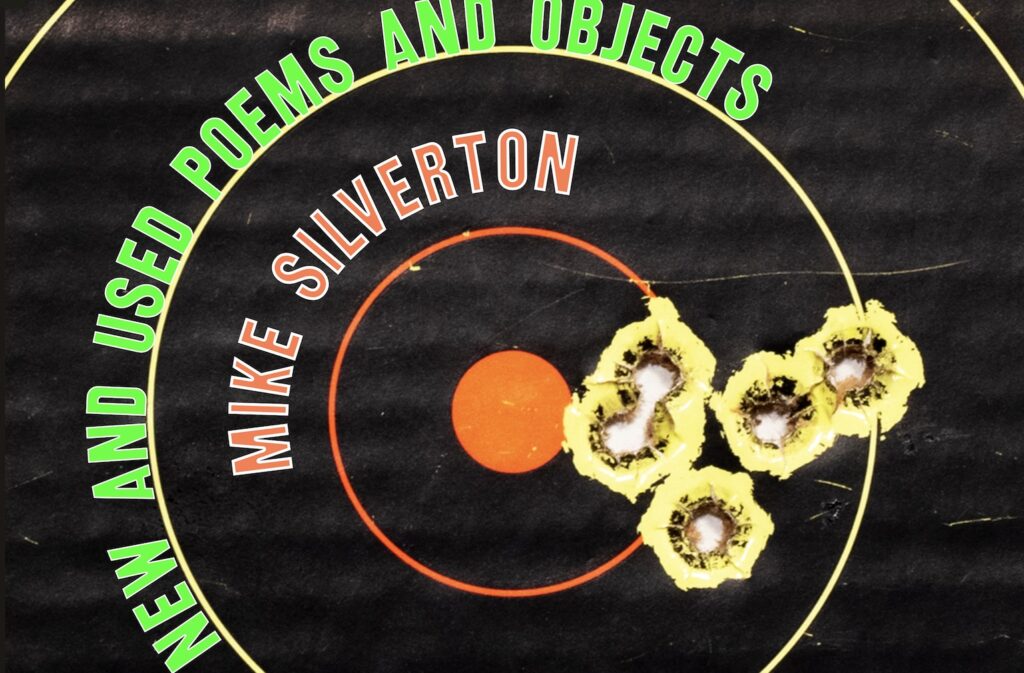
New and Used Poems and Objects
By Mike Silverton // Photographs by Kevin Johnson (2026, Sagging Meniscus Press)
It has now been 109 years since Marcel Duchamp’s urinal was not shown in an art exhibit in New York City. This was because the Society of Independent Artists couldn’t decide whether “Fountain” was actually art. So since their policy was to never reject any submissions, they quietly placed it out of sight.
Fast-forward about a century, and the contents of Midcoast Maine resident Mike Silverton’s book New and Used Poems and Objects seem nowhere near as weird as Duchamp’s urinal seemed to his colleagues. We are kind of used to the idea that anything you look at can be regarded as art, one way or another. Urinals can now be talked about as if they’re artwork, and so can Silverton’s makeshift contraptions and paintings, photographed for the book by Kevin Johnson.
Just to describe one of these “objects” in the artist’s own words: “While clearing out the garage and barn I came across an elegant old coat hook the brass base of which I trimmed and secured to a framed piece a friend gave me years before. And so, ‘The Poet Laureate Contemplates a White Porcelain Sphere.’” You have to see Johnson’s precision-skill photos to grasp the ways in which you have never seen anything like Silverton’s objects in your life.
Duchamp and the modernists called this art made of found objects “readymade.” The ideas that were careening into visual art in 1917 were also veering into literature. A poem could be looked at as an object, too. In the same way a bunch of random parts could be glued, hammered, or welded together to form something you never saw before, so could words. Words do not have to refer to reality. You can put seemingly unrelated verbs, nouns, and modifiers together in any order you can think of and then observe the result.
This artistic-literary movement as a whole is called Dadaism. Eventually it was noticed that you didn’t even have to think. You could just let words bubble up out of your Freudian unconscious, as if you were dreaming in words on paper. This came to be called Surrealism and filtered into visual art too (think of Salvador Dali’s famous melting clock). This is the literary and artistic milieu Silverton explicitly, in a couple of short, playful essays appended in the book, inhabits.
Dadaism and Surrealism were taken in lots of offbeat directions in the 20th century, some of them deadly academic serious, and some of them just for the curious fun of it. Silverton’s poems and objects, thankfully, are primarily for the fun of it. You can get a quirky, impish, funny, pathetic, ironic, or silly Monty Python-like kick off any page of New and Used Poems and Objects.
The kick can come from a weird combination of words that almost seems to mean something recognizable, but doesn’t. “Ahoy!” in its entirety goes:
Ahoy, eyes! Return!
An immortal’s waving a blizzard like a bedspread!
I need to watch.
Ahoy, Dracula, dead to the world in an ebony box
(exclusive of attachments),
on a bed of dirt from your native land!
(On the page facing this poem is Johnson’s photo of what could be a black box with a corkscrew prong sticking out of it.) If a poem like “Ahoy!” doesn’t exactly get your attention, there are others like “Tiptoe Away” that sound almost like wisdom, if you decide to take it seriously:
When you hear the dark angel snarling
unhand whatever impulse obtains
and tiptoe away.
I think Duchamp and his unruly co-conspirators Tristan Tzara, Man Ray, Mina Loy, Andre Breton, Francis Picabia, etc., not to mention Gertrude Stein if not Jacques Derrida, would be proud of the soapbox derby go-cart Silverton is driving through art and poetry a century after they got the ball rolling uphill. If you grasp what rocker David Byrne meant a few decades ago when he admonished us all to “Stop Making Sense,” then you should look through this book. For the fun of it, at least.
Dana Wilde is a former newspaper editor and college professor who lives in Waldo County.