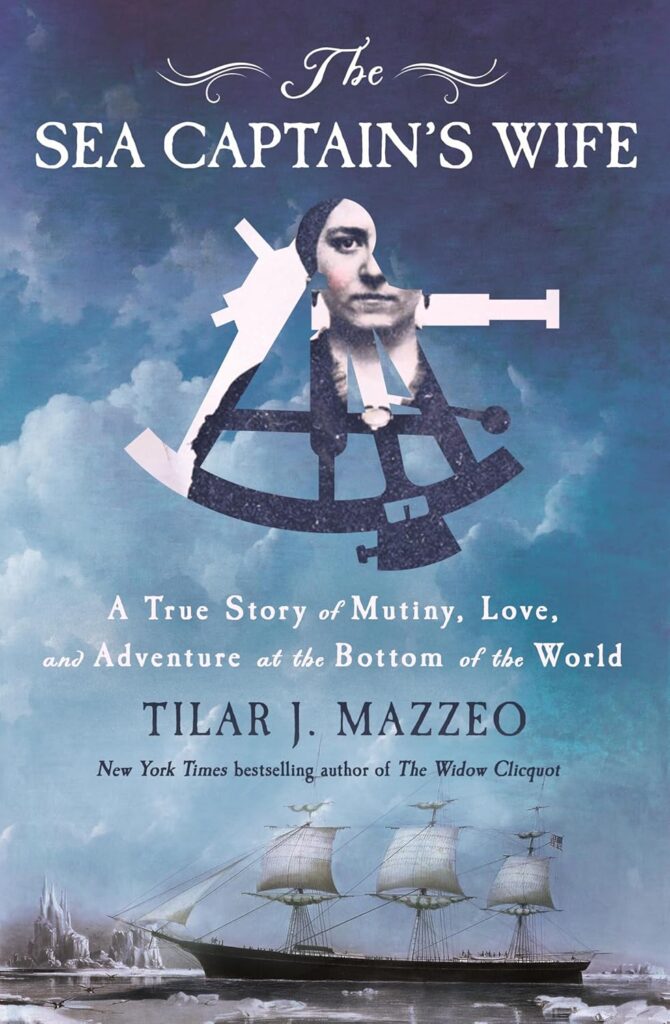
Mary Ann Brown Patten’s name didn’t make it into the title of Tilar Mazzeo’s book about her, The Sea Captain’s Wife, which I find a bit ironic given one of the author’s goals is to educate readers about the impressive achievements of a now-forgotten female sea captain. But also, perhaps it was her nod to tradition, recognizing that many accomplished women go unnamed and unacknowledged in history.
But what accomplishments: Patten was the first female captain to helm a U.S. merchant ship and to navigate around Cape Horn. And that was at age 19, while she was several months pregnant and caring for her deathly ill husband, Captain Joshua Patten.
After tuberculosis struck her husband early in the journey, the crew “acclaimed” Patten as its next captain. She’d worked alongside Joshua on a previous voyage and learned to read navigation charts, plot a course, and find her way with the stars. She had the “pluck” to work with the male crew. She had also picked up reading, writing, and math during childhood schooling, and could use the ship’s library, which included books on first aid and treating illnesses.
To research her book, Mazzeo used many documents, correspondence, and journals from various archives but found nothing written by Patten herself. She was born in 1837 to parents who had immigrated from England and grew up in Boston with two sisters and six brothers. She found a love match in Joshua, a man 10 years older from Maine. By age 16, she was married.
Both Pattens had grown up familiar with the working waterfront. He became a sea captain like many in his family, which was from the Rockland area. The couple hoped to earn enough to settle along the Weskeag River in South Thomaston.
They planned to make their fortune working on clipper ships carrying goods between international ports, agreeing that she would come along on any rigorous sailing jobs. What clearly wasn’t in their plans was Joshua contracting tuberculosis in 1856, while captaining the 216-foot schooner Neptune’s Car.
Along the coast of South America, without a reliable first or second mate, Patten stepped in as captain and got the ship to San Francisco. With Joshua still bedridden, the couple made it back to New York on other ships. But he died never knowing they’d had a son, and Patten herself succumbed to tuberculosis a few years later, leaving Joshua Jr. to grow up with their relatives.
Mazzeo, who also sails, explains in lay language the nautical concepts involved in Patten’s navigation of the dangerous waters around Cape Horn. The descriptions—of 50-foot-plus high seas, jagged coastline, blizzards, and icebergs from nearby Antarctica—dramatically convey the risk.
Mazzeo personally took to those waters in a kayak to experience the setting. In a recent interview with the Portland Herald, she noted, “It’s so hard to explain how truly extraordinary her skill was as a captain. That you could be 19 and have only done one circumnavigation and be such a phenomenally gifted sea captain and sailor is quite astonishing.”
There are many reasons to read this book. Primarily, it is a thrilling tale. It shows an undaunted woman, successful at doing what most assumed was a “man’s job.” And it offers insight into Maine’s glory days of producing schooners and sea captains.
Mazzeo, with family ties to Rockland and a past career teaching literature at Colby College, has a deep appreciation for this salty mix. Her tribute to a female sea captain is both inspiring and a heartfelt homage.
The Sea Captain’s Wife: A True Story of Mutiny, Love, and Adventure at the Bottom of the World
By Tilar Mazzeo (2025, St. Martin’s Press)
Tina Cohen has been an educator, librarian, and therapist, and spends most of the year on Vinalhaven.