I’ve never felt more compelled to celebrate Earth Day and World Oceans Day than in 2026.
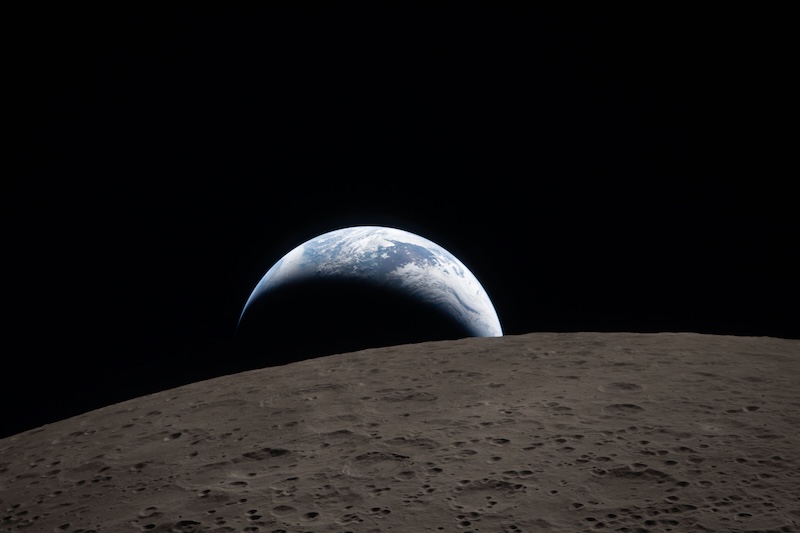
Partly, these holidays—on April 22 and June 8, respectively—help us recommit to conserving our planet, a task made even more urgent as the federal government continues to deprioritize science and funding to protect it. Additionally, the world just witnessed a remarkable scientific and technological feat as an international crew of astronauts on the Artemis II mission encircled the moon, bringing them farther than any human has ever been from Earth. Space travel offers a distinct reminder that our planet is small, fragile, isolated, and unique.
Seeing images of Earth from space also reminds us that our planet is composed primarily of oceans—just in time for World Oceans Day, which aims to help protect global oceans for future generations. This year, the event is focusing on how the ocean regulates climate, provides oxygen, and supports biodiversity.
Here in coastal Maine, oceans are foundational to our way of life. According to a new ocean economy dataset from NOAA, a strengthening U.S. marine economy added more than 500,000 jobs and grew wages by 32% from 2021 to 2024.
Despite this, funding for the very agency that measures this economic importance is in question. Cutting NOAA’s science assets used for weather forecasting, navigation, oceanographic monitoring, and more puts marine businesses at risk and hinders our understanding and management of oceans and coasts.
As the appointee to the Maine Climate Council with expertise in marine science, I’ve found it increasingly important to tell that story. The federal assault on science since January 2025 led the council’s Scientific and Technical Subcommittee (STS) to mount an ongoing effort to document the importance of science assets across the state. As expected, we’re finding that a diminished federal role in climate and environmental investment can reduce capacity, weaken decision-support, delay implementation, and disproportionately hit communities with fewer resources. The STS also recently released an interim report around Earth Day that highlighted select new science on 19 topics relevant to Maine’s people and economy, as well as critical assets for tracking these topics, which range from atmospheric temperature to groundwater drought. Overall, the report shows that continued investment in good science to inform decision-making, local planning, and practical climate action will help Maine people prepare for changes that are underway or ahead.
Pertaining to the Gulf of Maine, the STS interim report addressed changes in ocean temperatures, as well as projections of sea level rise and its impact on coastal environments.
For terrestrial systems, the report covered forest carbon, health and biodiversity, wildlife and plant species range shifts and endangerment status, freshwater invasive plants, and land conservation. Similar measurements can be taken of the Gulf of Maine, which is also affected by climate and other human impacts. But those measures are harder to study.
I would love to see the interest in going the distance in space rejuvenate our curiosity for exploration closer to home—for oceans. Society’s interest in the underwater world seems to have waned since Jacques Cousteau captured it from the 1950s to 70s. Just because we can’t see the changes below the ocean’s surface doesn’t mean they’re not happening. The shifts we’ve seen in wild kelp forests in the Gulf of Maine are an important example.
Now is a critical time to provide opportunities for field-based studies to interested students. Many kids still dream of being marine biologists. Let them. Let’s recalibrate the trend of more graduate students focusing on computer-based models alone, back to more focus on field work. Students can’t experience the beauty and appreciation of the underwater world from a desk. Kelp forests and coral reefs, two of the most biodiverse ecosystems in the ocean, are accessible without much technology, yet both are dying as we continue to pollute and warm the oceans. We are reminded by the Artemis II mission that pictures and stories capture the public’s attention better than data and models.
As we press on to ensure long-term success in space, let’s not neglect the only home we have. Let’s continue to invest in scientific discovery of our oceans, and our planet.
Susie Arnold is the senior ocean scientist at Island Institute, publisher of The Working Waterfront. She may be contacted at sarnold@islandinstitute.org.