It’s been an old-fashioned winter so far. Outside it’s all snow, cold. My phone is full of videos from Minneapolis that look like they could just as well be from Portland. Snowbanks line the roads, plumes of breath blend with clouds of tear gas. The zipper on my winter coat breaks, so I order a new coat. I see a video of a Minnesota man who describes federal agents tackling one of his neighbors and dousing him with pepper spray. The man in the video wears the same coat I just ordered. It’s a good, warm parka. You need a warm coat in a winter like this.
I love islands. I love that I can walk all the way around them. One of my favorite words is “circumambulate.” I like that I can see all the edges of an island; it feels like a manageable space. My wife and I moved to Peaks Island in Casco Bay as newlyweds on Sept. 1, 2001. Ten days later, on Sept. 11, we watched America convulse on TV. I felt like we’d just avoided something big and fast and dangerous. The island felt safe.
Today, the threat is no longer external, if it ever really was. A pseudonymous Twitter user once wrote, “Climate change will manifest as a series of disasters viewed through phones, with footage that gets closer and closer to where you live until you’re the one filming it.” This turns out to be true for all kinds of disasters. I watched videos of federal agents equipped for war brutalize residents of Los Angeles, then Chicago, then Minnesotans in the snow.
Then the rumors started: they’re coming to Maine next. The president wants to terrorize our Somali population, too. More videos appear. This time one of them shows my grocery store in the background. In the Old Port, near my former office, federal agents smash a car’s window and abduct a civil engineer—a legal resident with no criminal record. They leave his car open and running on the street. I don’t feel safe now; I feel helpless, and useless.
With my new coat to cut the wind, I take the dog down to the beach for a walk. If I squint into the low winter sun, Portland is visible two and a half miles across the water, about 20 minutes by ferry. The geographic separation is deceptive—Peaks Island is part of the city of Portland. My two older kids graduated from city schools. My youngest is currently in middle school with kids from the islands and the whole Portland peninsula. It’s one of the most diverse schools in Maine. On Jan. 21, 88 of about 500 kids were absent, almost 18% of the school. We all saw the videos from Minnesota, and in Portland immigrant families are staying at home, missing work and school, trying to stay safe.
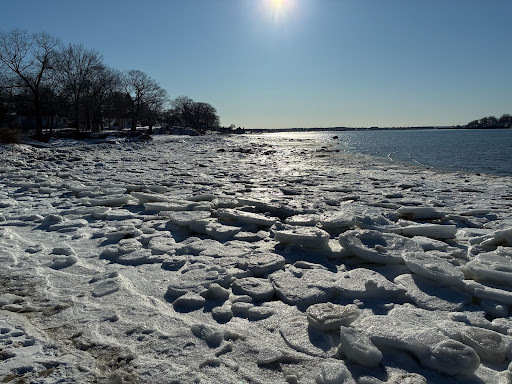
Winter on the island is usually peaceful, but this year it feels anesthetizing. The fear across the bay is like phantom pain from an amputated limb. I can’t walk the dog on the beach anyway, it’s covered with thick slabs of ice, left in a jumble by the falling tide.
Islanders have a reputation for rugged independence, but living on an island has taught me that problem solving mostly starts with asking for help. Islands are outposts; we’re not self-sufficient. Everything we need comes from the mainland, and the visible edge of an island is just a membrane, permeable to the whole world. When I find icy wind blowing through the zipper of my old coat, fiber optic cables under the bay carry my credit card number into cyberspace and a warehouse worker in Canada puts a warm coat into a box. Eventually the box is brought to the ferry, then loaded onto a pickup truck, and one of my neighbors leaves it on my porch. All of us are embedded in these systems, and each of us needs all the rest of us. No one is surplus to requirements.
Parents are organizing rides to and from the middle school for any kid that needs one, and attendance is up. The school is several hours round trip for us, with the boat schedule, but my wife and I are volunteering to help when we can. It doesn’t feel like enough. But for now, while the ice washes in and out on the tide, it’s all we can do.
Rusty Foster, of Peaks Island, is a writer and the author of the newsletter Today in Tabs. He can be reached at rusty@kuro5hin.org.