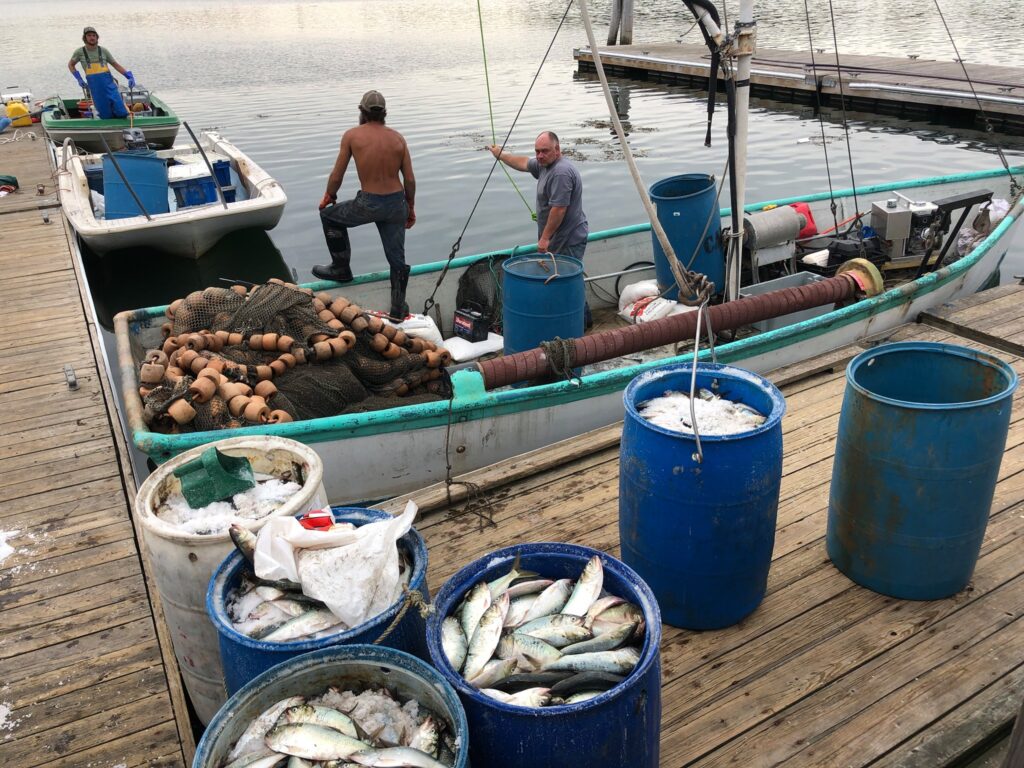
Like the schools of menhaden that roil the summer waters off the coast of Maine, a proposed law that would open that lucrative fishery to more participants has been raising turmoil among fishermen, legislators, and state regulators. Menhaden has become a significant part of the bait supply for Maine’s lobster industry, especially over the past several years when herring have been in short supply.
Introduced last year by Rep. Billy Bob Faulkingham, the House minority leader and a Winter Harbor lobsterman, LD 1353 was held over for consideration until this year. In early February, the Legislature’s marine resources committee voted 8-5 to recommend passage of the bill, which would ease requirements for obtaining a menhaden fishing license from the Maine Department of Marine Resources. The bill the committee ultimately approved differed substantially from the original that DMR testified against at a public hearing last April, but the changes didn’t entirely assuage the agency’s objections.
Current law limits issuance of a new license for menhaden—commonly called “pogies”—to fishermen who were licensed during any two of the years between 2019 and 2022 and reported landings of at least 25,000 pounds during any one of those years.
On Feb. 19, a few days after its initial vote, the committee approved final language for an amended bill authorizing DMR to issue 2026 resident and nonresident commercial menhaden licenses to fishermen who reported landings of at least 20,000 pounds (5,000 fewer pounds) in any of the years 2019, 2020 or 2021 (a shorter time period) and who held a commercial license in at least one of those years but did not have, and would not have been entitled to, a license in 2023.
DMR is still not happy with the amended bill. According to department spokesperson Jeff Nichols, the reduced landings requirements could allow as many as 20 additional participants into the fishery, resulting in a total of 376.
“The Department’s position,” Nichols said, “is that rather than continue to amend the eligibility criteria, the Department should use the existing authority the Legislature has provided to create an entry system where licenses are replaced when they exit the fishery.” DMR, he said, would support issuing new licenses at a 1:1 ratio as current license-holders leave the fishery once the number of outstanding licenses drops below 350.
Allowing more participants into the fishery is just what divides fishermen.
Introducing LD 1353, Faulkingham told lawmakers that the existing rule threatened “to shut out the very fishermen who helped build this fishery … but missed one qualifying year.” That was the case for fishermen such as Warren Graybill of Harpswell, who told the committee that he had the required landings “in one year, but not two out of three” needed to qualify for a license. He suggested that the amendment would allow only a few more participants into the fishery.
Initially, LD 1353 drew support from some members of the lobster industry, such as Jason Joyce of Swan’s Island. He told the committee that bait was in short supply and difficult to obtain on the island where there were no licensed menhaden fishermen but there were three fishermen who had the necessary boats and equipment, and had met the 25,000-pound landings requirement in the last year that the fishery was completely open, but didn’t have the two years of landings required to qualify for licenses in 2023 and later. Joyce said allowing those fishermen to participate in the menhaden fishery would benefit Swan’s Island lobstermen.
Tad Miller, a Tenants Harbor fisherman who harvests menhaden around Matinicus Island, opposed LD 1353 as introduced, arguing that the addition of as many as 20 more boats into the fishery would have a serious impact on the resource. According to Miller, fishing pressure is already impacting the menhaden in the water, where the fish are “wilder and harder to catch” than in the past.
“There’s only so much fish,” Miller said shortly before the marine resources committee released the text of the amended bill.
The fishery is regulated by the Atlantic States Marine Fisheries Commission which each year sets a quota for East Coast menhaden landings. It allocates a portion of that quota to each seaboard state from Maine to Florida. This year, the quota has been reduced by 20 percent from the 2025 total.
Maine’s quota for 2026 is 19.57 million pounds. While that sounds like a lot, in 2024, the last year for which DMR has published figures, Maine fishermen landed 25.64 million pounds of Atlantic menhaden valued at $13.2 million. However, that hardly describes the value of the fishery to Maine. Menhaden comprise a substantial proportion of the bait used by lobstermen in the state’s $528.4 million fishery. With the longstanding shortage of herring likely to continue, if the supply of menhaden were interrupted, many of the state’s lobstermen might have to leave their traps on the bank rather than in the water, fishing.
Miller also said that with too many boats fishing for menhaden, the bait market would suffer, especially west of Penobscot Bay and along the Midcoast. He’s worried that new entrants to the fishery who don’t already have customers for their landings will likely reduce their prices to attract buyers. That would be bad for fishermen already in the bait market, who could be forced to lower their prices to retain customers. Market disruption like that could also create “gaps” in the supply, he said, when lobstermen are most in need of bait.
He suggested that the menhaden fleet should be capped at no more than 350 licenses, with a 1:1 exit ratio for new licenses: “A lot of people will tell you it should be less than 350, and I’m probably one.”
The amended bill, which as of March 2 still awaits action by the full Legislature does establish a cap of 350 on the number of commercial menhaden fishing licenses and calls for a 1:1 entry to exit ratio for new licenses. The bill also directs DMR to identify groups of fishermen who should get priority for the first available licenses and to develop an entry plan for new participants in the fishery.