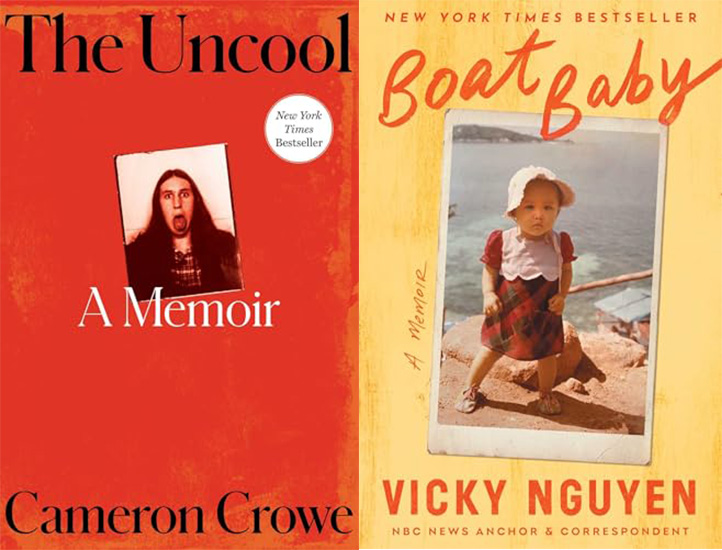
Boat Baby: A Memoir; By Vicky Nguyen (2025, Simon & Schuster)
The Uncool: A Memoir; By Cameron Crowe (2026, Avid Reader Press/Simon & Schuster)
Sometimes, the best stories journalists tell don’t make it to print or broadcast. Maybe it’s a source’s off-the-record revelation, off-topic confession, or angry outburst.
Two journalist memoirs—Boat Baby, by NBC News correspondent Vicky Nugyen, and The Uncool, by rock journalist and film director Cameron Crowe—offer some of the above, but their impact comes in the full disclosure of personal lives. Both writers lay bare their complicated family dynamics (are there any other kinds?), woven through the narrative of their career advances.
Nguyen caught my eye a few years ago with her consumer reports for NBC’s The Today Show. With segments typically a few minutes long, TV news tends to be superficial. Understandable, but some reporters shine more than others in this constricted medium. Nguyen is one.
She lays out the bullet points of her story, throws in quick asides, handles the anchor’s follow-up questions, adding even more factual asides. It’s a classic “tip of the iceberg” moment, with the correspondent’s depth of knowledge on her topic being what lies beneath the surface. Impressive.
As you might guess by her name, Nguyen (pronounced “Win”) originally hails from Southeast Asia. Her family escaped Vietnam in 1979, four years after South Vietnam fell to the North. Her mother had worked for U.S. officials, and so was probably marked for retribution.
Nguyen, an only child, was just eight months old when they fled, traveling on a boat with guides the family had to pay. Pirates intercepted the boat and, seemingly on a whim, let everyone live. Truly frightening stuff, but a testament to Nguyen’s parents’ determination to find a better life.
The family languished in a refugee camp in Pulau, paying the equivalent of $175 U.S. for a 10-foot by 10-foot campsite.
I remember well the stories of Vietnamese refugees coming to the U.S. A church I attended as a young man in the late 1970s and early 1980s took on a few Vietnamese children. A few families stepped up to share the burden, and as far as I know, they assimilated into the community.
The sense of pride in undertaking this rescue was palpable.
A year or so later, I began teaching at a school in Maine, and one of my students, for whom I was an advisor, was a survivor of the Khmer Rouge regime in Cambodia. His adoptive parents told me they believed he saw his parents murdered, and probably walked out of the country at night through jungles.
The first year, he was happy, upbeat, eager to learn. The second year, he stalked the dormitory with a menacing glare. He was sent to some kind of mental health facility.
I mention this because the humanitarian efforts of those years contrast so sharply with the cruelty and self-defeating immigration policies we see today. Nguyen’s family was sponsored, she writes, by an international children’s services NGO. The family succeeded, with her father starting and growing businesses, and of course his daughter making it to the big-time in the news business.
Nguyen recounts her first big story, going undercover with a photographer to document a national food supplier for restaurants and institutions allowing perishables to sit in vans for hours. That work got the notice of NBC and led to the Today Show gig.
She also writes about facing sexual harassment and racism at work, and, with no-holds-barred candor, about her father’s succeeding with a business but losing it by playing the stock market.
Nguyen marries her high-school sweetheart, who becomes a doctor, and the professional couple must balance and compromise on career ambitions.
The memoir unfolds in short chapters, some only a few pages, and Nguyen’s tone is self-deprecating, humorous, and honest, even about her own failings. It’s an engaging read and insight into the TV news world.
Cameron Crowe’s The Uncool carries more heft, coming as the writer and director looks back on a 50-year career. When I was 15 and 16, I was devouring rock music magazines like Creem, Circus, Hit Parader, and later, Rolling Stone. Little did I know that some of the band profiles I consumed were written by someone just a couple of years older.
Crowe was a bit of a prodigy in school, and his domineering mother, a college instructor, had him skip a couple of grades. He captures the 1970 vibe well, and describes how he talked his way into writing for an “underground” newspaper in San Diego. He meets and finds a patron saint in famed rock critic Lester Bangs, who breaks the news that both are, indeed, uncool, and urges Crowe to be brutally honest with the rock musicians he covers.
Crowe’s film Almost Famous (2000) fictionalizes—though just barely—his teen years covering Led Zeppelin, the Eagles, and the Allman Brothers Band. Pardon the pun, but it’s a pitch perfect rendering of the era, and funny and poignant, too.
In The Uncool, Crowe drops the artifice and shares the challenges covering his heroes. An apparently drugged-up Gregg Allman tells Crowe his recently deceased brother, Duane, is sitting in an empty chair, disgusted with the young journalist. Allman demands, and gets, Crowe’s recorded interview. The matter resolves, but haunts Crowe.
In another chapter, he writes about hanging out with Jim Croce and seeing evidence of the married singer having a one-night stand. Should a journalist include this in his story?
The long chapter chronicling the 18 months Crowe shadowed David Bowie suggests an equally challenging ethical dilemma. Years later, Crowe tells Bowie the access offered a view of creative genius. Bowie says he doesn’t remember much of the period, as he hadn’t yet kicked drugs.
In Almost Famous, the character of Crowe’s mother is a strong but funny presence. In The Uncool, we see much more—an intelligent, iconoclastic yet sometimes eccentric parent, who wanted her son to be a lawyer, but who inspired good work, even in a field she saw as shallow.
Both memoirs succeed because the writers turn their reporter eyes onto themselves with practiced scrutiny.
Tom Groening is a former editor of The Working Waterfront. He may be contacted at thomasjgroening@gmail.com