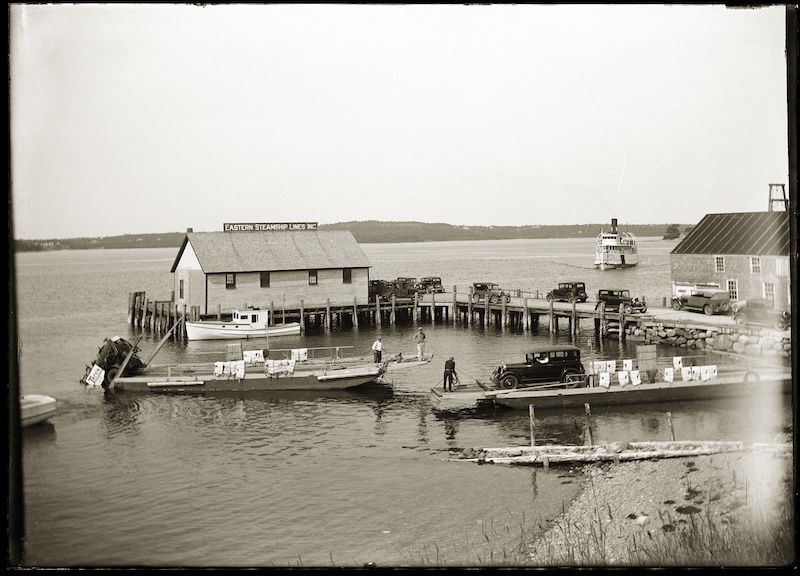
Sargentville’s wharf was bustling on a summer day around 1934 when Evie Kimball (Barbour) made a series of photographs using her 5-by-7-inch view camera. She had repeatedly photographed the area over several decades, always hunting for new “views” for her real-photo postcards. Of the hundreds of postcards she made around the Blue Hill peninsula between 1907 and 1940, the moment she captured this day was especially notable.
Sargentville, a village of Sedgwick, is not one of Maine’s most well-known coastal communities. At present, it might be best known for the tasty burritos at El El Frijoles, but it wasn’t always that way. As in many waterfront Maine communities in the early 20th century, various industries thrived there: ice, farming; mills making timber products, grist, furniture, and cider; and fishing. All of this was supplemented by tourism, but as the century progressed, the balance shifted further in that direction. Just a few years after this photo, a new bridge connected Sedgwick to Deer Isle, and the shift toward a tourism-based economy was irreversible.
This photo displays the rural community that thrived here before the Deer Isle Bridge. In the foreground are two of Captain Charles Scott’s car ferries. His family ran this transportation business, shuttling people and vehicles between Sedgwick and Deer Isle for more than a century. The one on the right is ready to head to the island with a 1927 or 1928 Chevrolet, while an arriving ferry has a dredging machine hanging off the rear, no doubt a useful machine when dealing with shifting sediment. Each ferry is equipped with numerous life jackets hanging on the rails.
Also in this scene, the steamship Southport is heading to the Eastern Steamship Lines wharf during what was most likely her last year of service on Penobscot Bay. She had been built in 1911 in Boston for the Eastern Steamship Corp. and initially ran the Boothbay-Kennebec River routes before taking the Penobscot Bay route in 1920. She later became part of the war effort, renamed the Col. Frank Adams, before being refitted as an excursion boat in New York City in the 1950s. The wharf is lined with period automobiles waiting for the steamer’s arrival. A 1933 or 1934 Ford V8 sedan can be seen to the right of the building, which helps us date the photo. Another building on the right and the hoists poking above its roof hark back to the “ice works” that had boomed on the wharf just a decade or so prior.
Like most of the postcard photographers of that time, Kimball did not intend to document a place for posterity. She was earning a living meeting the demands of a social media craze of that time. She had an artistic eye, great skill with a camera, and a drive to provide her customers with new views. Most of her glass plate negatives have disappeared save for a dozen that turned up at an auction and were donated to Penobscot Marine Museum by Phil Villandry. Her pictorial legacy, however, persists through the postcards she made and that people sent and collected. These historical documents provide a window to the past, and we are grateful for her work.
Kevin Johnson is the photo archivist for the Penobscot Marine Museum.