Right now, somewhere between the waterfronts of Bangor and Brewer, hundreds of shortnose sturgeon lie on the bottom of the Penobscot River, settled on the rocks like sardines, or the many logs that sunk during the region’s reign as Lumber Capital of the World.
Soon the sturgeon will wake from their winter’s rest, dispersing through the river and down to the bay.
It was nearly 20 years ago now that University of Maine researchers documented the presence of both shortnose sturgeon and Atlantic sturgeon in the Penobscot River. The large, heavy, bottom-dwelling fish were known to Wabanaki ancestors and were once a target of commercial fishermen for meat and caviar, a pursuit that along with water pollution in rivers nearly drove them to extinction. Shortnose sturgeon was among the first animals on the Endangered Species List, alongside the grizzly bear, California condor, and the American alligator.
After a fisherman accidentally hooked a sturgeon in the Penobscot, bringing the prehistoric creature up from the deep and back into the collective memory, biologists began to search for more.
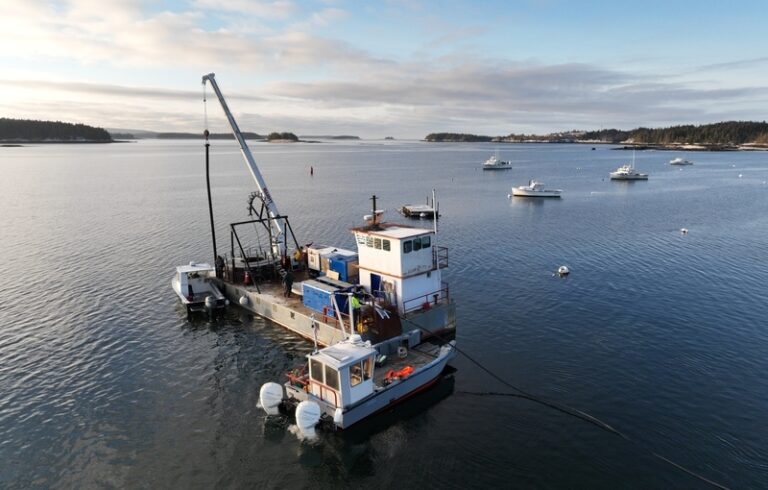
It didn’t take long to find them, dozens then hundreds of both species. Fish were tagged, weighed, measured, and released, an array of floating sensors picking up the sound waves emitted from the tags as the fish passed by, recording their movements. Even more fish were tagged in the Kennebec River.
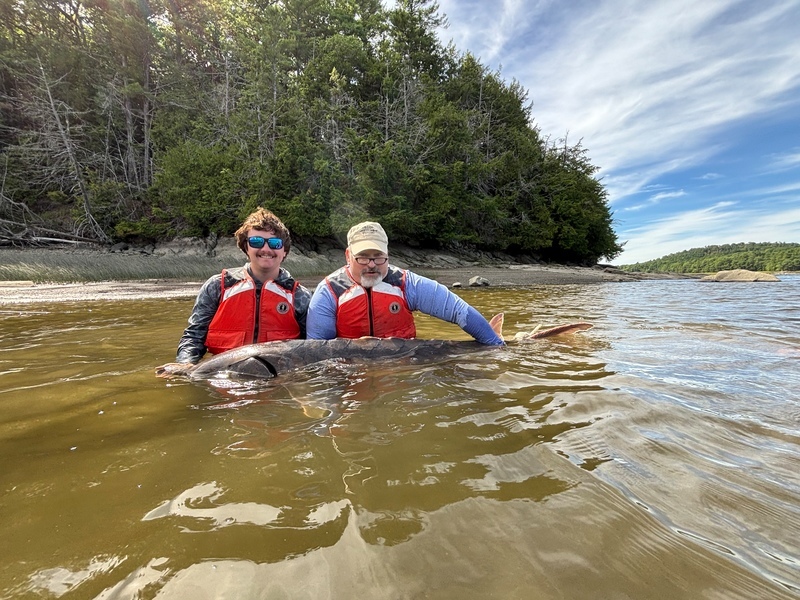
Research has continued, in collaboration with multiple researchers and many students, building on the work of those who came before, said lead researcher Gayle Zydlewski of the University of Maine. In 2025, graduate student Sander Elliott caught an Atlantic sturgeon in the Kennebec River that was tagged in 2007. The fish had doubled in size, to about seven feet long. In the Penobscot River, he recaptured an Atlantic sturgeon tagged in 2019 that was of similar size, the largest ever caught in the Penobscot.
The size is notable because Elliott had been finding that Penobscot River Atlantic sturgeon tended to be smaller than those in the Kennebec River. A previous student researcher, Matt Altenritter, had noticed a similar pattern.
In January, while presenting this information at the Atlantic Salmon Ecosystems Forum hosted by NOAA Fisheries in Bangor, Elliott said the size differences may have something to do with spawning, with larger fish being reproductive. Both Atlantic and shortnose sturgeon spawn in the Kennebec River, but to date spawning has not been documented in the Penobscot River, although shortnose are present in the rocky spawning habitat above the former Veazie Dam site, including juveniles.
Elliott plans to set out baited lines to try to catch the younger fish and determine their origin. The search continues.
Elliott has experience studying sturgeon in the mid-Atlantic region, where populations have rebounded. Trends in Gulf of Maine sturgeon populations are less clear. The University of Maine has been tracking sturgeon for 20 years, and the state Department of Marine Resources for longer than that. With funding from a NOAA Species Recovery Grant, they have combined their data and are working together to estimate the current abundance of both species of sturgeon, said DMR biologist Danielle Frechette, who also serves on a sturgeon committee of the Atlantic States Marine Fisheries Commission.
Conditions for sturgeon have improved in recent decades due to the Clean Water Act and dam removals, although mercury pollution may be an issue in the Penobscot River. They remain protected under the Endangered Species Act. “We think they are holding steady or potentially increasing,” said Frechette. “We need more information to better understand how sturgeon populations are doing so that we can chart their path toward recovery.”
The NOAA grant is funding the research by Elliott. This year he will re-deploy an array of acoustic sensors to monitor the movement of tagged sturgeon between rivers and along the coast, to learn whether and how patterns have changed. He’ll also be attaching pop-up satellite tags to Atlantic sturgeon to see where they spend the winter. Atlantic sturgeon make longer migrations along the coast, with Maine fish known to travel as far as Nova Scotia and North Carolina.
In the meantime, riverfront communities have awakened to the giants in their midst. In June 2023, river flows were high enough that hundreds of Atlantic sturgeon spawned in Cobbosseecontee Stream, a tributary of the Kennebec River, where they were visible from a bridge. Biologist and writer John Waldman described the scene in the journal Fisheries: 200 fish, large and quivering, packed into the clear, shallow stream with a crowd of people watching from the bridge, “enjoying a newfound ‘sturgeon fever.’”
At the forum in January, several people remarked that watching sturgeon is a way that people are getting to know their rivers, many for the first time.
It is not so hard to see a sturgeon, thanks to their mysterious habit of propelling themselves straight out of the water and landing with a splash, a kind of sideways bellyflop, an eruption of muscle, cartilage, and rough skin flashing in the sun.
In riverfront parks in Hallowell and Augusta, South Orrington and Winterport, people search the river’s surface for leaping sturgeon. Frechette of Maine DMR has asked the public for help as researchers try to establish where sturgeon cross paths with people.
Since then more than 100 people have reported sturgeon encounters: an accidental capture while fishing for stripers or smelts, while paddleboarding or scuba diving, carcasses washed up on the beach. Frechette said that, in addition to providing data on sturgeon movements, “the reports will help focus future outreach efforts to help connect people with these amazing fish.”
“These fish are really cryptic,” said Elliott. “We see them when they jump, but otherwise they are really hard to know.”
Elusiveness and mystery is part of their appeal. To see them is to wake briefly into a kind of dream, a glimpse of rivers full of life, moving freely, and to know the future can be big enough for people and fish.
You can aid the sturgeon search by reporting sightings of them both live and dead to the Maine DMR sturgeon reporter: https://survey123.arcgis.com/share/76f3d7e08838484e8524d6d35b54d71e
Catherine Schmitt is the author of The President’s Salmon: Restoring the King of Fish and its Home Waters. She was on the Penobscot River with researchers when they tagged the second and third shortnose sturgeon in 2006.