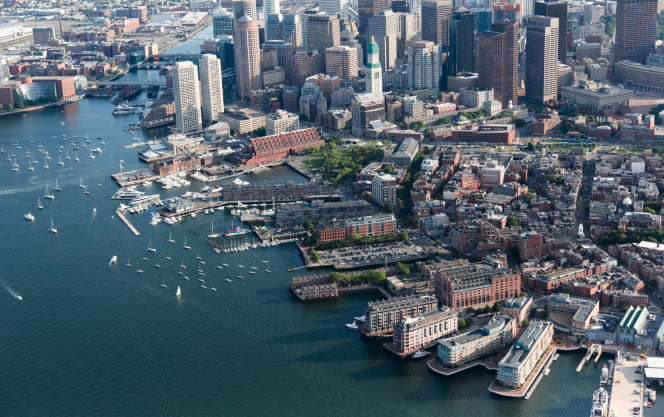
Three towns perched on the shore of Boston Harbor can now devise rules for shellfish harvesting, something no municipality near the harbor has been able to do for more than a century.
The Massachusetts Department of Marine Fisheries announced at the beginning of this year that water quality in certain parts of the harbor has improved to the point that mudflats off the coasts of Winthrop, Hingham, and Hull can be opened for shellfish harvests for direct consumption or commercial sale.
In the past, certain areas of Boston Harbor allowed for conditional shellfish harvesting, but the shellfish needed to spend time in Massachusetts’ lone purification plant before sale or consumption. That purification plant permanently closed after significant storm damage in December 2024.
Clammers can’t wade into Boston Harbor with clam rakes just yet, however. Massachusetts, like Maine, still abides by colonial-era regulations that give municipalities the power to regulate shellfish harvesting once the state deems an area safe for raking. That may take some time, said DMF Regional Shellfish Supervisor Wayne Castonguay, as municipalities are starting from scratch.
“They have no history of managing these resources, and so they need to take votes, they have to write rules and hire staff to patrol,” Castonguay said.
This is the first time parts of Boston Harbor have been cleared for possible harvest since a national typhoid outbreak traced to contaminated shellfish led to the death of at least 150 people in 1924-1925. This outbreak was the first time scientists were able to conclusively gather evidence about the role shellfish can play in spreading disease. It led to the creation of the National Shellfish Sanitation Program in 1925, a cooperative federal and state program to create rules and monitor water quality to ensure the safety of harvested shellfish for human consumption.
Boston’s Charles River and harbor have steadily gotten cleaner since the days when the area’s waterways were memorialized by the song “Dirty Water” by the Standells in 1965. It still took time to gather the data to prove that shellfish in the harbor could be safe to eat, Castonguay said. Shellfish are filter-feeders, meaning they are remarkably good at concentrating any pathogen or pollutant that may be found in a body of water.
“To have open shellfishing areas, you need basically the cleanest of any water quality designation, even cleaner than for swimming or boating,” he said.
For years, Boston simply dumped raw sewage into the harbor, and its beaches were routinely closed because of contamination. In 1982, the Conservation Law Foundation filed a federal lawsuit against the city for violating the Clean Water Act. Three years later, a federal judge sided with environmentalists, forcing the city to find a better solution to deal with its waste. The city began construction on a new wastewater treatment plant in 1989, and a new 9.5-mile tunnel to carry treated sewage out further from the shoreline.
It was a laborious process to clean the Charles River and Boston Harbor, said Chris Mancini, executive director of Save the Harbor/Save the Bay, one of the nonprofits that pushed for cleaner waterways in the area.
“This was a massive undertaking, with multiple lawsuits and major rate payer increases for folks. Now nobody thinks twice about it,” Mancini said. “We have a really clean harbor and we can go to the beach every day,”
Much of Maine’s coastline is conditionally open for shellfish harvesting, but there are several swaths of the coastline that are permanently closed, including much of Portland Harbor. Portland’s waters are closed because of sewer overflows, historic contamination from its industrial past, and waste and pollution from boating activity. There can be other causes for long-term closures, as well. Harpswell Cove off of Brunswick’s coastline was closed in 2024 due to a spill of PFAS chemicals.
Often, there is not one easily identifiable culprit for pollution, and it can be difficult to remediate issues that can cause closures near rural coastal municipalities, said Bridie McGreavy, who served as a past chair of the Maine Shellfish Restoration Resilience Fund and works with the Maine Shellfish Learning Network. To improve shellfish harvesting opportunities in Frenchman’s Bay, she and other advocates spent a decade painstakingly going from mudflat to mudflat to identify local sources of pollution.
There are no shortcuts to the grassroots efforts needed to improve the water quality of Maine’s mudflats, she said.
“It takes local leaders and active community organizations to get involved and to work in partnership with Maine DMR to figure out what’s going on for any particular closure and identify strategies for how to open them,” McGreavy said.
The process is often hampered by a lack of funding to remediate sources of pollution, she said. If there was strong funding available to help communities remediate issues, there would be more mudflats open along the Maine coast, she said.
“If we could really invest in our infrastructure, I think we would see more solutions become available to us or feel more available than they currently do,” McGreavy said. “Absent those kinds of resources and investments, communities are taking on the burden of addressing these kinds of issues and doing the best that they can.”