My mother, who was born, grew up, lived, and died in Portland and environs, was not much of a talker. She had that taciturnity sometimes associated with old-time Mainers. Mainers who, Robert Creeley once told me, “say as little as possible, as often as possible.”
But like a lot of us, she could tell funny stories, and rarely cursed or complained, though there were reasons to. She sometimes spoke with a tone of disdain or disgust, which I’m pretty sure was a learned trait. She was not in her heart disdainful or disgusted. Not very happy, in a wintry sort of way, but not ironic.
She had expressions that to a kid seemed parochial and peculiar. One was the word “cussid.” When she spoke it, you knew exactly what it meant. It carried an essence of Downeast disposition.
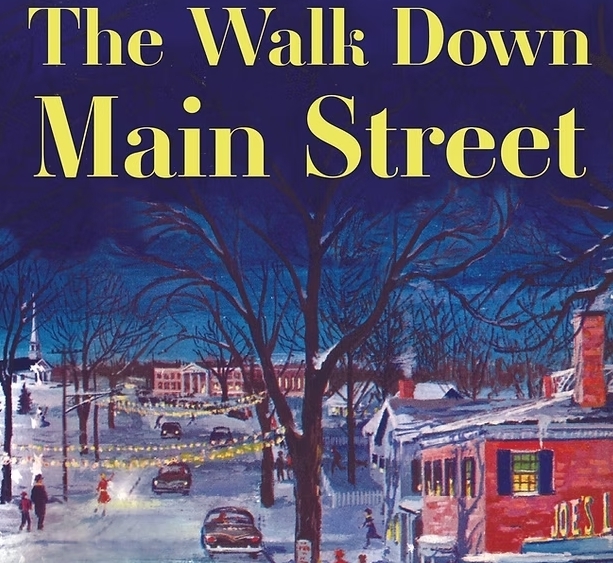
Sure enough, upon my re-reading of Ruth Moore’s 1960 novel The Walk Down Main Street—set in a small Maine town and helpfully re-issued recently by Islandport Press—I noticed that cussid in fact channels one of the book’s central themes.

“People is cussid,” Miss Eloise Marcy, the self-appointed town historian, tells a teacher who has gotten sucked into their coastal Maine town’s corrupt obsession with its high school basketball team.
“They may look nice and seem nice,” she says, “but in the long run, you’ll find most of ’em cussid. If a town ever has a good old tomcat row,” she explains, referring to an ugly schism in the town a century earlier, “you can bet your boots it’ll be over one of the two best things they’ve got, the church or the school. If only the Bible didn’t say ‘Love thy neighbor,’ it might help some. But there ’tis, down there in black and white, and if you don’t abide by it, you can’t be a Christian. Only, people is cussid, they ain’t going to be told what to do. They’ll have a fight and split up the church.”
Some pretty cussid stuff is going on in the circa 1960 story, too, mainly involving illegal betting and its effects on basketball games and players. But the most shocking cussidness turns up during a flashback chapter about Susie McIntosh’s marriage to a Coast Guardsman from Arkansas. When they were newlyweds Susie accompanied Brant McIntosh on a trip home to visit his dying grandfather. The reception there by Brant’s backwoods, shack-dwelling relatives is beyond cussid. His people are like dangerous curs.
Susie has to flee back to safety in Maine. But the truth is, cussidness is at home too. Before his death at sea, Brant endured nasty verbal abuse because he was from away, including a metaphorical use of the N-word even though he was white. Susie’s own father, Martin Hoodless, is so cussid that she and her children, two of whom are basketball players, can barely tolerate him in his own house. He’s the sort of Mainer Lew Dietz was talking about in his book Night Train at Wiscasset Station when he mentioned our “prickly pride.” Except Martin is beyond prickly, well into corrosive, with a penchant for upsetting everybody and everything, including the biggest games of the schoolboy basketball season.
According to the Oxford English Dictionary, the word “cussid” first turns up in the 18th century, around the time my mother’s families arrived in the vicinity of Boothbay. I wonder if they had something to do with the coinage. It’s a contraction of “cursed,” either humorously or contemptuously, or both. Cussid weather. The cussid government. “You cussid kids.” For the noun form cussidness, the dictionary drops the humorous connotation and gives just the synonyms “malignity, cantankerousness, contrariness.” Martin.
Miss Marcy wants to organize her projected history of the town, not chronologically, but around “times of cussidness.” In history “what sticks up most?” she asks teacher Al Berg, who himself has been coldcocked by antisemitism. “War,” she answers.
Al then ruminates on some examples of cussid behavior that influenced the town’s history, and finally reflects that cussidness is often accompanied by incredible courage. The two together make “a hellish combination … fairly common to most of mankind,” he thinks.
Cussidness is everywhere. In Arkansas, the Middle East, Maine. We’re living in a time of intense cussidness now, some of which Ruth Moore foresaw in forms such as the corrupt monetization of sports, the erosion of respect for teachers, and irrational schism. My mother learned her wintry use of the word from her environment.
Another peculiar word she and her sisters had was “cunnin’.” It was used mainly to exclaim on cute babies: “I’n’t she cunnin’.” Cunning is an old word, meaning originally “knowing.” Somehow in America by about 1840, it had the sense of crafty or sneaky. The cunnin’ baby somehow knew exactly what she was doing when she charmed everybody into mush. It seemed like a chilly way to think about a baby.
You have to have a mind of winter to endure people’s cussidness. Maybe it’s best to keep your own cussidness to yourself as often as possible. This is my mother’s wisdom, and maybe Ruth Moore’s, not mine.
Dana Wilde is a former newspaper editor and college professor who lives in Waldo County.