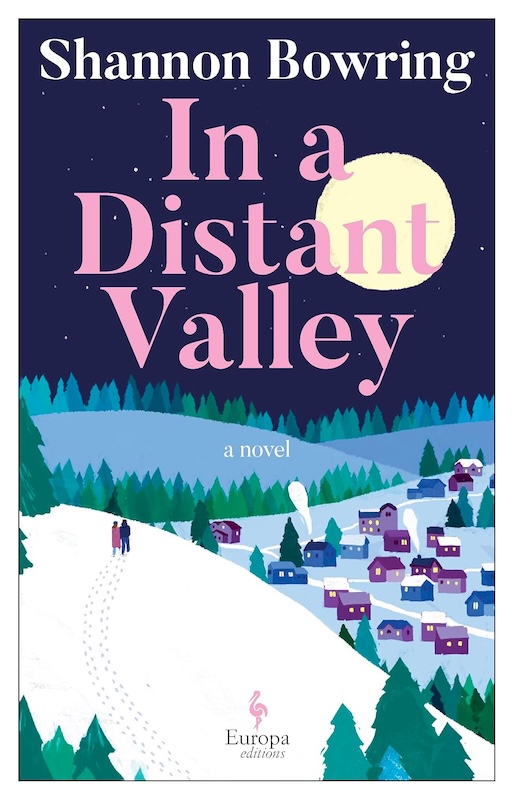
In a Distant Valley
By Shannon Bowring (2025, Europa)
Author Shannon Bowring describes her fictitious town of Dalton as in “the county”—a reference to Maine’s northernmost Aroostook County. With its isolation and harsh winters, some readers might assume it’s a place where few would choose to live unless rooted there.
But whether to leave Dalton is hardly one of the big questions confronting Bowring’s characters. She spotlights people in the midst of personal struggles, showing how they can redefine themselves and live differently than might be expected.
Among the rich cast are a series of young men. One of them, like his father, is drunk, angry, and abusive. But we watch how he rejects his own father’s example and becomes a more involved parent to his sons and more respectful to their mother. He holds down a job and comes to live a more sober, responsible life.
Another man is left alone with a baby after the suicide of his wife and questions what went wrong or could have been done differently. But help comes from two sets of grandparents who help raise his daughter and provide unconditional support. Believing in himself, he gradually connects with a woman, and by book’s end, they seem poised to get together and form a blended family.
A third young man is college-aged and unsure of his sexual identity. But he finds acceptance despite many unresolved questions. He feels support, not shame.
None of these examples struck me as contrived, or as tidily packaged “case studies.” They felt real and serve as examples of resilient personalities. We see how their respective traumas leave them stronger and more empathic.
Bowring’s insightful and beautifully written trilogy began with The Road to Dalton, continued with Where the Forest Meets the River, and has concluded with In a Distant Valley. Three books in three years! Described as living on Maine’s Midcoast now, Bowring grew up in a small, isolated Aroostook town (Dalton’s prototype?) near the Canadian border. She earned a bachelor’s in English/creative writing from the University of Maine and a Master of Fine Arts from the University of Southern Maine.
This last Dalton book ends on New Year’s Eve, 1999, so we don’t see how these characters have weathered the two and half decades since then. We don’t know how Dalton would have been affected by COVID, or social media, or debates over immigration.
But, I have a question for Bowring: Could the series continue with another Dalton update? I’d like to see how the community would welcome more recently arrived “new Mainers.”
Elizabeth Strout took on Lewiston in a novel, The Burgess Boys, which features Muslim characters and the mosque where they worship. Many Maine communities, whether rural or dependent on manufacturing, once had little ethnic or religious diversity. But economic need eventually brought new migrants to bolster the local work force in factories and fields.
Some longtime residents have felt challenged by those changing demographics.
But I would hope that residents of a place like Dalton would extend their tolerance and compassion to those initially seen as “different.”
As we know, many of these characters had the bravery to want a new option, a second chance. They benefited from family and community support. Seeing commonalities and appreciating opportunities, it seems to me Dalton’s citizens would extend the same helping hand to newcomers.
Tina Cohen has been an educator, librarian, and therapist, and spends most of the year on Vinalhaven.