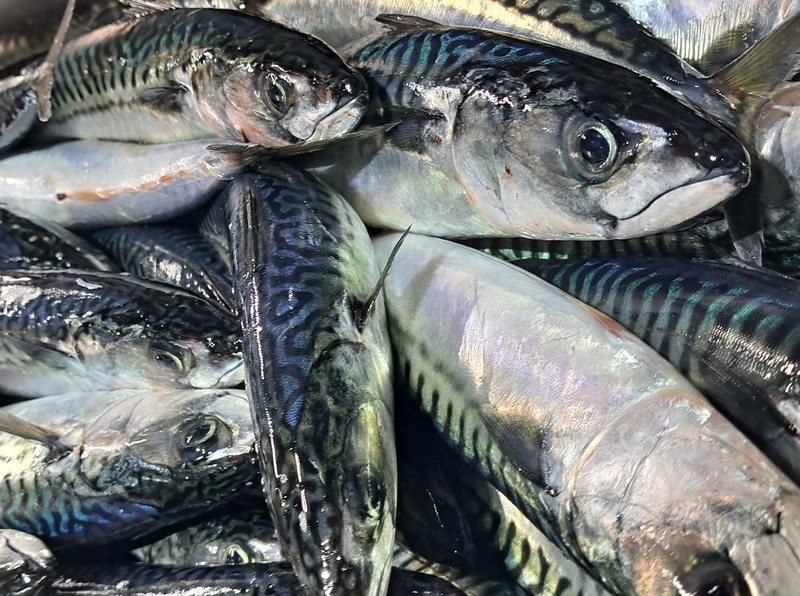
In late May, NOAA Fisheries announced a new research initiative with the Northeast fishing industry to gather information about the Atlantic mackerel, a fish so common that it is often overlooked for research and so misunderstood that regulators have routinely miscalculated how many are in the sea.
With the new two-year initiative, researchers hope to fill in gaps about mackerel’s behavior and mortality rate after hatching. Incomplete understanding of mackerel mortality rates from fishing and other factors has led regulators to set flawed catch targets after strong recruitment years, said Jason Didden, a fishery management specialist with the Mid-Atlantic Fishery Management Council.
“For example, the 1997 mackerel allowable biological catch was specified 10 times higher than what we now think the total spawning stock biomass was in that year,” Didden said. “We just had kind of a fundamental misunderstanding of the stock’s productivity.”
The project, which will receive $2.3 million this fiscal year, will enlist 50 fishing vessels to help researchers gather data.
Those involved will gather mackerel samples, use echosounder sonar to find and gather information about the fish, and conduct an egg survey, according to information provided by NOAA Northeast Fisheries Science Center. Researchers will work with the Woods Hole Oceanographic Institute in Massachusetts to develop a more complete picture of where the mackerel live and what environmental factors contribute to the stock’s health or decline.
The Atlantic mackerel fishery in the U.S. is worth up to $23 million annually, according to NOAA Fisheries. Commercially, they are caught for export to Europe for food and as baitfish for striped bass and bluefin tuna. Atlantic mackerel make a great starter species for recreational fishing, said Chris Uraneck, recreational fishing project lead with the Maine Department of Marine Resources.
“In Maine, they come in close to shore, so you could catch them from the dock or a pier,” Uraneck said. “It’s easy to catch, so it’s fun for families.”
Maintaining a stable population in the north Atlantic has been a challenge. Since mackerel were first regulated under the Magnuson-Stevens Fishery Conservation and Management Act in the late 1970s, there have been several strong spawning years followed by steep declines in fish numbers.
Researchers now believe that’s because U.S. regulators were creating flawed models of mackerel populations based mainly on a multi-species trawling method for live fish and not incorporating data from an egg survey favored by Canadian regulators. When the Canadian egg survey data was combined with the trawl data, they realized that high recruitment hasn’t led to long-term stability.
“You can see these big age classes enter the fishery and kind of be fairly quickly wiped out,” Didden said.
Regulators also must contend with the fact that the mackerel are crossing between U.S. and Canadian waters, and the two nations haven’t worked together to manage the fishery. There are environmental advocates and fishery stakeholders on both sides of the border who believe the other nation is the problem.
The Canadian government recently has ruled that the commercial mackerel fishery will remain closed for the coming fishing season. Oceana Canada, an environmental advocacy group, said that this will not be enough to stabilize the fishery’s numbers.
“The population remains firmly in the critical zone, with a negative near-term outlook for recovery due to unsustainable levels of fishing pressure in the United States and a history of overfishing and mismanagement in Canada,” the group said in a statement.
U.S. regulators have become much more cautious about raising the catch limit. NOAA Fisheries’ most recent assessment of spawning stock of mackerel found it was 56% of the way toward the 181,090 metric tons target for the fishery’s restoration. That’s technically above the threshold for being declared overfished.
However, a committee cut the projected numbers for the fish by 93%, based on past experience. U.S. commercial fishermen will be allowed to catch some 10,714 metric tons of mackerel in 2026. That is some 7,500 metric tons more than was allowed in 2025.
On paper, it appears mackerel have had a banner recruitment year, but researchers and fishery stakeholders are waiting to see if this year’s data will validate the trend toward recovery, says Didden.
“I think in ‘27, we’ll have a better read of whether this was real recruitment, or was it a bit of a phantom and evaporate after we see those fish in Years 2 and 3,” Didden said.