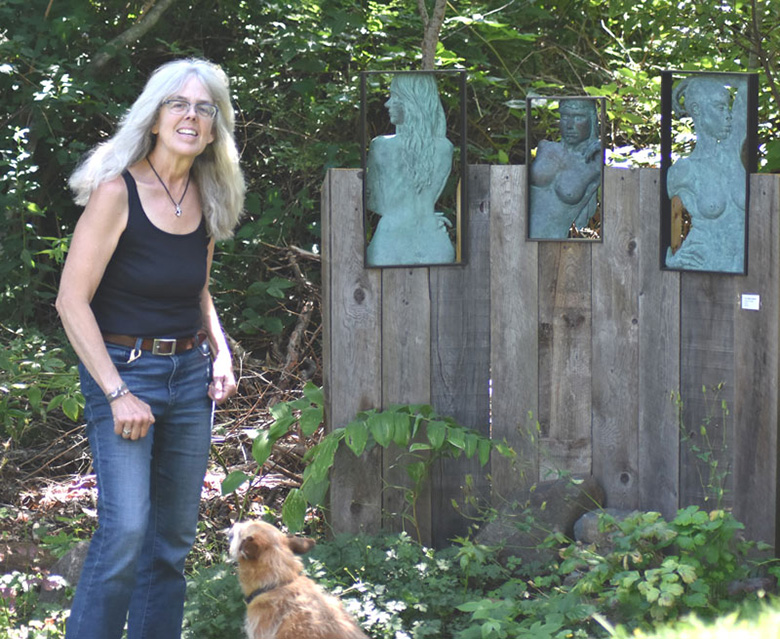
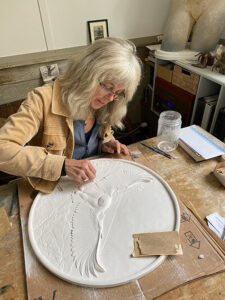
Twelve miles out at sea on Monhegan Island, sculptor Daphne Pulsifer often works in near solitude. In her peaceful, airy studio on Light House Hill Road, she shapes her pieces accompanied by her dog, Emma, and the visitors who occasionally stop in during open hours to peruse her work.
Yet in these quiet moments of creation, Pulsifer reflects on the connection with others she says inspire each sculpture and have populated her life on and off the island.
Pulsifer was born in Newport to a family with deep roots in Maine. When she was very young, her family left Maine and she grew up in New Jersey and Philadelphia. Much of her extended family remained in Maine and she remained connected to the state and visited often.
“We grew up coming home to Maine every summer,” she said. “There was always this sense that Maine was home.”
As a child, Pulsifer was incessantly creative.
“My mother used to complain and say that I didn’t have any clothing that didn’t have paint or ink stains or something on it,” she said.
However, it wasn’t yet clear to Pulsifer that she would become an artist. After high school, she enrolled at Carnegie Mellon University in Pittsburgh, where she intended to study architecture. In retrospect, the move was not one she had thoroughly thought through.
“I don’t think I had a clear idea of what that could mean in terms of a career, and once I was involved in the academics of it, it didn’t hold me,” she said.
What did captivate Pulsifer was the idea of living out at sea. For one of her classes, she and her peers researched coastal islands, and she became captivated by the island and artist colony of Monhegan.
“I thought, I want to go check that place out,” she remembers.
Pulsifer traveled to the island one May while still a student
“That was the big, big moment, to come here and think, OK, this is kind of cool. I think I’m going to stick around,” she says. “I loved the beauty of the environment, and being able to just be present and walk around and read and draw.”
After that first visit, Pulsifer dropped out of college. She would return to Monhegan just months later, in the fall, to spend winter on the island.
“It just felt so natural to me to be here,” she says.
She settled on the island in 1983. She began her tenure working at the Trailing Yew Inn and at the Monhegan House, but also found a place within the art scene.
She also met and fell in love with her husband, Daniel Bates, on Monhegan. “He was just on the road, digging a ditch,” she recalled. He had two children and together they had two more. The island encouraged the family to be self-sufficient, Pulsifer said.
“When we were raising our children here, we didn’t have many alternatives,” she said. “We didn’t go ashore for long periods of time or even short periods of time during the winter.”
The family would move to the mainland in 1989 so Bates could go back to school, but after the kids graduated from high school, the couple would continue to return to Monhegan during the summers.
Over the years, Pulsifer’s art style continued to evolve, moving from printmaking to sculpture, working in wood, plaster, bronze, and even blocks of blue Styrofoam, used to keep floating docks aloft, and that wash up on Monhegan’s shores.
She loves the physicality of sculpture and the extra layer of difficulty involved in creating three-dimensional artwork.
“It’s an engineering problem almost every time where I have to consider, OK, how is this going to be molded,” she said, “How is this going to, literally, support itself, and what are the different considerations that might come into play?”
Humans, wild and domestic animals, and flowers feature often in Pulsifer’s sculptures.
As a sculptor, she does not engage with the art community in a typical way.
“A lot of the work I do is solitary work. I don’t work with other artists. I’m not like a plein air painter. I kind of envy them sometimes, because they can take their work anywhere and go with their friends and be a group,” she said.
She does host gatherings with other artists, though.
“It’s important to me to have connections even though I actually kind of work in isolation most of the time,” she said.
Pulsifer has also curated and cultivated a sculpture garden behind her studio, where some of her larger works stand among lush, planted beds. She hopes visitors will find peace among the art and greenery.
“It makes me really happy when I look out and see someone sitting on the bench,” she said.
She’s grateful to live a life in which she is free to create every day and continue living in the present.
“I’ve always tended to be more focused on today, and then the world sort of evolves around me,” she said.
This story first appeared in the Lincoln County News and is reused with permission and gratitude. This version has been lightly edited and condensed.