This piece first appeared in UMaine News.
More than 70 percent of Maine’s fishing value comes from American lobster. The fishery has delivered prosperity for decades, but it also leaves coastal communities exposed if lobster populations falter, ocean conditions shift, or markets change.
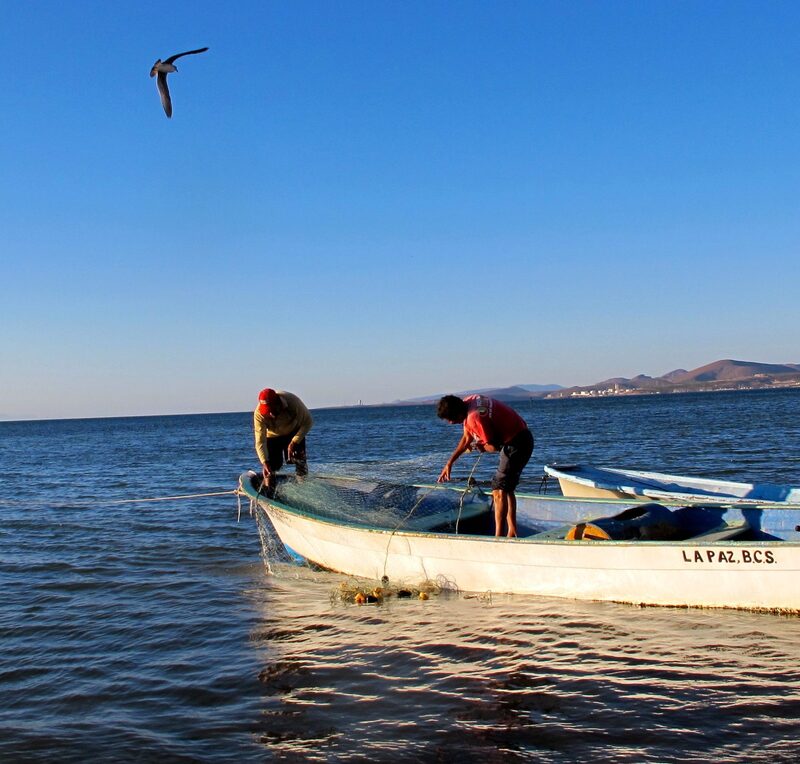
That pattern is not unique to Maine. For more than 20 years, University of Maine professor of marine sciences Heather Leslie has collaborated with an international group of researchers studying how coastal communities respond to environmental, economic, and political pressures in northwest Mexico.
Leslie’s research program, based at UMaine’s Darling Marine Center, examines how marine ecosystems and the people who are part of them respond and adapt to environmental and socioeconomic changes.
Supported by the National Science Foundation and other funders, Leslie and her colleagues have shared data, resources, and fieldwork across regions, producing studies on the ecological and social characteristics of fisheries and examining how fishing communities respond to change, particularly in northwest Mexico.
Together, the research points to a commonality across disparate coastlines: when fishing communities lose variety, in species or in business structure, their resilience declines.
Leslie recently spoke with UMaine News about the findings. Her comments have been edited for clarity and brevity.
Is having fewer species a hardship for fishing communities?
To focus on the analogy with New England, it used to be that 25 or 30 years ago fishermen in coastal Maine were not just fishing for lobster. They were fishing for finfish and shrimp in the wintertime and lobster in the summer. Now more than 70 percent of fished value on the coast of Maine comes from one single species: the American lobster.
While that’s been a really lucrative and biologically productive fishery over the last couple of decades, we’re also seeing that it can really constrain people’s opportunities to rely so heavily on one species.
There are a lot of similarities between the communities you study in Mexico and the ones here in Maine, but what are the differences?
One thing that’s different between the two regions is the biological variety. As we move toward the tropics, we tend to see a greater variety of animals and other organisms. Think coral reefs. The poles don’t necessarily have that wide array of species, and we see that when we look at what people fish in Maine versus Mexico. In Maine, particularly now, we have a fairly small set of species that are harvested commercially and recreationally, whereas in Mexico in some places, folks are catching tens of different species each year.
However, we have observed that for better or worse, Mexico, in many places, is starting to look like Maine. And what I mean by that is the number of targeted species is declining, and where and how people can fish is becoming more constrained.
The group’s recent research references the organization of fisheries and how that plays a role in their success. Can you explain the different ways fishermen organize?
In some instances — and this is true in Maine, as well as northwest Mexico — fishing businesses and people are organized as cooperatives and share decisions, expenses, and revenues. Another typical way that people organize themselves to fish is through privately held businesses, where one person is leading and financing the operation and hiring other people to fish.
There also are smaller cooperatives that aren’t as well-resourced as the larger ones. And then there are folks who fish and sell their fish on their own; this owner-operator model is the one that most people think of when they think of the coast of Maine and lobsters.
How people organize themselves to fish can play a big role in how they’re able to respond to disturbances in the fishery. We were able to document through close work with communities in different parts of Baja California Sur that individuals who are part of fishing cooperatives have different sources of resilience to change than individuals who are working for private businesses or on their own.
Is one type of organization better than another?
There are financial and logistical advantages to being part of a cooperative, and that’s why they are so prevalent in regions we’ve studied. But there’s also liabilities that cooperatives face that people working in these other organizational structures are not exposed to. One of those liabilities is that large cooperatives tend to have a smaller set of species that they’re focused on, in part because they receive concessions, or exclusive access to specific fishing places, for high value species like lobster.
When conditions change and those species become less accessible to fishermen, cooperatives may be more economically exposed and have fewer options to switch to than other types of fishing organizations.
A recent paper led by Mateja Nenadović, a UMaine alum and University of Rhode Island professor, makes a strong case that it’s not that one of these forms is better than the other, it’s that there are changes that people encounter in the business of fishing, whether it’s economic or environmental or political, where one or the other of these organizational forms tends to be advantageous.