One day, painter Janice Moore recalls, she was out driving with her son Joseph Coleman who was scouting locations for his short film Vacationland (2022). Moore relishes these opportunities to explore with her son as she usually goes on solo road trips in search of painting subjects. “He’s very creative,” she notes, “and I like getting his perspective.”
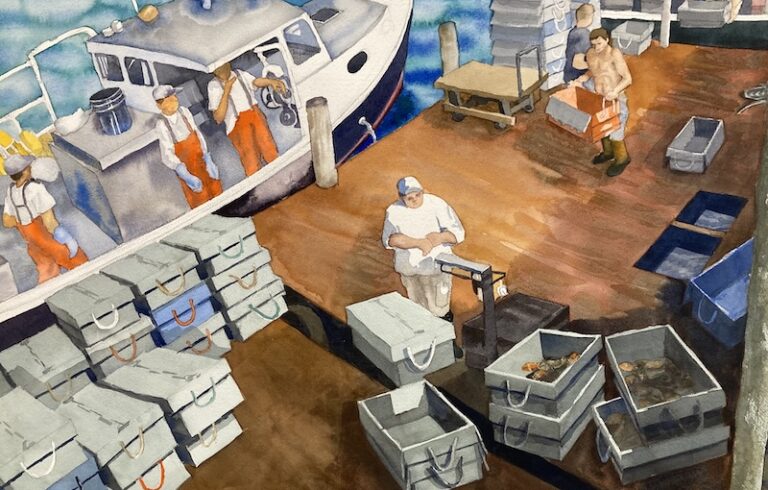
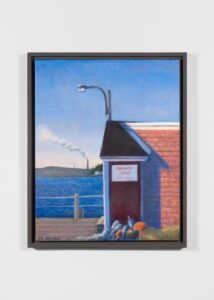
On this particular drive, Moore came across the scene that would result in her painting “Private Wharf, Harpswell.” She had been thinking about ways of conveying distance in small compositions. Beyond the small shack with its single light, she could see the smokestacks of the Wyman Station power plant on Cousins Island and the SD Warren paper mill in Westbrook. The view also encompassed a jumble of lobster fishing gear in the foreground. “Nothing’s too precious around working waterfronts,” she says, “and I like that.”
Moore also paints still-lifes and interiors—among them a memorable series devoted to chairs—and coastal landscapes, including many islands. She always has at least 10 to 20 paintings in process. They can take years before she feels they are ready to show.
Moore is currently working on a series of the former B&M Baked Bean cannery in Portland. “My art is contemporary and not historical,” she avers, “but knowing the history and hearing the stories about working there is essential in my process.” Her painting of the factory’s exterior will eventually hang at Northeastern University’s Roux Institute, which is building a campus on the site.
The artist’s family hails from the Digby area of Nova Scotia but she was born in New Brunswick while her parents were visiting relatives. “My grandfather always insisted I say I’m from Nova Scotia,” she notes, “and that has always felt right.”
The family moved to Houlton in Aroostook County when Moore was five. From the mid-1970s to mid-‘80s, they spent summers living on the cheekily named M.T. Pockets, a marine trader trawler anchored in Northeast Harbor. Moore remembers lots of teak and windows. “I received great lessons on light, perspective, and scale aboard boats along the Maine coast,” she recalls. “Boating and making art share a similar thing for me: If I go too long without access, I lose my center and perspective.”
Moore points to her mother as a source of her creativity. She had a sewing business and once made a dress for Boston Red Sox legend Carl Yastrzemski’s wife. Mother and daughter took painting classes together at Portland School of Art—now named the Maine College of Art & Design—when Janice was in high school.
Moore took as many painting and photography classes as were allowed while at the Waynflete School and, later, at Sarah Lawrence College. At the latter, she studied with photographer Joel Sternfeld. “I’m still unpacking what I learned from him about making art and about clarifying what I’m intending to convey,” she writes.
Fresh out of college, Moore took a job at the Daniel Wolf Gallery in New York City, which provided an “incredible education” in fine art photography. The gallery assembled collections for art institutions, including the Getty Museum in Los Angeles. She also did a yearlong internship at Magnum Photos in New York City, the renowned cooperative photojournalist agency started by Robert Capa, Henri Cartier-Bresson, and others after World War II.
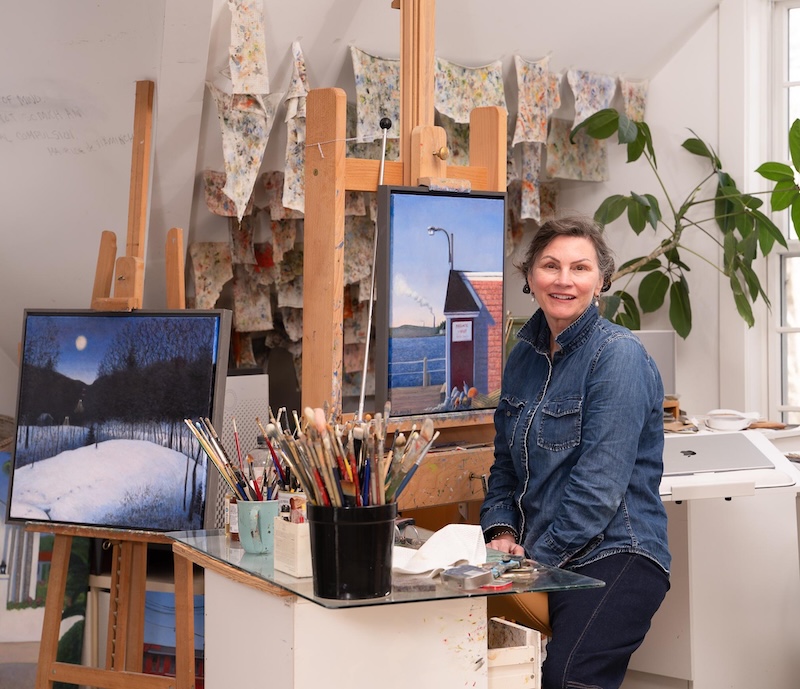
Moore moved to Freeport in 1998, into a house built in 1817. She added a studio over the garage during a major renovation in 2004. She loves the light-filled space. “I can leave things in a complete state of disarray,” she writes, noting that something in the chaos leads to order in her compositions. The studio looks out over the 145-acre Mast Landing Audubon Sanctuary. “Heaven,” she calls it.
Moore has been living with Multiple sclerosis for 33 years. While a challenge, especially regarding strength and balance, she has learned adaptations for painting and life. Energy is fleeting, so she is as intentional as possible with her time. “I never know what each day will bring,” she explains, “or how much gas I’ll have in my tank.” She paints on, resilient, defiant, and engaged.
Moore’s work has appeared recently in the Union of Maine Visual Artists’ juried show Washed Away at the Portland Public Library and the Center for Maine Contemporary Art’s biennial. You can see more of her work on her website, www.janicelmoore.com.
Carl Little is curating “Francis Hamabe’s Maine: A Lifetime in Art” for the Castine Historical Society this summer. He contributed a chapter on photographer George Daniel for Fire Island Art: 100 Years, forthcoming from Phaidon.