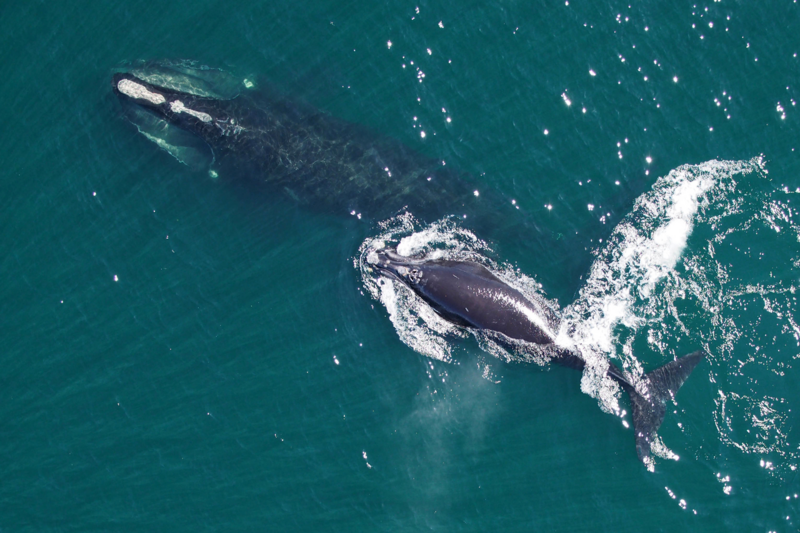
In August, the National Marine Fisheries Service announced it was planning to seek public input on the scope of new rulemaking for fisheries to protect the endangered North Atlantic right whale and other large whale species from fishing gear entanglement.
If a new bill becomes law, the agency may decide to slow down that rulemaking process by some seven years.
That’s because the U.S. House of Representatives passed a bill on Sept. 1 to extend a pause on new rules to protect right whales from entanglement. H.R. 9436 would extend that moratorium, which was due to expire Dec. 31, 2028, to Dec. 31, 2035.
The bill, co-sponsored by Rep. Jared Golden of Maine’s 2nd Congressional District, a Democrat, along with Rep. Mike Lawler, (R-New York), received rare bipartisan support, with 10 Democrats crossing the aisle to vote alongside 209 Republicans in its favor. Another supporter was Rep. Chellie Pingree, also a Democrat, of Maine’s 1st district.
The legislation likely will now go before the Senate. The administration of President Donald Trump previously said in a statement that he supports an extended pause in new regulations to protect the whales.
In an interview with The Working Waterfront before the vote, Golden said that lobstermen had already done a lot to cut the risk of whale entanglement. New measures to protect the whales must also protect fishermen’s livelihoods, he said.
“There is a limit to how many new regulations fishermen could actually adopt without just being put out of business outright,” Golden said.
Proponents of the bill have also said the pause is necessary to allow NOAA Fisheries to complete a round of information-gathering and analysis of right whale behavior and interactions. That effort began as part of the late-2022 law that paused new fisheries rules to protect right whales until 2028. In an earlier statement, Golden stated that layoffs at NOAA and government shutdowns caused this information-gathering to be delayed.
Rep. Jared Huffman (D-California) disagreed. Speaking on the House floor before the vote, Huffman said an extension of the moratorium would reward the Trump administration for not faithfully following laws to protect the whales and other endangered species.
The administration has been “dragging its feet, firing staff, axing science, and deprioritizing ropeless gear—perhaps because they think Congress will bail them out and kick the can a little further down the road,” Huffman said.
Conservation groups have been vocal in their opposition to the bill, and have launched campaigns for its defeat in the Senate. Gib Brogan, a fisheries campaign director for Oceana, characterized the legislation as an “extinction bill” that will put the species in danger.
There are an estimated 384 North Atlantic right whales in the ocean. While that number is 7% higher than it was in 2020, environmental advocates characterize the recovery as fragile.
Brogan argued that this bill short-circuits the regional process of fisheries management that brings stakeholders together to create consensus about future policy.
“Before we can even have the public process, have participation of conservationists and fishermen and scientists and the experts across the board … they want to pause and extend this out for another chunk of time.”
The Maine Lobstermen’s Association (MLA) submitted a letter in favor of the bill, saying it will give regulators time to get the information needed to put rules in place that can protect both the whales and the lobster industry.
MLA sued the National Marine Fisheries Service in 2021 to stop new whale conservation regulations from taking effect, arguing that regulators were basing those rules on estimates of worst-case scenarios.
“They filled in with some pretty far-reaching assumptions that didn’t reflect the reality of risk on the water, and that’s not OK because there are some pretty hard-hitting economic consequences to that,” said Patrice McCarron, MLA’s executive director.
In 2023, the U.S. District Court of Appeals for Washington, D.C. ultimately sided with MLA, saying regulators must use “the best scientific and commercial data available” in rulemaking.
All eyes will now turn to the Senate on this issue. Golden did not directly say whether he had discussed the bill with his counterparts in that chamber.
“I think it’s fair to say that the two senators from Maine care a lot about lobstermen in Maine, as well,” Golden said.
Those two senators, Republican Susan Collins and independent Angus King, both helped push through the 2022 legislation that delayed the right whale protections.
Spokespeople for Collins did not respond to a request for comment, as of press time. A spokesperson for King said he did not have any comment.