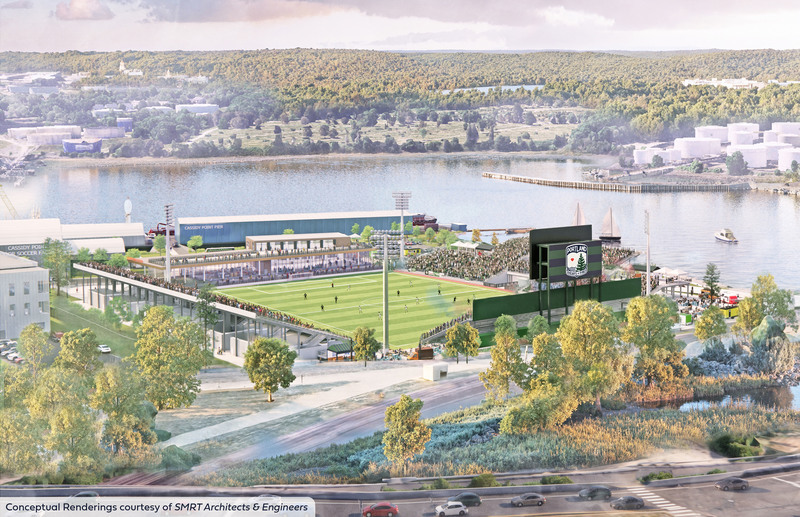
A high-profile debate has broken out over the proposed re-zoning of more than half of a 23-acre parcel of industrial land on Portland’s western waterfront where the popular Hearts of Pine professional soccer club hopes to build a new stadium.
The Hearts of Pine have submitted a proposal to the Portland Planning Board to rezone part of the property so it can build a $50 million-plus soccer stadium with 9,000 to 11,000 seats. It has an agreement with the current owner to purchase just under 14 acres.
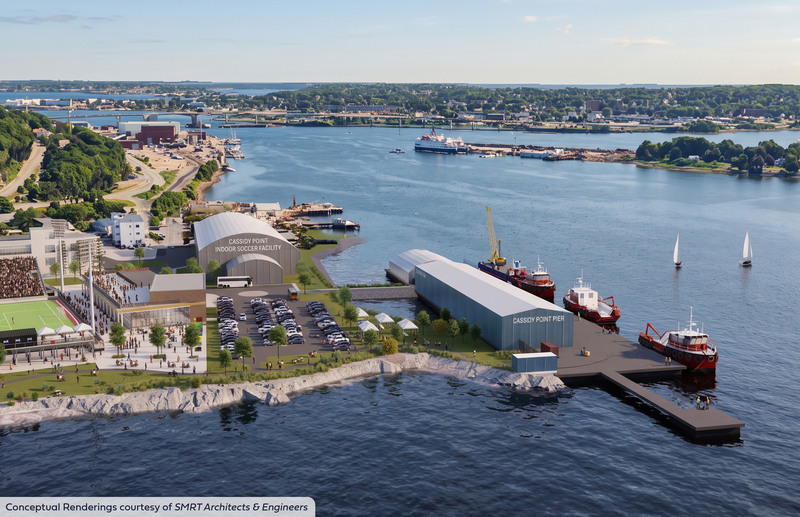
The club says the project would transform what is currently a fenced-off industrial coal storage site into a vibrant destination with new recreational space. The club says it would not take ownership of or displace the site’s 600-foot pier.
Opponents, however, maintain that the city’s working waterfront should be preserved at all costs. The stadium is not dependent on the waterfront to operate, they say, and can be built in many different places.
Advocates say it’s vital to protect the 20 miles of working waterfront property that’s estimated to remain along Maine’s long, jagged coast. Otherwise, they say, the state could lose both marine-related businesses and the maritime culture embedded through its history.
The Waterfront Alliance, an organization that aims to protect the working waterfronts of South Portland and Portland, has not taken a formal position on the proposal. But several members have taken individual positions, said Chair Nick Mavodones, who opposes the plan.
He said people appreciate having the Hearts of Pine in Portland, but that it would be “short-sighted” to rezone the land, because the soccer team can build a stadium elsewhere. If that land is rezoned for a stadium, it could never again be used as a freight terminal.
“I’m opposed to it personally because we have a very finite amount of working waterfront property not only in Portland, but along the entire coast of Maine,” Mavodones said. “Anything that isn’t water-dependent and doesn’t need to be on the water’s edge and can be built upland or somewhere else shouldn’t take away working waterfront land.”
Hearts of Pine founder Gabe Hoffman-Johnson said the club looked at multiple sites for a new stadium, including the former Sable Oaks golf course in South Portland, a farm in Westbrook, the Maine Mall parking lots, and a decommissioned oil tank farm in South Portland.
The team wants to be in an urban setting, Hoffman-Johnson said, and Cassidy Point was the only place on the Portland peninsula with space for a stadium, with parking and transit options nearby, and that was for sale or lease. The club aims to begin construction in 2027 and open a new stadium in early 2029.
The club, he said, isn’t trying to supplant working waterfront property, but rather improve the upland portion of the site.
“We’re here to contribute to Portland and Maine and we want to continue to engage in conversations around what we can contribute to that end,” he said. “It doesn’t need to be mutually exclusive. We certainly have a deep respect for the working waterfront—past, present, and future.”
Since beginning play in the USL League One professional soccer league two years ago, the Hearts of Pine have sold out every home match at Fitzpatrick Stadium, which can seat about 6,000. The stadium would be used by both the men’s team and the club’s professional women’s team, the Wildness, which begins play next year.
The club announced in August that it had agreed to purchase part of the 23-acre site at Cassidy Point, on the western end of Commercial Street near the Veterans Memorial Bridge. That stretch of waterfront is primarily industrial, located up the Fore River and west of the Casco Bay Bridge.
Owned by Sprague Operating Resources LLC of Portsmouth, New Hampshire, the site includes a marine terminal and industrial warehouse, storage, and a large open-air coal pile. A recently passed city ordinance requires Sprague to permanently cover the coal pile by Jan. 1, 2027, and to remove it by 2030.
To build a stadium, the soccer team needs the parcel to be rezoned from the Waterfront Port Development Zone to the B-5 Urban Commercial Zone, while also adding “stadium” as a permitted use in the B-5. The team plans to build the stadium, an indoor soccer facility for youth and adults, recreational trails, and open green space.
In decades past, the site operated as Merrill’s Marine Terminal and was a busy place exporting and importing large volumes of hardwood pulp, rolls of newsprint, scrap metal, coal, and other products.
But with those markets largely gone and the infrastructure aging, the upland portion of Cassidy Point — the portion the soccer club wants — is no longer economically viable, said David Glendon, chairman of Sprague Operating Resources. Sprague announced in September that it had agreed to sell the remaining nine or so acres, including the pier and warehouse facilities, to McAllister Towing and Transportation Co., the parent of Portland Towing tugboat and ship docking company.
“Unfortunately, the Merrill’s terminal was built to serve a market that no longer exists, and alternative industrial uses are not viable at the site,” Glendon wrote in a public comment to the Planning Board.
Before its first workshop on the proposal in September, the Planning Board received dozens of written comments from people on both sides of the issue.
A number of marine-related organizations and business, including the Maine Port Authority, Maine Lobstermen’s Association, and Portland Pilots, oppose the plan. A former city planner, two former Planning Board chairs, and a former city waterfront coordinator have also gone on record in opposition.
Bill Needelman, who was the city’s waterfront coordinator from 2014 until 2025, said the Portland waterfront is an economic engine for Maine, and that Cassidy Point should remain zoned for industrial use.
“I express this opposition in the full knowledge of the popularity of the applicants and goodwill that the Hearts of Pine have generated in the community,” Needelman wrote. “We all love the Hearts. However, the port is the true heart of the city.”
But supporters said a new stadium and recreation area can serve as an economic engine of its own while creating new opportunities for community events and revitalizing a waterfront property.
Portland resident and former Planning Board member Sean Dundon wrote that allowing the stadium would phase out an obsolete industrial use, while maximizing public access and benefiting area businesses. The plan, he said, is compatible with Portland’s ReCode initiative, a comprehensive rewrite of the city’s land use code and zoning map that was approved by the City Council two years ago.
The stadium proposal is about co-existence, not displacement, Dundon wrote. “Rezoning for a stadium allows developers to preserve critical industrial nodes—such as a 600-foot deep-water pier—while transforming the surrounding surface footprint into a public gathering space,” he wrote. “This achieves ReCode’s balance of economic modernization without entirely erasing Portland’s industrial capabilities.”
The new proposal isn’t the first time that waterfront development has spurred pushback.
Condominium construction on Chandler’s Wharf in 1985 alarmed residents who feared fishing and marine infrastructure would be pushed out by condos and offices, sparking a 1987 referendum that brought strict waterfront zoning.
In 2019, a local developer withdrew plans to build a 93-room hotel on a wharf in the central waterfront zone following opposition from fishermen and the community at large.
Even the landmark Becky’s Diner on Commercial Street faced some pushback when it requested a zoning variance in 1990 to be able to open. At the time, the city’s waterfront zoning prohibited non-marine commercial businesses in that location.
In the end, owner Becky Rand was granted a variance after successfully arguing that she would cater primarily to fishermen, as well as prepare bulk food dishes such as lasagna and macaroni and cheese to take on fishing trips.
The process for the Hearts of Pine’s stadium proposal will play out in the months ahead with workshops and meetings before the Planning Board makes a recommendation to the City Council. If councilors approve a zoning change, then the project would go back to the Planning Board for a separate review.