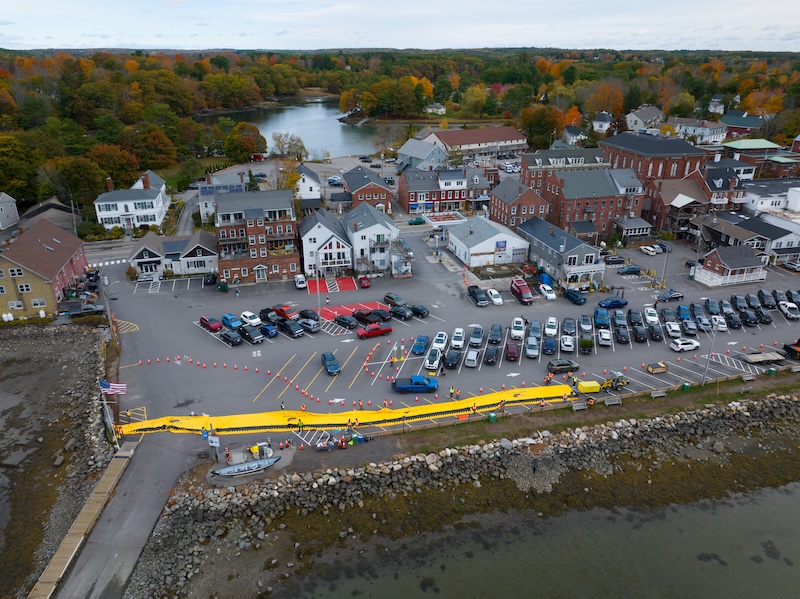
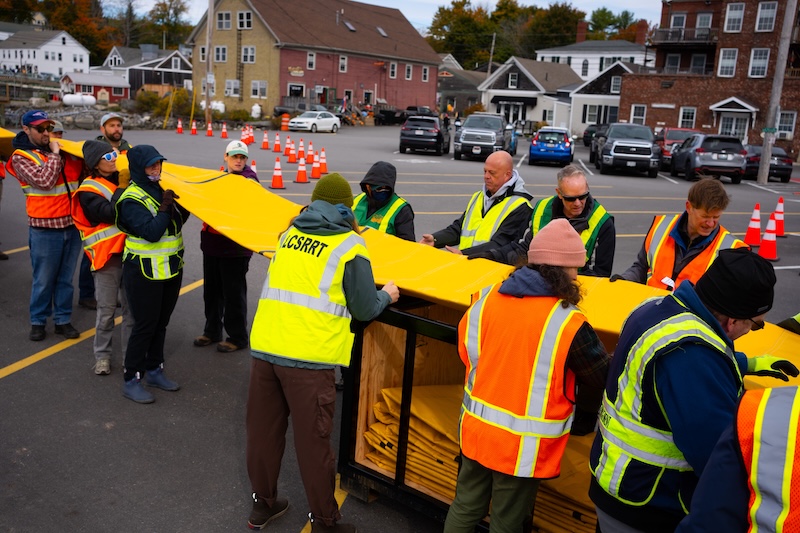
Under gray skies and in a stiff wind on a Saturday morning in mid-October, about 30 people wearing reflective safety vests lined up on each side of a section of the barrier that is a key part of Damariscotta’s plan to protect its historic downtown from flooding.
The volunteers—residents and other community members, town employees, and representatives from local emergency management agencies—were learning how to deploy a 200-foot-long section of the 850 feet of flood barrier the town purchased from Quebec-based MegaSecur in 2024 for $135,508.68.
Made in Canada with a mix of PVC-coated polyester, steel, polyethylene, and polypropylene, the bright yellow flexible flood barrier requires no electricity or permanent infrastructure to use. Once deployed, it uses the weight and pressure of incoming water to hold it in place and lift the top layer of fabric up to a height of 39 inches.
“The more [water that] comes into it, the better it works, because it will become heavier and heavier,” Stéphane Turcotte from MegaSecur told the volunteers. The material can also withstand some serious punishment, he noted, including being battered by ice, tires, telephone poles, and other debris.
“Anything that can be pushed by water,” he said, has been captured in the barriers, “and they remain in place.”
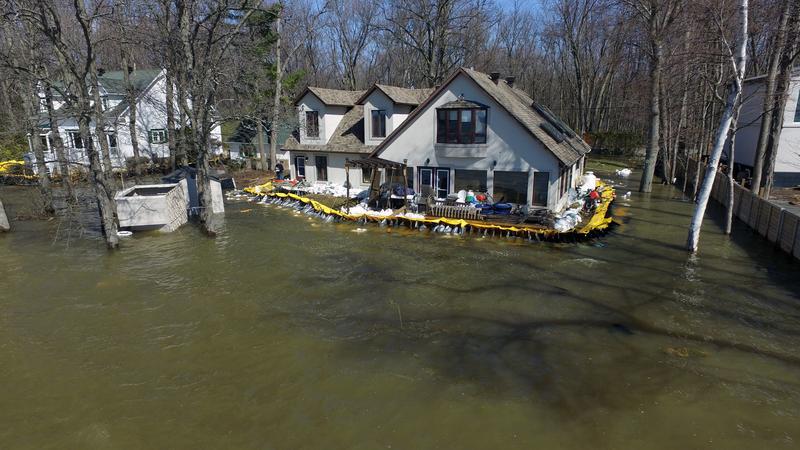
Like many coastal communities, Damariscotta has invested in layered infrastructure to protect itself from rising sea levels and worsening storms, such as the ones that battered Maine’s coast in the winter of 2024. Across the world, municipalities, businesses, and homeowners have considered a range of solutions to these threats, from elevating roads and other infrastructure to using vegetation, shellfish reefs, and other natural techniques to blunt the effect of floods.
Deployable barriers may offer a more affordable and flexible solution for communities looking to protect vulnerable areas. While sandbags have long served this role, newer designs have emerged in the last decade, ranging from walls that can temporarily be raised around structures to softer barriers that activate when filled with air or water.
Damariscotta had originally planned to install a permanent floodwall, but concerns about environmental impacts, aesthetics, and an estimated cost of $1.5 to $2 million caused the town to explore deployable floodwall options, said Emerson Wesselhoff, an Island Institute Fellow working with the town who organized the flood barrier deployment training.
The barrier is just one component of the town’s flood resiliency plan, and has been over a decade in planning, she said. A study the town completed in 2015 identified resiliency options for the downtown, including sewer system upgrades and a permanent floodwall that would extend approximately 4 feet above grade along the riverside municipal parking lot.
In the years since that study, the town tackled projects one by one, including making sewer and drainage upgrades. Purchasing the deployable flood barrier was the final major component of the town’s $4 million flood resiliency project, which included elevating sections of the municipal parking lot and installing a 150,000-gallon stormwater retention tank underneath it.
While the town’s climate resiliency planning is ever evolving, the push now is to raise awareness and get the community involved, Wesselhoff said, which is where October’s training came in.
Deploying 850 feet of heavy flood barrier can be done with a handful of public works employees, but having 20 or 30 people from the community involved would make things go more quickly, Wesselhoff said.
“We want to rely on community members because they love this place and that is a huge motivator,” she said. And having community volunteers pitching in helps to free up emergency responders and public works employees who may be needed elsewhere.
The town has a preliminary plan for the flood barrier that right now lives mostly in people’s heads, Wesselhoff said. Eventually, a formal plan will be written up with a deployment checklist and guidelines for communicating to volunteers. Marks will be painted on the pavement to indicate where the barrier needs to go.
The flood barrier is stored in sections kept in four large crates. Each section of the barrier is connected by heavy-duty Velcro. The full barrier of 850 feet will extend from the bridge on Main Street, around the corner at 49 Main St. into the parking lot, stretch along the parking lot’s riverfront, and end on the hill at Water Street.
It took less than two hours to deploy one section, learn how to make corners, and repack it during October’s deployment training. Wesselhoff estimates that with 20 to 30 trained volunteers, the entire barrier could be set up in three to four hours.
The next training is planned for April 2027 and will once again include a trainer from MegaSecur. The hope is to do a full barrier deployment at that training, said Wesselhoff. The cost of that training and the one in October is being covered by a $10,000 community climate planning grant from Island Institute, which publishes The Working Waterfront. Once those professional trainings are complete, regular trainings will be handled by locals.
Stephanie Bouchard is a freelance writer and editor living on the coast of Maine. Find her at stephaniebouchard.net.