Like many coastal homeowners, John and Cathy Seibyl are used to worrying about erosion. Since they bought their home on the western shore of Great Diamond Island a decade ago, they’ve noticed that the bluff leading down to Casco Bay is slowly washing away.
But the Seibyls have a newer concern, as well. When their basement was hit with 12 inches of flooding last winter, they realized that water is coming at them from both sea and the surrounding land.
“It’s a complicated organism, a bluff and its upland,” John Seibyl said. “… There’s a bit of an epiphany to realize that there’s water coming from all directions.”
That discovery has shaped how the Seibyls are approaching a years-long project to protect their 1.2-acre property from the elements. Not only are they reinforcing the old chunks of stone and brick that protect their shoreline from waves, but they’re rethinking the grassy lawn that covers the upland part of the property.
They’re now testing which native shrubs and perennials can stand up to the island climate, with the goal of re-landscaping with the plants that do best and publicly sharing their findings.
They’re part of a small but growing movement of coastal Maine property owners trying to move away, where they can, from the traditional hard infrastructure of large rocks and geotextile fabric arranged into riprap.
While still seen as necessary in places that are exposed to open ocean, that harder infrastructure can deflect waves to neighboring properties. It can also degrade over time, as it can block natural sediment from flowing between land and shore.
“That effectively just cuts off the life supply of sediment from the upland to the coastal wetland, and in many cases that’s a major issue,” said Tim Forrester, managing partner and director of coastal resources at Yarmouth-based planning firm Flycatcher LLC.
“That sediment feeds and nourishes the intertidal zone and the subtidal zone for plants and animals and macroinvertebrates and everything else. … If the sediment’s no longer washing in, it would just wash out and not be replenished. So then, eventually those armament projects are going to fail because there’s nothing else in front of them.”
Projects that are more sensitive to those concerns have gotten a boost in recent years, after Maine enacted new rules and guidelines in the wake of the devastating winter 2024 storms that encourage nature-based techniques for protecting shorelines.
The Seibyls have enlisted Forrester’s firm and Portland-based Acorn Engineering to help with their project, which is part of a broader push to implement nature-based solutions around Casco Bay, supported in part by Island Institute, publisher of The Working Waterfront.

The City of Portland, which includes Great Diamond, helped secure a grant to pay for a workshop in August highlighting the Seibyls’ efforts.
Both Seibyls have led busy careers in medicine: she as an epidemiological researcher at the Department of Veterans Affairs, he as a neuroscientist and advocate for those with Parkinson’s disease. They’re drawing on their understanding of the scientific process to find the best solutions for their land.
“Wouldn’t it be nice if we could learn a little bit about upland management?” John Seibyl said. “It’s not something that is particularly evident when you think about shoreline erosion, but understanding the hydrology of the land is really important.”
Referring to their larger experimentation with upland plantings, he added dryly, “I’m calling it ‘Seibyl’s folly,’ because it’s rather expensive.”
The Seibyls are quick to note some unique aspects of their property, including that it used to be a coal-fired power plant for the U.S. Navy, so its soil has residual coal and little organic matter.
They neighbor the island’s barge landing and catch lots of water flowing off Great Diamond Island. A nearby storm drain originally installed by the Navy is now obstructed, which contributed to their recent flooding.
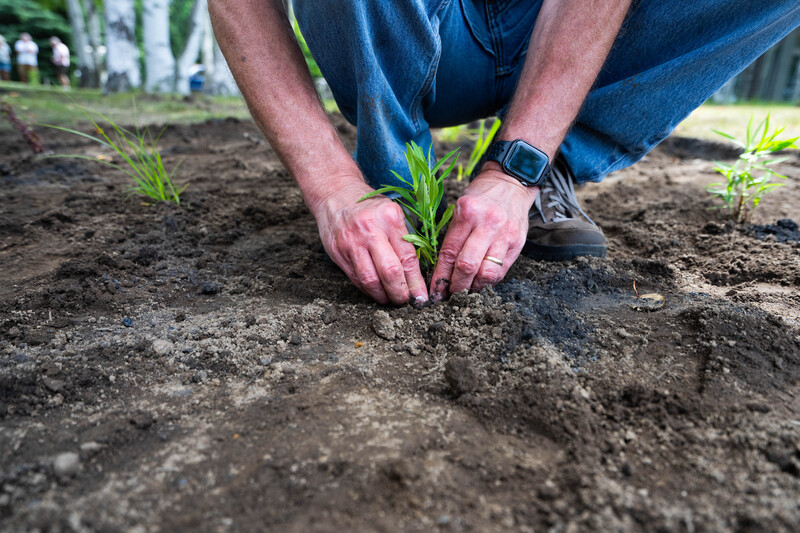
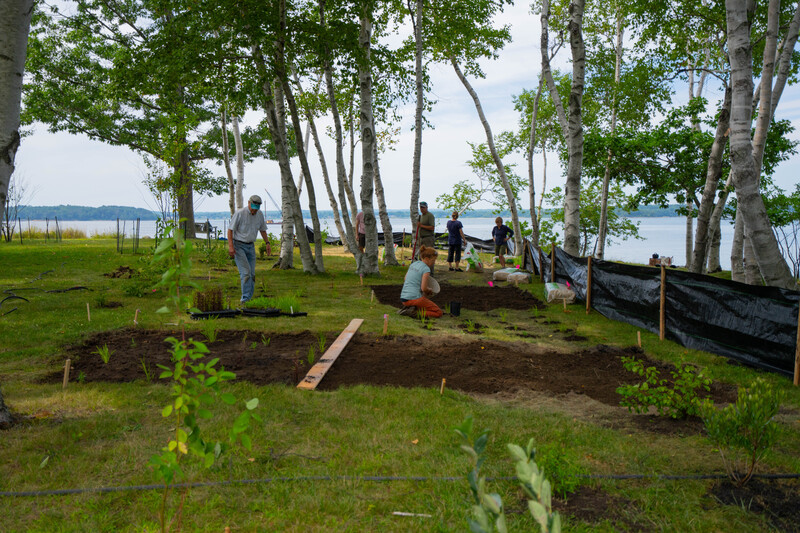
With the help of volunteers, they recently planted patches of different species, including chokeberry, summersweet, sweetfern, seaside goldenrod, yarrow, and New England aster, and will spend a year monitoring how well they grow in concert with the birch trees already established on the yard. Based on the findings, they’ll develop a final re-landscaping plan and work to get the project permitted. Their goal is to restore the organic matter that has run off their property over the decades.
According to the Maine Department of Environmental Protection’s “OUR SHORE” guidelines, a combination of trees, shrubs, and smaller plants above a shoreline can help soak up water and hold soil in place, strengthening it against erosion. That’s in contrast to pavement, lawns, and roofs that can increase the flow of water down the slope.
The Seibyls’ approach is a blend of hard and soft infrastructure, as they’re also using natural techniques to reinforce the harder riprap the Navy left behind.
Their goal is for the earth around the riprap to “maintain vegetation and grow and allow root structures to get in between the rocks and establish itself,” helping secure it and connect it to the upland, said Forrester.
Forrester credited the Seibyls for offering other Maine property owners an example of newer, nature-based techniques for protecting shoreline. Although some such projects will still require riprap, he noted it can be easier and more affordable to use natural solutions.
“It’s changing the mindset of people to what a living shoreline actually is,” Forrester said. “Sure, a storm can come in, it can have some impact, it can rip out some vegetation. But it’s a lot easier to run over to Skillin’s [Greenhouses] and buy 25 potted plants and stick them back in the ground than it is to have a contractor come over on a barge and restack and rebuild a whole riprap section.”
Charles Eichacker is the editor of The Working Waterfront and Island Journal. He may be contacted at ceichacker@islandinstitute.org.