Darting deer is a challenge in a location where deer are not habituated to people. That’s why it’s handy to be able to call your neighbor and ask if you can set up by a window with your dart gun in their house. “I always end up shooting out of a bathroom window for some reason,” said Dane Stevens. “I don’t know why, but that’s the spot that always seems to be the best spot.”
Stevens is a wildlife biologist and Isle au Haut resident. His neighbors give him a lot of ribbing for using their houses as blinds, but the reasons for darting the deer are no joke. Stevens is capturing deer on the island as part of a multiyear study testing whether an ingested form of an ingredient commonly used in flea and tick treatments for pets is effective for killing ticks on mice and deer.
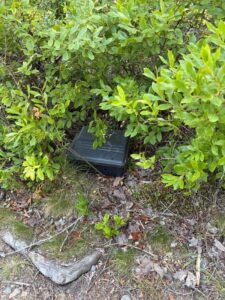
Fipronil is an insecticide used in veterinary products such as Frontline that are applied directly to the skin of pets. The insecticide is also used in bait boxes available through professional pesticide applicators as a spot-on treatment applied to rodents via a wick that they rub up against, but studies have shown that this tick management method can be labor intensive and expensive.
“It’s awfully hard to get real good coverage topically as opposed to an oral,” said Chuck Lubelczyk, a vector ecologist with MaineHealth’s Lyme & Vector-Borne Disease Laboratory in Scarborough.
MaineHealth is partnering with White Buffalo, the nonprofit wildlife management organization that Dane Stevens works for, and the Connecticut Agricultural Experiment Station (CAES) on the study, which is funded by the Centers for Disease Control and Prevention (CDC). The hope is that the study will show the oral application of fipronil effectively reduces tick abundance and if so, for a commercial product to be made available to consumers, he said.
The more tools in the tick reduction tool shed the better, said Mike Fedosh, an Isle au Haut resident and Select Board member whose southeast side property is being used as a control site for the study. Fedosh said that sometimes when he takes his morning cup of coffee to the rocks below his home, he’ll drop his gaze from the ocean to see dozens of nymphal ticks crawling across his legs. He trims the bushes that overhang the path to the rocks, but, he said, “ticks happen.” That’s why there’s doxycycline stored in his medicine cabinet.
Maine’s coast and islands have been tick hotspots for years, and Isle au Haut has been participating in tick research for decades. The current research project is different from previous efforts in that it is simultaneously targeting two key hosts for ticks: mice and deer. The fipronil-laced bait is deployed to sync with the times of the year when ticks are seeking out their deer and mice hosts, said Stevens, maximizing the chances of killing ticks. The bait for mice is placed in bait boxes while the bait for deer is broadcast at specific locations at dusk using a spin feeder.
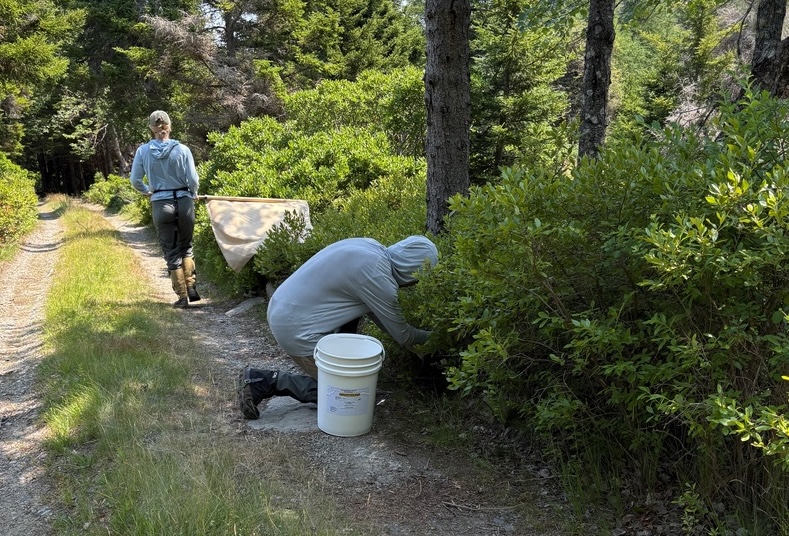
At various times of the year, the research team conducts drag surveys across the landscape and captures mice and deer to analyze the level of the insecticide in their blood and check for ticks on their bodies. Now in the fourth year of the study and the third of treatment, the team expects to have enough data by this fall to start seeing trends, Stevens said. Anecdotally, though, none of the deer the team has handled have had any ticks on them. Lubelczyk cautions that a lack of ticks found doesn’t mean their absence is due to the fipronil. Because of two years of drought, he said, tick numbers are down.
Even though the CDC grant for the study doesn’t cover researching non-target impacts, such as how the insecticide effects other animals eating the laced bait or if it is getting into the soil and water, the team is doing limited sampling to have some data on that aspect, Lubelczyk said.
While the team in Isle au Haut is conducting their part of the study, the scientists in Connecticut are examining how long fipronil stays active in deer, which is important from a deer hunting perspective. “One of the hopes is that as these new products are developing, what we call the withdrawal time is going to be a lot shorter [than with older veterinary medicines], which would mean that you could, in theory, put some of these products out, stop before the hunting season starts, still be able to kill ticks, but then the animals would be allowed to be harvested,” Lubelczyk said.
With about one more year left to the original research grant, the team hopes to find additional funding to extend the study by two years. “I think we have a real tick-borne disease epidemic in the Northeast United States—if not broader—and I am personally surprised that there is not more being done about this,” Stevens said.
Ultimately, he hopes that the study results in a marked decrease in tick densities that leads to the development of integrated tick management products targeting mice and deer that can be deployed across home landscapes as well as more broadly.
Stephanie Bouchard is a freelance writer and editor living on the coast of Maine. Find her at stephaniebouchard.net.