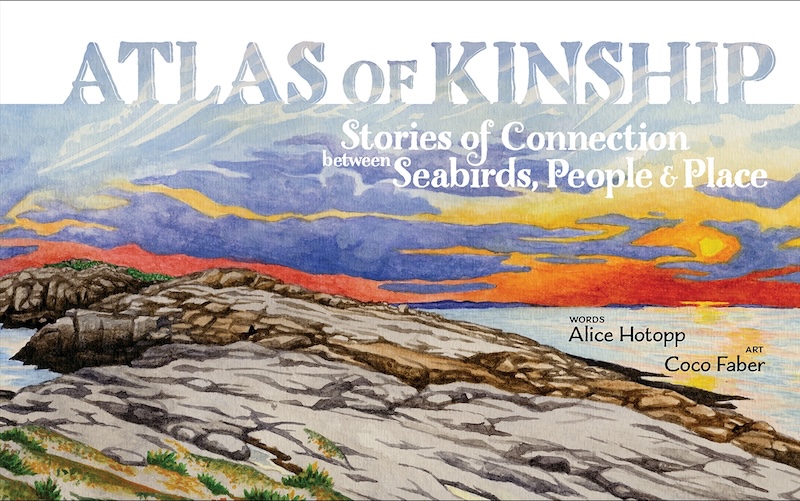
Atlas of Kinship: Stories of Connection between Seabirds, People & Place
By Alice Hotopp, illustrations by Coco Faber (2026, Littoral Books)
Ecologist Alice Hotopp’s book, Atlas of Kinship, has one explicit, overriding theme: Everything in nature is connected.
The particular connections in question involve the seabirds that make their homes on the coast of Maine. Across this collection of about 14 short articles, we get lists and depictions of many birds, including Arctic and common terns, razorbills, black guillemots, common eiders, gulls, double-crested and great cormorants, and sandpipers, to name a few. The main thread throughout is the endlessly endearing Atlantic puffins.
Early on we learn about Willie, who was banded as a puffling on Matinicus Rock in 2002, grew up at sea as all puffins do, and after several years returned to an island a few miles from his natal home to set up his own adult life. He has lived there pretty successfully ever since. A live-feed camera of his and his mate Millie’s burrow has allowed the world to monitor the homestead for many years.
We learn that like a lot of coastal birds during the last few hundred years, the puffin population has suffered gravely from disruptions by humans. In the 1960s efforts were mounted to restore puffins to the coast, and we learn of the groundbreaking work of Steve Kress, who in 1969 started from scratch to develop restoration methods at Eastern Egg Rock in Muscongus Bay that have been adopted around the world.
Kress’s Project Puffin successes continue today, as evidenced just this summer in an Audubon Seabird Institute count that observed at least 200 active burrows, the most since the high in 2019 of 188. Hotopp meanwhile describes other notable restoration and preservation projects at Petit Manan Island, part of the Coastal Islands National Refuge, and at Seal Island, where the book’s illustrator, Coco Faber, has patrolled the grounds as a wildlife biologist for 10 years.
The articles conveying the information run from a couple to eight or 10 pages of unusual two-column design, most interspersed with Faber’s colorful drawings and maps in a style reminiscent of children’s books. The prose is characterized by a rhetorical approach that is part magazine article, part personal essay, and part writing-workshop-prompt response, and leaves the general impression that overall the book is aimed toward young adults.
Indeed, we find the author toward the end depicting a moment of imagined panic about the ravages of climate change and how they might affect her daughter when she’s grown to young adulthood. The fears then divert to a daydream of the little girl growing to become a skilled kayaker just like her mother, in love with the seabirds.
“I believe in both of the futures that flashed through my mind that day. Like all the generations before and all the generations after, my daughter will live in a fraught, beautiful world, a world in which joy is as stark and full and profound as danger.” In this romanticization, the young adult is steered toward the same appreciation of the puffins and the same sting of sympathy for their struggles that the mother feels. The moral of the story, as we hear in different kinds of explicitness at the end of almost every piece, is that there is a “cacophony of kinship that sustain(s) us all” and that is located in all of nature, particularly the life histories of the seabirds.
The idea that everything in nature is connected is repeated something like a mantra in many environmental contexts, usually referring to intricate webworks of biological and ecological processes. Those kinds of details aren’t really presented in this book, beyond examples of humans looking after some birds and of humans wreaking havoc for others. Atlas of Kinship is instead a bird’s-eye moral elegy on a world in which everything that is connected seems to be coming apart, but can be put back together.
Dana Wilde is a former newspaper editor and college professor who lives in Waldo County.