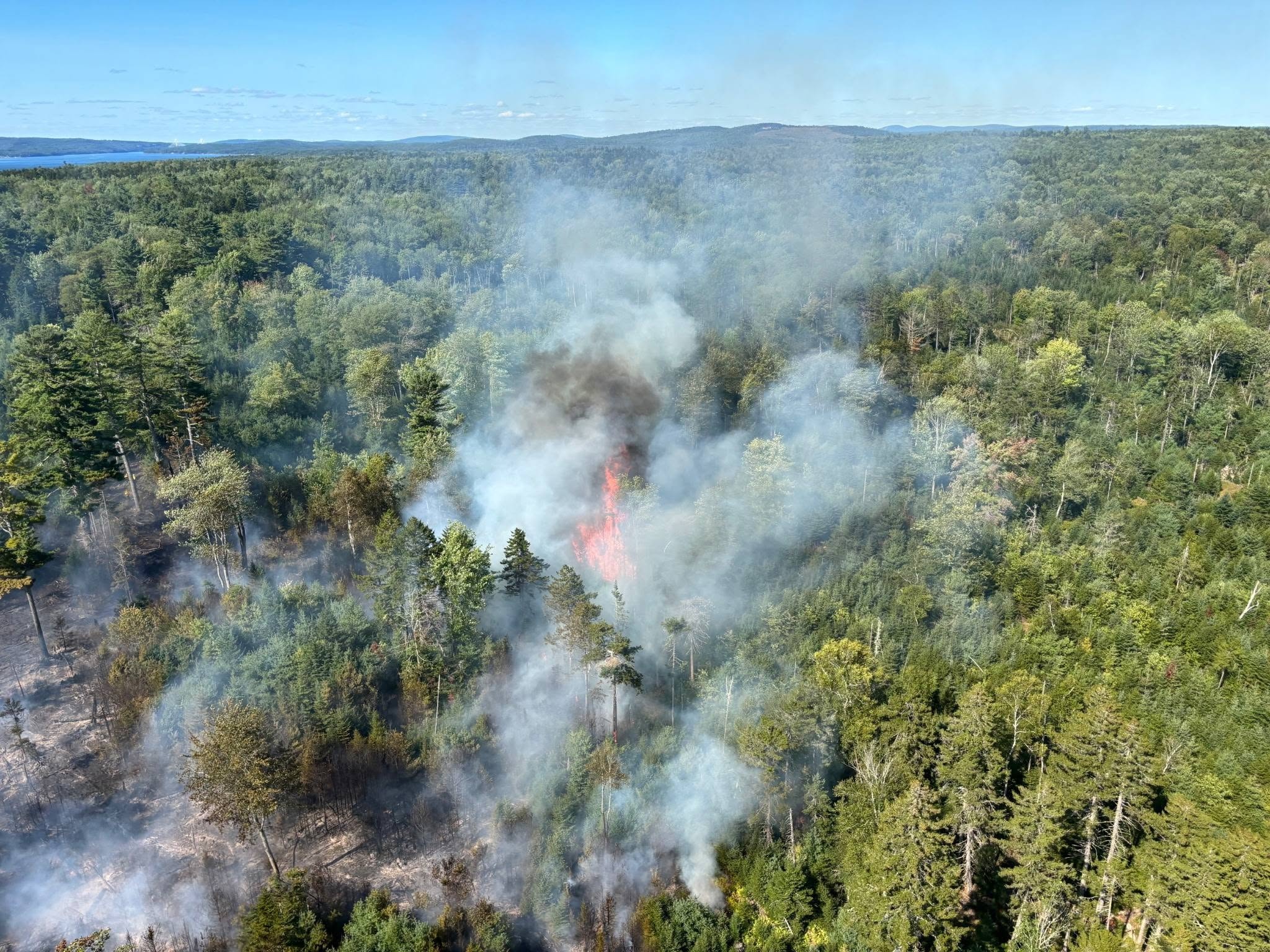
Just before noon on Saturday, Aug. 29, a Penobscot resident called the Hancock County Regional Communications Center in Ellsworth to report a wildfire near the intersection of Dunbar and Castine roads. Within minutes, local volunteer firefighters were on the scene trying to douse a conflagration that had ignited trees towering 100 feet into the air.
But the fire continued to grow. Fortunately, so did the resources assembling to fight it.
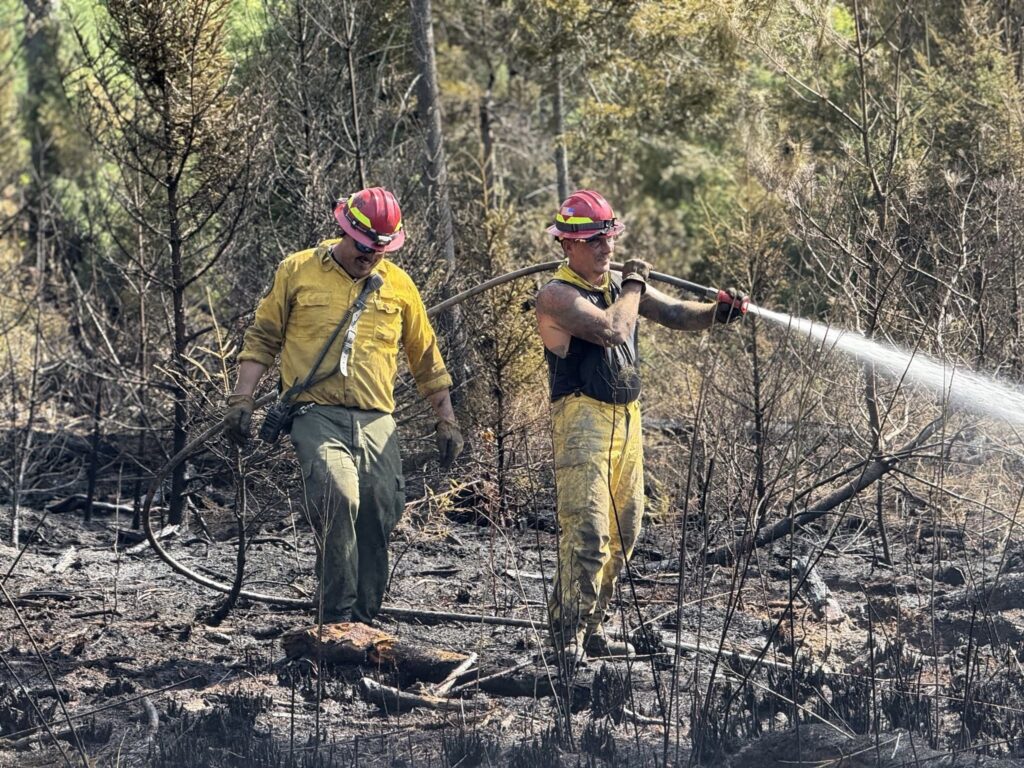
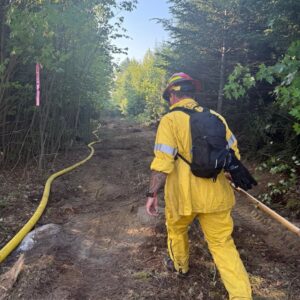
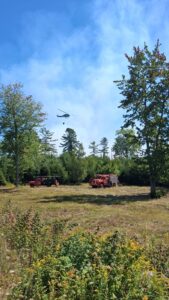
According to Penobscot Fire Chief James Clarke, more than 50 firefighters from towns across the Blue Hill peninsula joined forces to help contain the blaze, laying out thousands of feet of hoses into the dense forest while a Maine Forest Service helicopter dropped water from above. Contractors, landscapers, and arborists brought their bulldozers and earth-moving equipment to establish a break around the wildfire.
By the following morning, the 5.6-acre fire was finally contained and crews remained all day to stamp out any flare-ups. Noting the dry conditions—about 96% of Hancock County experienced moderate or severe drought over the summer—Clarke credited the quick response from nearby departments and private companies in preventing the wildfire from spreading out of control.
Despite Penobscot’s successful outcome, the events of that weekend remained troubling for Isle au Haut resident and Select Board member Mike Fedosh. His unbridged island, almost entirely forested, has just one fire engine, a tank on the back of a pick-up truck, and a single backpack water tank.
“Being on the mainland, you have adjacent communities pitching in,” he observed. “But the Island Transporter out of Rockland is almost the only way you could get equipment out here, I imagine … You’d need something that flies to come out here to address a wildfire.”
That logistical difficulty is one reason why Isle au Haut is focusing more of its attention on prevention and mitigation of wildfires. It recently received a $10,000 grant from Island Institute to join other towns on the Blue Hill peninsula in developing a community wildlife protection plan to identify the risks and prioritize actions to reduce them.
“We have a population of about 50 in the winter—roughly 250 in the summer—on an island 4 miles by 7,” Fedosh said. “Add to that we’re mostly forested, we have a fuel source, and it doesn’t take really any [forestry] background to look at all the dead trees standing and on the ground. We all fear the potential, what might happen if a wildfire started here.”
Changing climate, new risks
Prior to Isle au Haut’s participation, nine mainland communities had been working together to address climate resilience, energy efficiency, and greenhouse gas reduction. After successfully applying for grants to upgrade wastewater treatment facilities, salt-and-sand sheds, and conduct flood risk assessments, a group called Blue Hill Peninsula Forward turned its attention to another climate-related threat: wildfires.
Admittedly, the Pine Tree state might not be the first place one thinks of when discussing wildfires. But Maine Forest Service ranger and fuel reduction coordinator Kent Nelson said it would be a mistake to discount the threat here.
“We’re the most heavily forested state per capita in the nation,” Nelson points out. “And 78% of Maine’s homes are in the wildland-urban interface, compared to the U.S. average of 32%. So with all that vegetation growing and structures in these wooded areas, we do need to have these regional fire plans and work together to try to reduce the risk of home ignition from a wildfire.”
A recent pattern of “flash” droughts is also heightening the risk in eastern Maine. While the state’s overall climate has grown wetter over the past decade, precipitation has fallen heavily in isolated storms separated by increasingly longer dry spells. Along the coast, where thin topsoil covers granite ledge, a lack of deep water storage has made conifer forests exceptionally sensitive to even three to four arid weeks.
“When you get an even-age stand of spruce on a coastal island, it’s more susceptible to disease, and spruce are very shallow rooted, so they blow down,” Nelson said. “Our coastal islands—and a lot of the peninsulas—have a lot of what we call fuel loading.”
Nelson has been collaborating with Allen Kratz of Blue Hill Peninsula Forward on a regional wildfire protection plan funded by $250,000 in congressionally directed spending. The federal money has enabled the group to hire SWCA Environmental Consultants of Scarborough to develop a comprehensive strategy that includes:
- An assessment of wildfire hazards and vulnerabilities.
- Identification of assets at risk, such as homes, critical infrastructure, natural resources, and cultural resources.
- Recommendations for reducing risk through vegetation management, home hardening, emergency preparedness, and public education.
- Prioritized actions and implementation strategies.
“The Blue Hill peninsula presents several interesting planning considerations,” said Arianna Porter, lead project manager in SWCA’s disaster and resilience division. “The peninsula includes a mix of forested landscapes, seasonal and year-round populations, historic village centers, working waterfronts, and transportation constraints associated with a coastal geography.”
“Isle au Haut presents additional considerations because access is limited to boat and air transportation,” she added, “which can affect emergency response, evacuation planning, and the movement of equipment and personnel.”
From plan to protection
Kratz said SWCA will present the draft plan to the public at an Oct. 21 meeting in Blue Hill. Based on input from that event, he anticipates a final draft by the end of the year.
“In January and early February, we will be going to the select boards for their review of the plan,” Kratz said. Subsequent adoption of the plan “will enable all towns to apply for implementation funding because FEMA has … a community wildfire defense grant program.”
He expects the plan will provide each town with “things like community education, informing people about the nature of risk, what they can do to create defensible space around their homes and other structures.”
Another tangible benefit is raising a new level of awareness to the importance of firefighters, firefighting, volunteer departments, and mutual aid agreements.
“Communities have found that it increases the uptake of volunteers,” Kratz said. “They also have an educational component in cooperation with the educational system, schools, and other places for community education.”
Most important, from Nelson’s view, is that a strong and widely adopted protection plan leads to more funding to help communities like Isle au Haut prepare for the inevitable. He envisions funding to support “community chipping days” to reduce wood waste near homes, pre-positioning cisterns for fire suppression, and cutting fire breaks around locations that commonly experience ignitions, such as transfer stations.
“But the state, and local fire departments, can’t do everything,” Nelson said. “There has to be some onus on the homeowner and it’s really not that hard. To keep your house safe from burning, just manage the vegetation within a hundred feet. People think that it’s just going to be a wall of fire that comes from the woods and burns their house down … But basically it’s just needles and leaves, what we call the fine fuels, that ignite really easily because they dry out after a rain event within an hour.”
Whatever equipment and prevention strategies the plan introduces, Fedosh is sure it will be welcome on Isle au Haut.
“If this place were to light up now,” he said, “we’re not in a position to hold the fire or check its spread.”
Jack Beaudoin has worked as reporter, columnist and editor at the Journal Tribune, Portland Press Herald, Kennebec Journal and Maine Monitor, among other publications across the state. He lives in Stonington.