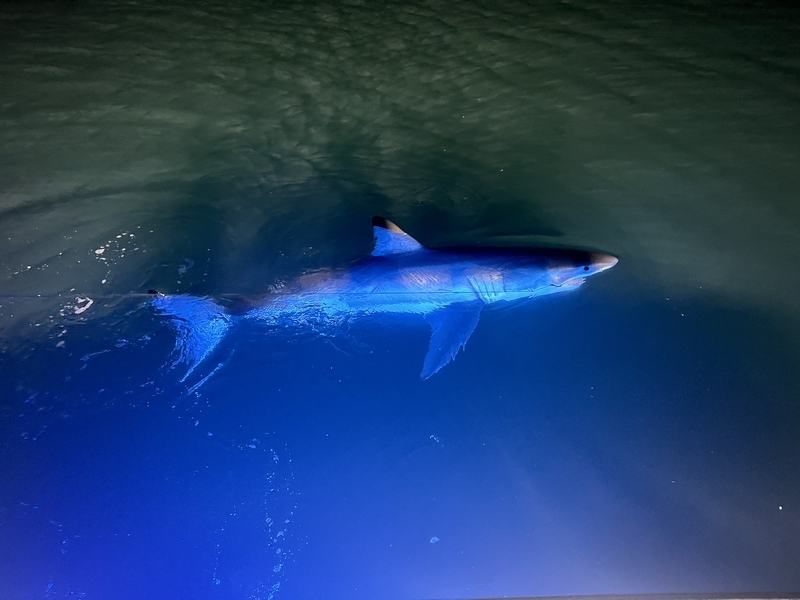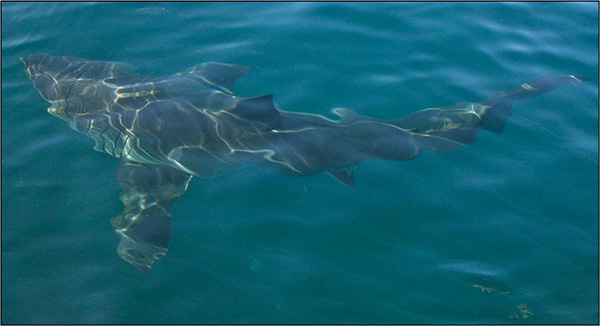
Early August saw a flurry of beach closings as white sharks were spotted near Maine shores. While that news may alarm some swimmers, it turns out this is largely a conservation success story.
That’s according to two experts on the matter: Walt Golet, associate professor of marine science at the University of Maine, who studies the ecology and management of highly migratory species including sharks, and Matt Davis, Maine Department of Marine Resources’ lead shark researcher.
I spoke with Golet and Davis after receiving many questions about these sightings.
White sharks are found worldwide, following their preferred temperature range. While often associated with the California coast, they’ve always occupied the western Atlantic, too, making their way from as far south as the U.S. Caribbean in winter to Atlantic Canada in summer. They can live up to 80 years, and females don’t reach maturity until their 30s. Given that they reproduce so late in life, fishing pressure and other mortality has a big impact on the species.
Prohibitions on white shark fishing didn’t happen until the 1990s. By that time the 1972 Marine Mammal Protection Act had been in place for over 20 years, and marine mammals, an important food source for sub-adult to adult white sharks, were recovering. Over the last 30 years, with no retention of white sharks allowed, their numbers are rebounding.
“The population ebbs and flows according to food resources and mortality, so now you have more food and more individuals are surviving,” said Golet.
The Gulf of Maine is in the middle of several seal rookeries, making it a natural hotspot for white sharks. The Maine coast may also provide important habitat for juveniles. Golet and Davis recently started a collaboration to tag juveniles—sharks under nine feet in length—in nearshore Maine waters, in partnership with researchers from UMass Dartmouth. Pups can be three to four feet at birth; subadults range from nine to 15 feet; and adults can reach 21 feet.
Juveniles eat squid and bony fish like stripers, menhaden, and mackerel. As the sharks become subadults, they transition to eating fatty, more energy-dense marine mammals. Adults are opportunistic, eating gray seals, harbor seals, harbor porpoises, and some other cetaceans, including floating dead whales.
“Most of the sharks tagged off of Cape Cod and the Carolinas are subadults or adults,” Davis explained. “Juveniles aren’t typically found off of outer Cape Cod, so that stage is underrepresented in tagging, especially along the Maine coast.”
Davis often gets asked whether this is the new normal for southern Maine beaches. His response: “It’s just too early to say.” He notes other factors that may contribute to the sightings: “A lot of the sightings are from drones, and we haven’t had a lot of that in previous years. A lot of juveniles are just under the surface, so you can see them from a drone but not from a boat or shore.”
Also, from a visual observation point of view, most of Maine’s 3,500-mile coastline is deep and murky. We tend to see sharks along sandy beaches because it’s possible to see them in the clear water against a light sandy bottom—especially with drones and more people looking. Yet that leaves plenty of coastline where it’s harder to see them.
To get a better sense of their spatial distribution and numbers, Maine DMR began deploying acoustic telemetry receivers which detect tagged white sharks in 2020.
More than 35 receivers now operate from Ogunquit to Lubec, with data updates posted on the state’s White Shark Data Portal.
Davis noted an interesting difference in the perception of the sharks between the east and west coasts. Many Californians surf in the habitat of white sharks without too much concern, he said, while New Englanders more often regard them with fear. I could relate to this. I grew up on Cape Cod and frequented Martha’s Vineyard as a kid, where the first Jaws was filmed. That introduced me to “great whites.”
Nowadays, I manage any nagging fears while boogie boarding these shores by learning more from the shark experts and being aware. I also remember that Davis continues to be an avid surfer in coastal Maine.
Susie Arnold is the senior ocean scientist at Island Institute, publisher of The Working Waterfront. She may be contacted at sarnold@islandinstitute.org.