The waterfront on Little Cranberry Island, aka Islesford, is the beating heart of this remarkable community off the southern end of Mount Desert Island. Lobster boats and their crews come and go from the fishermen’s co-op, ferries arrive and depart, islanders mingle—the place is abuzz.
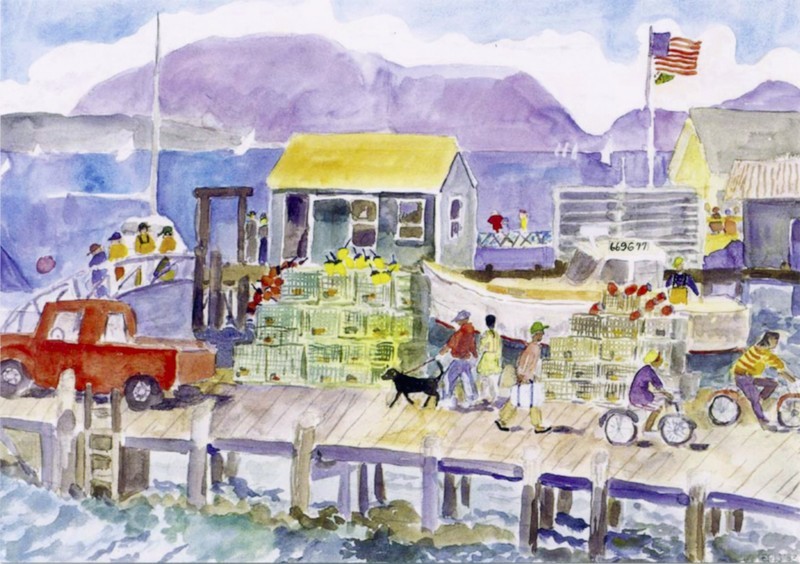
In her lively watercolor “Town Dock,” painted in 1995, Edith Wright (1929-2018) captured those dynamics with a kind of joy. Among the stacks of traps, people walk a dog, ride bikes, traverse the dock ramp, and tend to a lobster boat. The hills of MDI serve as iconic backdrop to the bustle.

A colorful palette heightens the scene, from a red pickup truck parked at one end of the pier, to yellow lobster buoys and roof, to Old Glory waving overhead. Wright brings additional energy to the view through inspired brushwork, in turn quite precise—the boat sports an identifying number, 669677—and abstract, as in the foreground where waves break against the pilings.
Wright and her husband Charles (1928-2022), a doctor, first came to Little Cranberry from their home in Atlanta, Georgia, in the early 1970s, renting the Baldwin house (they also spent several summers with Edith’s sister Dodie Pierce in Northeast Harbor). After taking a few years off in the ‘80s, the couple decided to acquire their own Maine home. In the winter of 1987, they looked at a bunch of places around MDI before returning to Islesford. Hildegarde Ham met them at the dock and showed them Rita Fernald’s house. It was, recounts their daughter Marnie Read, “like coming home.”
Wright had extensive training in art. Born in Boston, she majored in studio painting with Sarah Baker (1899-1983) at the American University art school in Washington, D.C. She continued her art education at Atlanta College of Art where she studied with L. Comer Jennings Jr. (1926–2016). She took workshops with Wolf Kahn, Janet Fish, and Charles Reid and was a member of the Georgia Watercolor Society (she also painted in oil). She showed her work in the Atlanta area as well with Kate and Dan Fernald at the Islesford Artists Gallery.
For a time Wright worked in the photo lab at Life magazine where she once accidentally cut in half each image in a roll of film taken by famed photojournalist David Douglas Duncan. She also had positions at the Whitney Museum of American Art in New York City and the Philips Collection in Washington, D.C.
Have paint, will travel: that was Wright’s MO. She took along painting supplies on trips to the Yucatan, Egypt, Italy, France, and Spain, as well as the north Georgia mountains and the Okefenokee Swamp. She had a special love for gardens.
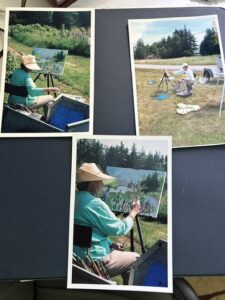
Wright’s daughter describes her mother’s painting routine on Islesford as leisurely. She worked plein air, wandering the island in a golf cart in search of a motif. Seated in a folding chair in front of a small easel, she would take up her brush and begin composing. She also had a studio in her house.
Wright interacted with fellow island artists, including Ashley Bryan, Marian Baker, Mark Howard, Peter Rudolph, and Henry Isaacs. She also added to the art scene by hosting her “painting girls,” a group of Atlanta women she had met in painting classes and invited to the island. “They had a ball,” Read relates. “Folks on the island still talk about those gatherings.”
Wright found a muse—and a welcoming community—on Islesford. Her love of this summer retreat lives on in her bright and lively paintings.
Carl Little curated Francis Hamabe’s Maine: A Life in Art for the Castine Historical Society (through Oct. 12, 2026). His article on how two vintage Steinway pianos ended up on Sutton Island appears in Island Journal.