“I am particularly fond of the Impressionists,” painter Carol Sloane noted in an email exchange. “Their view of life resonates with me,” Sloane wrote, “how every time we look at something it seems to transform.”
Sloane seeks a similar impression of the world when working around tidal water and in her plein air landscape painting. She spends time watching shadows move, rocks emerge and submerge, and “observing light getting brilliant, then rosy, then dusky.”
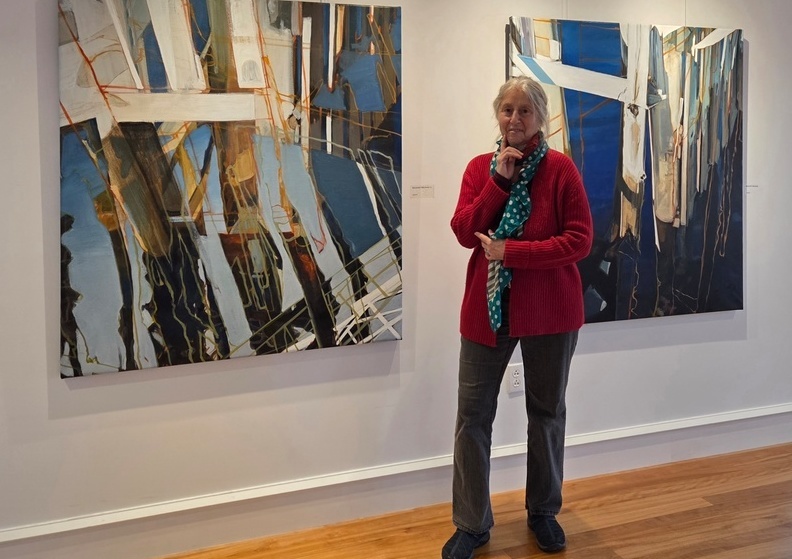
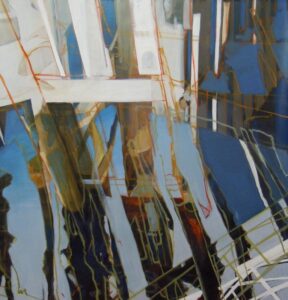
Her “Belfast Pilings” series exemplifies Sloane’s endeavor to evoke that experience of a shifting landscape. The pilings that support the city’s pedestrian bridge, she explained, are in fresh and salt water, exposed and then hidden depending on the tides. By painting them at different times using overlapping images, she achieves the effect of movement and circulating water. She also creates a dazzling abstract composition.
Sloane came to Maine, to Montville, in 1972, five years after graduating from Skidmore College with a bachelor’s degree in art. As noted on her website, she wanted to live in the country “more than she wanted a career in art.” She raised sheep, cultivated a large garden and sewed at the Leather Bench in Camden.
Sloane eventually started her own business making fabric handbags. She marketed her work for many years through Perspectives, a fine crafts gallery in Camden, and at craft shows around the country. In 1994, wishing to leave the consumer-oriented life and work instead “in a more abstract world,” she became obsessed with a desire to paint again.
That obsession gained momentum through six winters at the renowned Art Students League in New York City in the 1990s where Sloane studied painting with Ken McIndoe and Leatrice Rose. She drank in the city and its culture, visiting galleries and museums. She also benefitted from several artist residencies, including a six-week Carina House stint on Monhegan in 2002.
In 1992, Sloane moved to Washington, Maine, where she helped establish an art hub. She was a founding artist of the Downtown Gallery (1995-2012) and a member of the Gibbs Library Art Committee. In 2017, she moved to Rockland, where today she gardens on a more modest scale but with “great enthusiasm” and continues to follow her muse.
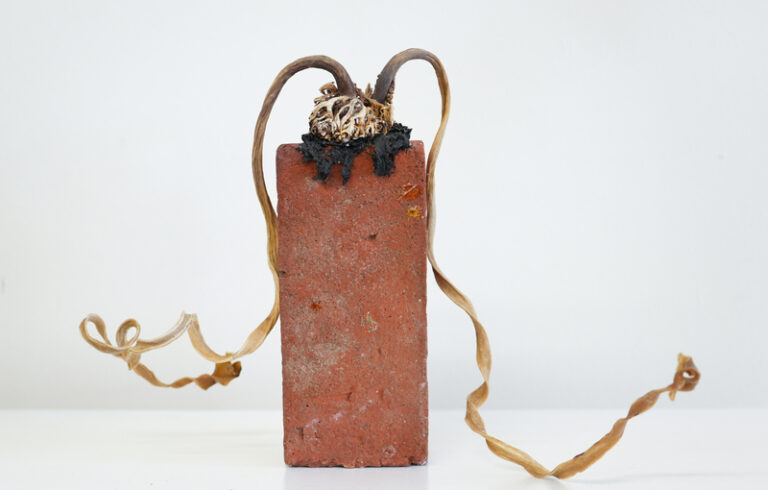
Sloane’s studio is a “jumble.” She collects things—dolls, pitchers, flower seeds, and kitsch—that catch her fancy and may be painted later. During a recent winter, she tried painting over old canvases as a way of “mining languages and memories” and compressing her “visual diary experiences.”
Sloane is a member of the Midcoast Salon, a group of artists who meet monthly via Zoom to share projects and discuss topics, like one last winter titled “Aging Artists: Challenges in Living and Legacy.” She finds it an engaging way to interact with other working artists.
“I experience a certain recklessness when I consider the enormity of our three-dimensional landscape,” Sloane has explained, “and work to place a small part of it onto a two-dimensional surface with paint.” She wants to create “a sensation of a place rather than a clear representation.” Her Belfast pilings paintings attest to the success of that admirable mission.
Sloane has shown at the Caldbeck Gallery, the Craignair Inn in Spruce Head, Thos. Moser in Freeport, the Maine Coastal Islands National Wildlife Refuge Visitor Center in Rockland, and the Portland Public Library. You can see more of her work at www.carolsloanemaine.com.
Carl Little is curating Francis Hamabe’s Maine: A Lifetime in Art for the Castine Historical Society this summer. He contributed a chapter on photographer George Daniel for Fire Island Art: 100 Years, from Phaidon.