If you live on or near an island shoreline in the Casco Bay region, you may have already heard about a local group of volunteers who have been working hard to raise awareness about coastal erosion and related climate vulnerabilities to our islands. This collaborative group now includes representatives from Great Diamond, Little Diamond, Long, Chebeague, and Peaks islands.
Five years ago, Tracy Sommers from Great Diamond began a local campaign to educate her community about the dangers of sea level rise. Early on, she saw the value of collaborating with local nonprofits and state experts. The heavy storms in the winter of 2023-2024 brought a new urgency to the group’s mission.
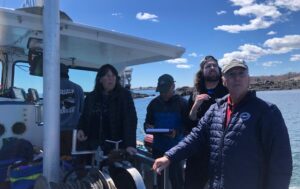
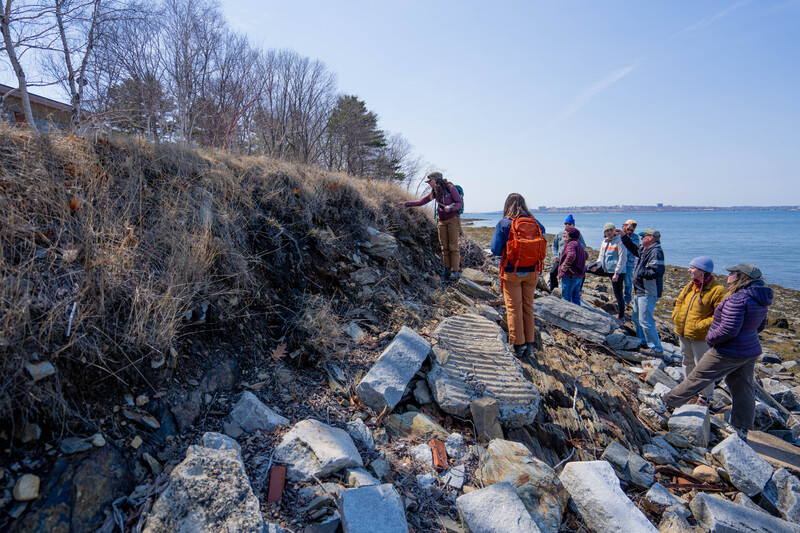
You may have seen the Calling Your Bluff series: a webinar introduction to bluff erosion followed by a day-long symposium at the Gulf of Maine Research Institute (GMRI). This event brought together residents and experts from across Maine, including the Maine Geological Survey, the Department of Environmental Protection, GMRI and Island Institute. Thanks to a state coastal community grant, these events were professionally recorded and made available on Greater Portland Council of Government’s YouTube channel. This grant also funded two other successful projects: an online “toolkit” that compiles available resources, and island-specific community conversations to discuss climate resilience priorities.
For more information on the Calling Your Bluff toolkit, please visit https://www.islandinstitute.org/calling-your-bluff-toolkit/.
As Tracy explains, “We learned very early on that working beyond GDI—building relationships and partnerships across islands—was essential to advancing knowledge and action at home. These connections have created opportunities for shared learning, expanded community engagement, and access to resources that would not have been possible working in isolation. Just as importantly, this broader collaboration has strengthened our relationship with the City of Portland, helping to align island-led efforts with city and regional priorities, and creating a more coordinated approach to resilience across Casco Bay and ultimately to our island.”
The Casco Bay Island Climate Collaborative (CBICC) formed in 2025 to bring together volunteers from the GDI Partnership, the municipalities of Long and Chebeague, and the city islands of Peaks and Little Diamond. This group is moving forward with new educational content to advance knowledge and encourage action on each island. For example, in the fall of 2025, Island Institute hosted a workshop on Little Diamond to showcase the nature-based solution designed and implemented by local volunteers to mitigate erosion at the ferry pier and beach, and to rebuild the dune.
The Collaborative is now partnering with Island Institute and Portland’s sustainability office to create new programming entitled “Beyond the Bluff.” Thanks to a public-private partnership (a Casco Bay Estuary Partnership grant to Portland and the generosity of a GDI homeowner), a workshop will be held this August to highlight upland bluff management strategies to mitigate shoreline erosion. Over the past several years of working together, Collaborative members have found that although their communities are different in some ways, they share many of the same concerns for the future.
“We all care so much about our respective islands. Through the Collaborative we have each learned so much from each other that we can then take back to our own islands,” notes Ellen Grant from Little Diamond. “LDI has benefitted from learning of climate problems and solutions executed by other islands, and they have learned from our experiences. The CBICC has been an enriching and productive connector for Casco Bay islands.”
By partnering across island communities, the group has expanded the reach of its education efforts while strengthening its competitiveness for grant funding. This spring, a grant awarded to Island Institute by the Casco Bay Estuary Partnership is supporting work on five islands, where residents are exploring practical solutions to shoreline challenges.
As part of the initiative, Emma Polhemus, a Maine Conservation Corps member hosted at Island Institute, is conducting site visits on each island, assessing three shoreline properties per island. These assessments will use Maine DEP’s OUR SHORE guide to provide homeowners and members of the Collaborative with detailed reports outlining site conditions, recommended next steps, and potential nature-based stabilization strategies.
To extend these findings to a broader audience, Island Institute in partnership with Portland and island leaders is hosting a webinar in May highlighting key issues and showcasing recommendations drawn from one representative site on each island.
Working together, the group has discovered not only greater capacity to reach more residents, but it is also more effective and efficient. Tracy says, “A big part of [our] progress has been creating a space where our community is heard and taken seriously. We’ve helped bridge that gap and shift the mindset from frustration to participation—moving from ‘why isn’t something being done?’ to ‘how can we be part of the solution?’
“That’s the shift—from frustration to shared responsibility—and that’s what I’m most proud of.”
Beth Mackey is a resident of Great Diamond Island and a member of the Casco Bay Island Climate Cooperative.