Last summer I finally succumbed to sailboat ownership after decades of heroic resistance. I’ve sailed my whole life, but always on boats owned by other people, which is the best kind of boat. I had just returned to the island after months hiking the Appalachian Trail in the claustrophobically forested southern mountains, and Casco Bay’s cool, sparkling waters were at their most alluring when my alleged best friend informed me of a free sailboat that I ought to “take a look at.” The Universal Boat Distribution System had cast its gimlet eye upon me.
Still, I resisted. There’s nothing more expensive than a free boat, and my first inspection revealed a 1977 Cape Dory Typhoon that had sat in the woods for eight years and was currently full of water. I sighed in relief at a narrow escape. But my increasingly culpable friend told me to look again, and with closer inspection I had to admit that the deck and cockpit sole seemed very sound, and the woodwork, though it would never be beautiful, did appear firmly attached and sturdy enough. Aside from draining and swabbing out the cabin, it didn’t seem to need any urgent repairs.
So I called the owner, who informed me that the boat was certainly not free, and that pretty much sealed it. For free, this was a very questionable boat. But for $1,500 it was a great deal. All the sails and spars had been stored indoors, and all the bits and pieces were present and accounted for. My tenure as a boat owner had arrived. I delayed every upgrade that could possibly be delayed and managed to spend more time sailing than working on the boat, which is as close to winning as you can get in the fundamentally losing proposition of boat ownership.
One afternoon in July, I was lounging at the mooring after a sail when I saw a Catalina 27 motoring in toward the vacant mooring next to mine. It was helmed by a man in his twenties and crewed by a woman of about the same age. They both displayed a refreshingly unstudied approach to their tasks—a genuine beginner’s mindset, without the weight of orthodoxy or received technique. After overrunning the pennant several times they traded jobs and nearly got the pennant wound up in the propeller. They seemed on the precipice of discovering an exciting new way to pick up a mooring, but regrettably I had to row back to the dock before I found out whether they did.
That Catalina had the look of a free boat if I ever saw one. Scuffed topsides, always a bumper or two dangling from the lifelines, bits of line flopping this way and that as it rolled in the incessant chop in Diamond Pass. The canvas on the headsail and the mainsail cover were green, but not the nice green you’re imagining. The other kind of green. On Labor Day weekend, the owner and some friends sailed it in the TEIA Club’s annual race around Peaks Island, and then managed to wrap the jib inside out, which I wouldn’t have thought possible. I know it didn’t leave the mooring again all season, because that jib remained mis-furled for the next month.
I took my boat out of the water early in October, as I prepared to finish the southern couple hundred miles of the A.T. with my son Mica and his boyfriend Christian. I was taking the sails off the Typhoon and getting ready to lower its mast when I noticed that the Catalina was riding strangely at the mooring. The boot stripe was underwater at the bow, and I could see more of the stern than was seemly. I rowed over and observed that the boat was full of water inside, a good six inches above the cabin sole. A pair of canvas sneakers drifted about as it wallowed. I sent some pictures to my boat-recommending friend, who also oversees the mooring field, and he said he’d contact the owner.
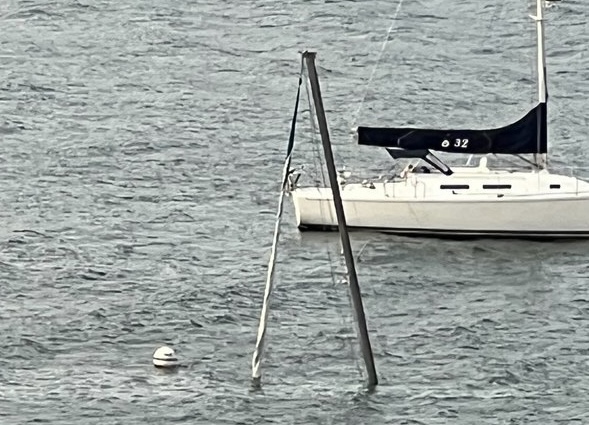
In case you’re not a nautical expert: six inches of water above the floor of a sailboat is a catastrophe that demands immediate action. In maritime lingo, we boaters refer to it as “sinking.” So I was very surprised to get a text from my friend two weeks later, just after I had finished telling this tale as we hiked through the Smokies. The text read “This was the inevitable conclusion:” above a picture of the top few feet of a mast with its instantly recognizable mis-furled jib poking out of the water. It cost the owner $5,000 to get it salvaged and hauled to the dump, because there’s nothing more expensive than a free boat.
Rusty Foster lives on Peaks Island and writes the email newsletter Today in Tabs. He can be reached at rusty@kuro5hin.org.