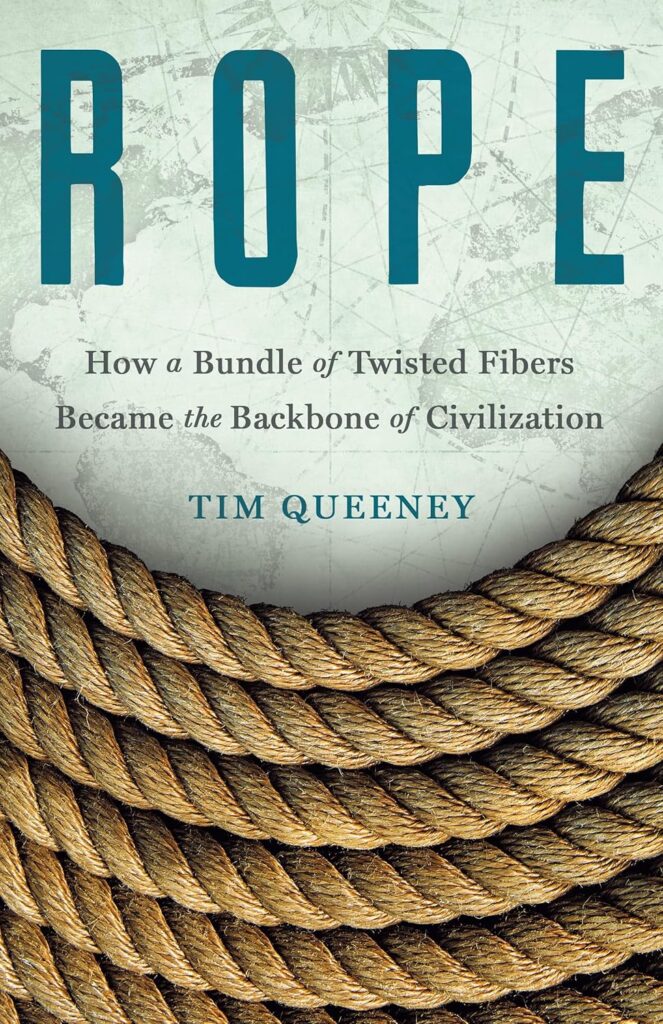
Clipper ships, splices, knots, cowboys, pyramid-builders, bridge engineers, tightrope walkers, executioners—this book has them all. Like Salt, Cod, and other thoroughly researched books about familiar things and their many lives, Rope considers the bundled and twisted combinations of plants, metals, and synthetics we humans all use to keep our world running—or standing, as may be the case aboard a sailing dinghy or a full-rigged ship.
Metal rope? Sure: recall the twisted cables we use to support suspension bridges or the stays that keep a mast standing. Rope for what the New York City police department considered a criminal enterprise? Of course … consider the French high-wire artist who crossed between the twin World Trade towers three decades ago, several times in broad daylight before being arrested—and before those towers fell in a terrorist attack. (Setting the tightrope in place for the stunt, in case you’d like to know, involved a bow and arrow, monofilament line, and a naked man; if you’re still curious, read the book.)
Rope played a major role in the laying of the first transatlantic telecommunications cable, both in the manufacture of the cable itself and the long ropes used to find and retrieve it when it broke, deep in the Atlantic Ocean off Ireland.
Author Tim Queeney, a Maine resident who formerly edited Ocean Navigator magazine, connects his own longtime fascination with rope, knots, and the many things one can do with them to his own father, with whom he often sailed small boats. “Like many men of the World War II generation, Dad was not comfortable talking about his inner struggles,” Queeney writes in an introduction. “He definitely didn’t chew them over with me.” If they spoke about knots, Queeney doesn’t say. But he concludes, many years later, after going through a crate of his father’s old ropes (two of them joined together with a sheet bend) that this knot “meant something more important to me than merely the joining of two lengths of rope—the knot had existed because my dad had tied it—I have no proof, but I like to think that somehow my dad tied that knot for me.”
A gift or a life sentence? Depends on one’s perspective. For Queeney, those father-son sails morphed into a maritime career, not to mention all the research required to produce a book like Rope. He begins with prehistoric archaeology, from cave dwellers in Europe chasing and trapping wild animals to ancient Egyptians building pyramids, both using twisted fibers or earlier approximations like vines. His book unfolds in a series of chapters (Queeney entitles them “strands”) on topics such as stitching together skins to make boats and dragging huge blocks of stone up ramps.
And on he goes, through obvious things like fishing (lines, nets); executions (hangman’s knots, etc.); mountain climbing; rope tricks; cathedral-building; kids’ skip ropes; to the fantastic and futuristic, from theatrical tricks to an imagined “space elevator.”
“The technology to build a space elevator is tantalizingly close,” Queeney states in one of his later strands. “According to its most fervent adherents, the major technological problem of the tether, a rope so fantastically strong as to invoke the fabled Indian rope trick (see page 237 in the book) is within humanity’s grasp.”
With all its detail, this is a very readable book. An author with prodigious research skills—Simon Winchester comes to mind—can produce an unreadable text if they’re not careful, or isn’t edited with the reader in mind. Winchester did just that in Atlantic, which I’ve never finished. Mark Kurlansky, author of Salt and Cod, falls at the opposite end of the readability spectrum. So does Tim Queeney. Pick up Rope, details and all, and you won’t be disappointed.
I’m not certain, but I think the combination of good writing, fascinating anecdotes, varied focus—and yes, the details—make Rope a book you won’t want to put down.
And just in case you’re interested in his fatherly sheet bend, Queeney ties up that loose end in a brief epilogue: “The rope knotted by my father’s hand still hangs on my wall,” he writes. “I think I’ll leave it right there.”
Rope: How a Bundle of Twisted Fibers Became the Backbone of Civilization
By Tim Queeney (2025, St. Martin’s Press)
David D. Platt is former editor of The Working Waterfront.