A new teaching and research vessel at the University of Maine’s Darling Marine Center is expanding student access to the largest ecosystem on Earth: the open ocean.
The new 45-foot vessel is the biggest in the center’s fleet. Previously used as a commercial tuna fishing platform, it will support student training, faculty research, and workforce development within the School of Marine Sciences and Maine Agricultural and Forest Experiment Station.
With docking stations at both the Darling Marine Center and in Portland, the vessel will give students and faculty improved access to offshore waters throughout New England, from the Gulf of Maine to Rhode Island. It has considerable range, able to travel up to 100 miles offshore, cruise at 18 knots and carry 700 gallons of fuel.
“A tenet of my teaching philosophy has always been learning by doing,” said Walt Golet, UMaine associate professor of marine science. “This vessel will serve as the perfect platform for our students to do just that.”
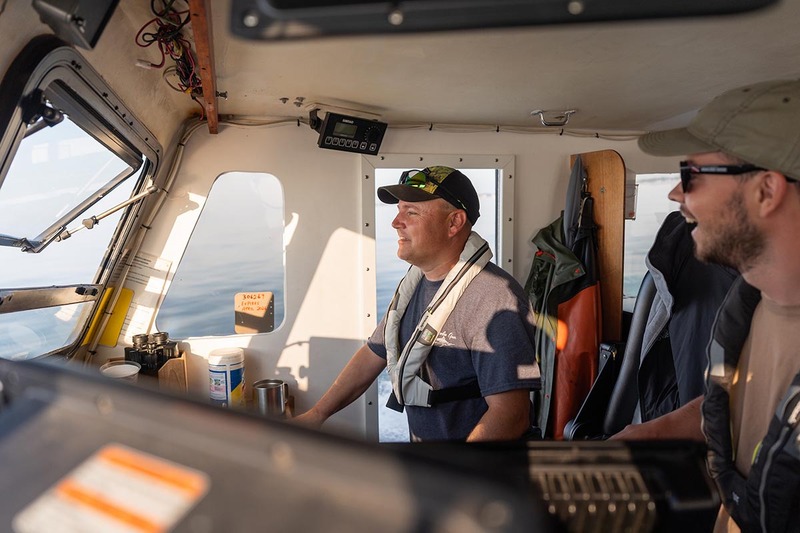
Depending on the fieldwork, classes of up to 20 students or more can participate at once. Equipped with specialized safety equipment, a fully enclosed wheelhouse, an onboard generator, a heating system, and a small galley, the boat is designed for extended trips and comfort, even in challenging weather. It also has two large bait wells, living quarters with four bunks, a head, a roof top crane, a pot hauler, and a tuna door that can be used to bring large fish onboard for tagging or serve as a dive entry point.
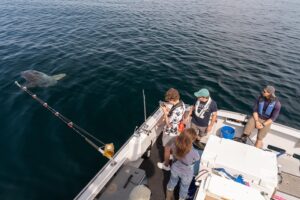
Golet has already been using the vessel for several courses. The boat’s platform allows students to tag fish and collect data that help track their movements and collect data for fisheries management. Golet, who leads the Pelagic Fisheries Lab, is using the vessel to conduct his research on Atlantic bluefin tuna, billfish, sharks, and other large migratory species and bring students onboard to participate.
Students also assist with deploying gear and learn safety protocols for handling animals, as well as basic vessel and navigation skills.
In addition to shark and tuna tagging projects, the vessel will support marine mammal and seabird surveys, fisheries research, and other offshore studies. It will also enhance courses included in UMaine’s Semester by the Sea program, which brings students from the Orono campus to the coast for an immersive marine science education.
The vessel was gifted by an anonymous donor who has a passion for cooperative research and education and sought to create more opportunities for UMaine students to experience the ocean firsthand.