Born in Bar Harbor, Paul Trowbridge grew up in Maine in the summers. He had, he writes, “a real affinity for boats and the docks that came with them.” His parents spent 10 years on Crow Island off Deer Isle, coming and going by way of the lobster dock at Sunshine (his father, writer Clinton Trowbridge, turned the experience into a book, The Crow Island Journal, 1970, illustrated by his wife, Lucy Reeves Trowbridge).
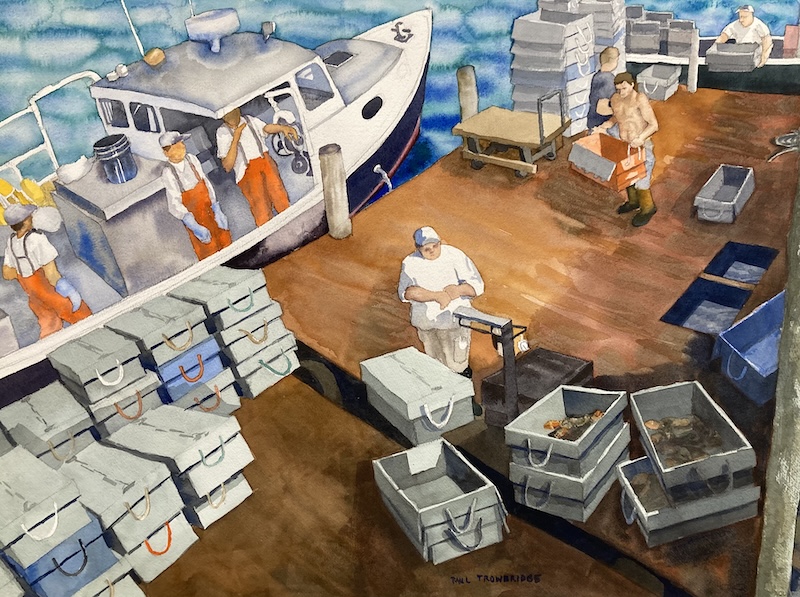
That landing is the setting for Trowbridge’s watercolor “Dockworkers.” Three lobstermen in Grundéns converse on their boat while others bear crates here and there. A man in a surgeon-like white outfit weighs the catch. The painting, Trowbridge writes, “is about respect for what the lobstermen do and an appreciation of the shapes and colors of boats, docks, and figures.”
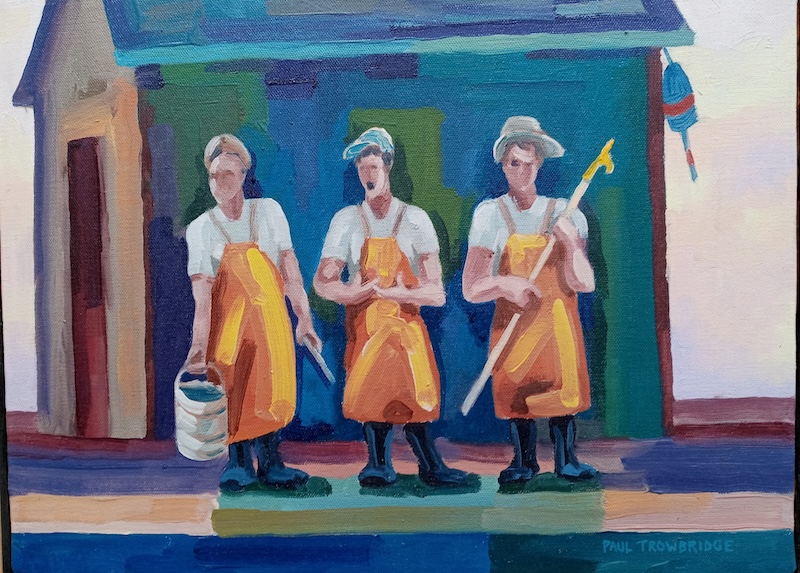
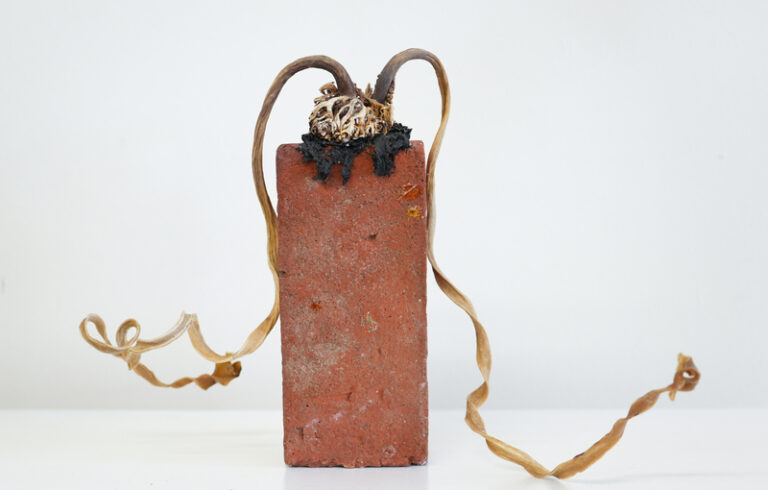
A similar trio of orange-aproned lobstermen takes center stage in “Three Musicians II.” Trowbridge based their bearing on African sculptures he had studied, incorporating the shapes into “the local vernacular.” He borrowed the title of this “humorous conceptual piece” from Picasso. He also credits Stephen Pace’s paintings of Stonington fishermen for seeking more simplicity in his work.
Growing up, Trowbridge was always interested in art “to some degree.” He earned a bachelor’s degree in creative arts at Principia College where he studied with watercolorist James Green (1911-2005), who shared his technical expertise and emphasized “practice, practice, practice.”
Later, at the School of the Museum of Fine Arts, Boston, Trowbridge took a course on contemporary art. His teachers traveled to New York City every few weeks to take pictures at galleries, which they would then share with their students in slide shows. “We saw Ellsworth Kelley, Frank Stella, and others, pop artists, minimalists, and conceptualists,” he writes, adding, “The ideas were fast and furious.”
At the University of Memphis, Trowbridge took art history courses while ensconced in a large studio where he focused on figurative dance studies. That three-year stint—culminating in a Master of Fine Arts degree in 1990—was the first time he felt respect for his place in the art world.
Returning to Maine in the 1990s, Trowbridge vowed to fit in with a culture that tended to disdain outsiders. While working as a carpenter, he fought for every opportunity to paint. Lucky for him, his wife Jennifer had a career in dance and was “sympathetic to art-making even though the bank account didn’t do well.”
“After grad school and the heady atmosphere of ‘what is real art?,’ ‘what is relevant?’ ‘what is sentimental tourist art?,’” Trowbridge recalls, “I felt a little guilty painting boats, harbors, and quaint villages.” While appreciating those big questions, he believed in “an authentic quest, an honest pursuit” that would lead to “the real stuff.”
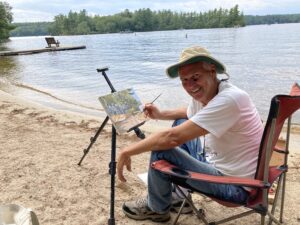
Painting plein air, Trowbridge grew familiar with coastal motifs. In his studio in winter, he could “push” an idea. Working in series became his habit. “I would make progress by doing many versions and takeoffs from an original idea,” he notes. He cites Cézanne’s paintings of Mont Sainte-Victoire as an inspiration.
A recent series exemplifies this process—and Trowbridge’s love of the landscape. After learning that a developer planned to build nine homes on the Salt Pond blueberry barrens at the Blue Hill-Sedgwick line, he made nine paintings “to commemorate and celebrate the land and to protest the loss of the iconic view and natural habitat.” The paintings, shown at the Turtle Gallery last summer, highlight the beauty of the 38 acres accented with glacial erratics that look to him like “a natural Stonehenge.” A percentage of the proceeds from the sale of his paintings went to support a buy-out of the land, which the community successfully negotiated.
Trowbridge has worked in animation with Noel Paul Stookey in Blue Hill, taught watercolor at the WoodenBoat School, and shown his work at many venues on the Blue Hill peninsula and beyond. Recently the Sedgwick-based artist has been attending a drawing group at the home of Deer Isle painter Erik Meijer. Once intimidated by portrait painting, he is starting to enjoy the challenge, “seeing the face as a miniature landscape.”
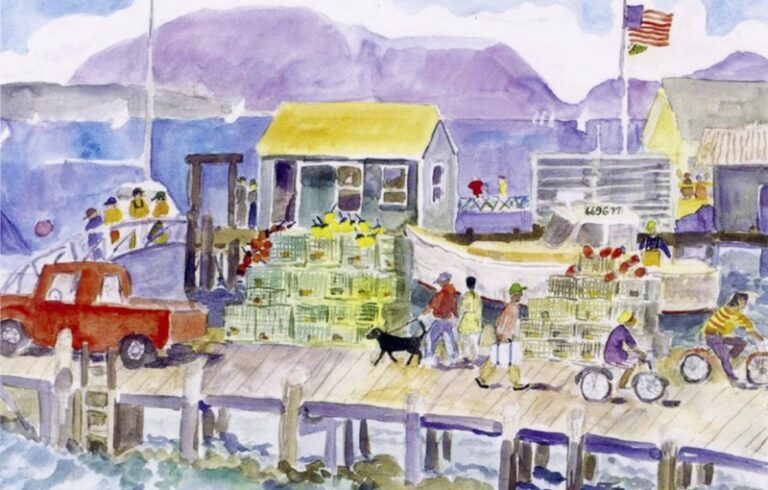
After a conversation with his mother last year, Trowbridge began working on a version of a painting she did of Burnt Cove on Deer Isle. He has simplified the subject, emphasized the color, and given more illusion of distant space. “What a fun way to communicate,” he writes, as he contemplates spending inordinate amounts of time this winter “thinking, editing, applying paint with a brush and so forth,” in search of the “real stuff.”
Carl Little’s recent publications include a profile of poet Gary Lawless in the Island Journal and a feature on Ellen Windemuth’s jewelry in Ornament Magazine.