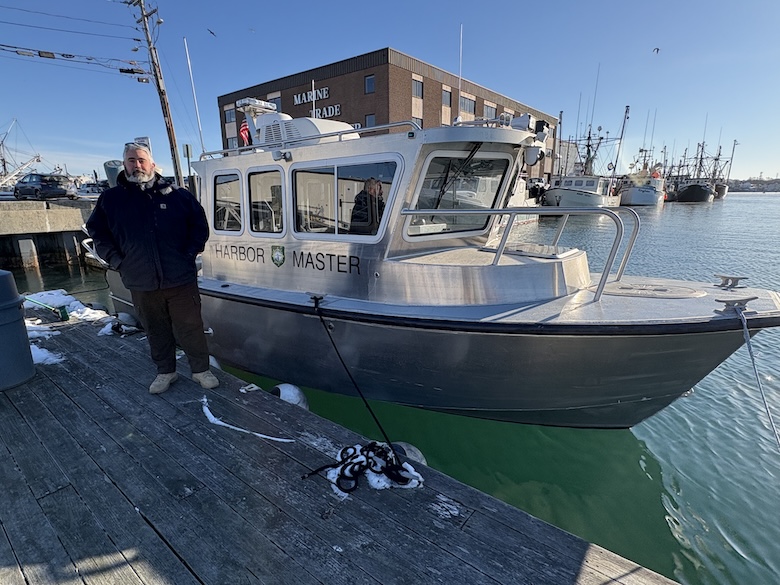
Maine’s busiest and most diverse port has a new harbormaster as well as a new, 25-foot vessel for his office to use.
Paul Plummer started as the Port of Portland’s harbormaster in mid-November after eight years in the same role in Harpswell. On the surface, Harpswell and Portland might appear to be opposites, but Plummer said the two ports have many similarities.
In Harpswell, Plummer oversaw some 2,400 moorings and 216 miles of coastline while managing growing administrative responsibilities. He worked with multiple and varied constituencies and dealt with issues such as abandoned and derelict vessels.
In his new position, his overarching responsibilities will be much the same, Plummer said during an interview in his waterfront office. He will oversee 860 registered moorings while taking on administrative responsibilities, working with multiple constituencies, and handling issues like abandoned vessels.
“Coming from Harpswell, we had pretty much everything Portland has except cruise ships and tankers,” he said.
Plummer, who is 39, has spent most of his career on the waters and shores of Casco Bay. He grew up in Freeport and was the marine warden and deputy harbormaster in Brunswick from 2010 to 2017 before assuming the Harpswell role. He now replaces Kevin Battle, who retired after 10 years as Portland’s harbormaster and more than 10 years as deputy harbormaster before that.
In Portland, Plummer oversees safe navigation and operations within the waters of Portland Harbor—Portland on one side, South Portland on the other, multiple islands offshore.
The port sees many competing uses, from small recreational powerboats and sailboats to huge cruise ships and oil tankers. It’s home to scores of fishing boats, container cargo ships, and ferries that serve Casco Bay’s islands. It also hosts large events such as the annual Peaks to Portland swim, lobster boat races, and Fourth of July fireworks.
“I think the biggest thing for today’s harbormasters, especially in today’s age, is conflict mitigation,” Plummer said. “We have shared use of the waterfront and try to mitigate those conflicts. Putting out small fires everywhere is part of the day-to-day operation of a Maine harbormaster.”
Plummer’s experience and his calm, professional demeanor make him an ideal fit for the job, said Will Owen, the Yarmouth harbormaster and president of the Maine Harbor Masters Association. The association represents over 140 waterfront municipalities from Kittery to Eastport that have harbormasters.
“He knows where he’s coming from both on the administrative level and functionally on the water,” Owen said. “I’m very happy to keep him in Casco Bay and working a couple of towns over; instead of to my left, he’s now to my right.”
Plummer works out of a first-floor office in the Marine Trade Center on the Portland Fish Pier, which he shares with his administrative assistant and a deputy harbormaster, Hattie Train. Berthed outside is the new 25-foot aluminum harbormaster vessel powered by twin 250-hp Mercury outboards. It was built by Lyman-Morse Workboats in Thomaston and launched last fall.
Most of the state’s full-time harbormasters are in southern Maine, below the Kennebec River, Owen said. Through the years, a growing number of towns have seen the importance of having a full-time person in charge of enforcing regulations and overseeing the waterfront. In some places they belong to the local police department, whereas in others they are standalone offices, such as in Portland Harbor.
Harbormasters in coastal communities east of the Kennebec River are more likely to be seasonal or part-time, Owen said.
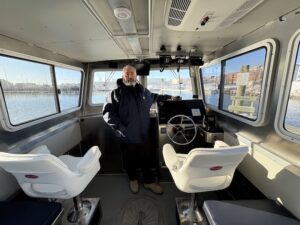
No matter where they’re located, harbormasters have taken on added responsibilities, much of it administrative. Plummer guesses that 75 percent of his job in Portland will be administrative.
One “continuing and growing problem” Plummer is prepared for is the uptick in the number of vessels abandoned along the Maine coast in recent years. His predecessor had to deal with it in Portland and Plummer has first-hand experience with it from his time in Harpswell.
Last year, the Coast Guard removed the 83-foot motor vessel Jacob Pike from the waters of the New Meadows River in Harpswell, where it sank during a winter storm two years ago. The vessel was built in 1949 but had been long retired from its original use as a sardine carrier.
The question about the Jacob Pike and other abandoned vessels is who ends up paying for their removal. When removing the Jacob Pike, the Coast Guard said it would bill the owner for the cost, which could exceed $300,000. Plummer worked with the Coast Guard during the process.
Plummer said he and the vice president of the Maine Harbor Masters Association have been talking with a state lawmaker about developing legislation that would somehow force or encourage boat owners to foot the bill for removal costs of derelict boats. As it now stands, owners can plead guilty in court to a misdemeanor crime of abandoning a vessel and simply pay a small fine, leaving it up to local municipalities to pay for the removal costs, he said.
For now, he’s focusing on building relationships as he gets to know the wharfs, marinas, and officials in the two cities and with agencies such as the Coast Guard and Marine Patrol.
“The running joke I tell people is—and it may not be as applicable here in Portland Harbor because there are more resources—is that harbormasters are really police, fire, and public works on the water. All three and then some,” he said. “Whatever comes up, it typically gets thrown on you first and then you have to delegate. ‘Do I need to call the Marine Patrol? Do I need to call the Coast Guard? Do I need to call the fire department?’ It usually starts with you.”
Clarke Canfield is a former reporter for the Portland Press Herald and the Associated Press. He lives in South Portland.