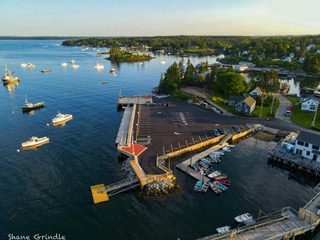
Many people and organizations in Maine, including the publishers of this paper, have rightfully sounded the alarm about the loss of working waterfront along the coast. What is obvious is that Maine’s coast has become a very desirable place to live, and many fishing families have been displaced from shorefront access. This is the story of one town’s efforts to save that access and working waterfront.
St. George, which includes Port Clyde, has seen its share of working waterfront shrink over the years. Just over a decade ago, the peninsular town had a mere 183 feet of public access to its largest asset, the Atlantic Ocean, upon which many residents depended.
In 2014, when the property next to Port Clyde’s public landing became available, the town recognized it as a once-in-a-lifetime opportunity to protect a deep-water piece of working waterfront. The harbormaster at the time, Dave Schmanska, asked the owners whether they’d consider selling to the town, after they previously donated the site of the existing landing, which was outdated and impossible to expand. They agreed to sell at a discount, and the town went to work.
Most of that work fell to the Harbor Committee, which I chaired at the time. We first held public informational meetings, initially to ask the town to purchase the property, and later for a rehabilitation plan to build a new landing. We stressed the need for preserving working waterfront. Subsequently, voters agreed to spend $800,000 to purchase the property, and later to issue a $2.6 million construction bond, which added $25 to the average annual tax bill.
We hired firms to assist us with communications, planning and, perhaps most importantly, getting permits from the state and U.S. Army Corps of Engineers.
We planned to run new sheet steel from a wharf that was in good shape across one that needed repair, creating more usable space but requiring a permit to fill two small coves.
We were surprised to hear at our meetings from non-fishermen who particularly valued watching fishing boats coming and going, bringing in fresh seafood that they could enjoy.
By around 2019, we’d obtained permits and went to choose a contractor, but were surprised to learn that soaring construction costs had put the plan beyond our original estimate.
We needed to find more money or scale back the project. The latter wouldn’t save much and would go against voters, so we decided to apply for a federal grant.
First, we unsuccessfully applied for a grant with a 60-40 split between the feds and the town. We’d sought letters of support and application assistance from other entities like the state Department of Marine Resources and Island Institute.
We were encouraged to reapply and started back up around the arrival of the pandemic, which stalled things for the better part of two years but eventually led to new grant opportunities aimed at re-starting the economy. One of them fit our project well, offering an 80-20 split.
We reviewed our plans again and sought assistance from Maine’s congressional delegation, including Sens. Angus King and Susan Collins. They provided invaluable help and our application for $4.8 million dollars was approved in 2022.
Of course, these grants come with strings and most steps from that point on required federal approval. The town retained a consultant and engineer to oversee construction and ensure the town got what it paid for. Fortunately, a member of our committee had useful previous experience in commercial building and was knowledgeable about contract requirements.
Each change resulted in either a credit or, more often, an extra charge, all needing to be negotiated with the contractor. It’s easy to rack up thousands in extra charges when straying from the original bid. Our largest change order created an extra $500,000 in costs, as we tried to remove a huge rock that our surveys had called ledge, 20 feet below the mud line. We also recognized the importance of clear lines of communication with the contractor.
As the project dragged on for years, we sometimes faced questions and criticism from the public about it. Some meetings brought frustration and second-guessing about what we were trying to do. At times social media would fill with misinformation and rumors, mostly from people who rarely, if ever, attended our meetings. The committee released periodic updates, but we learned that detractors are gonna detract.
Finally completed in 2025, the project has enhanced the working waterfront and increased shore access for everyone. It turned out very well, and many of the town’s residents and visitors seem to think so. While we thought we had plenty of money going into this, we ended up spending most of it in the end. The town and several organizations have even used the site for a fundraising concert—not something we originally envisioned, but nonetheless, a beautiful shorefront spot for locals to take advantage of.
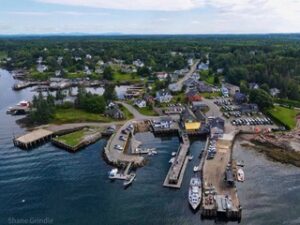
In the area where the general store burned, the facility has helped to bring people into the village of Port Clyde. A grassy elevated area above the dock has attracted many to just enjoy the view, watch the lobster boats come and go, and perhaps spend some money locally. It provides more parking and a safer traffic pattern in a highly congested area. The docks are being used for kayak rentals, islanders, charter boats, and transient boats that all can tie up to over 100 feet of new floats. Lobster fishermen have used the commercial dock and float. Two new hoists are available, along with a new year-round launch ramp.
We knew the project would take years, but none of us expected it to be a decade-plus and require hundreds, if not thousands, of volunteer hours. We dealt with some extraordinary circumstances that could not have been predicted.
So, for those of you who might be contemplating saving some working waterfront in your own town, this may be a cautionary tale. But in the end, our new landing was worth the trouble.
Dan Morris is a lobster fisherman and former member of the Maine Marine Patrol. He grew up in Port Clyde and previously led the St. George Harbor Committee.