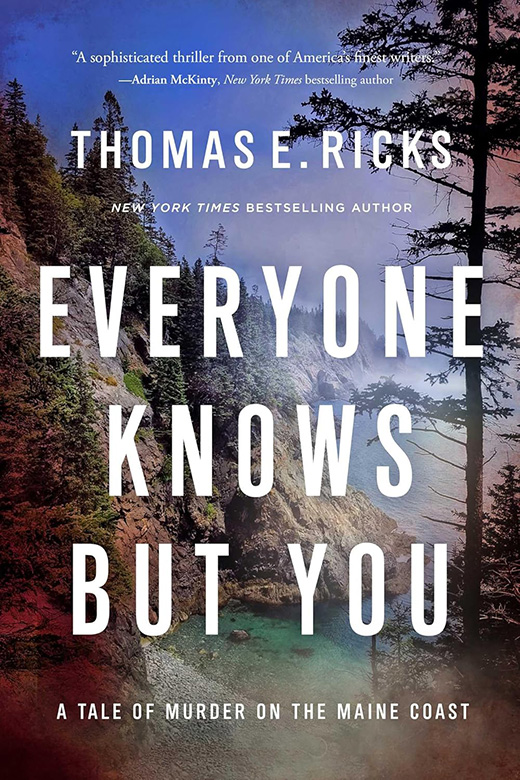
Everyone Knows But You: A Tale of Murder on the Maine Coast
By Thomas E. Ricks; Pegasus Books (2024)
Early in Thomas Ricks’ novel Everyone Knows But You, FBI agent Ryan Tapia goes into the local diner on Liberty Island to begin a murder investigation. The Fisherman’s Pal, as the diner is called, is bustling with breakfast. Ryan sits at the counter, where the waitress aggressively ignores him.
We already know Ryan is new to his posting in Bangor and has been clued by his FBI predecessor to the fact that the locals regard both law enforcement and strangers with suspicion. He has arrived expecting to feel like an alien.
And does. So he puts on his imperturbable G-man face and overhears about a page worth of scene-setting snatches of conversation.
“Hey numbnuts, your truck is blocking mine on the wharf.”
“Bought that new floating rope, I think it parts too easily.”
“Goddam federal regulations. F— the whales.”
By and large these exchanges sound pretty authentic, as if they were sentences that had actually been overheard in, say, Stonington, and maybe recorded in a notebook for use in a novel.
As the waitress keeps ignoring him, Ryan gets a little rattled. What had he done wrong?
He is bailed out of the predicament when a paternal-seeming fisherman cajoles the waitress to cut Ryan a break and get him a cup of coffee, slyly pointing out, “He’s from the government.”
Ryan is surprised the fisherman knows this. They strike up a conversation that starts to shape the mystery surrounding the discovery of Ricky Cutts’ body in shallow water outside town.
This scene in a way carries the main theme of the entire book: Maine coastal towns are so socially insular, they are almost impenetrable by people from away, no matter how close the stranger seems to get.
Starting with almost no clues (adjectival form: clueless), Ryan proceeds to interview a cast of characters on the island (which the book’s map shows is fictionalized Deer Isle).
Early on there are some pretty uncharitable caricatures of local people, including Ricky Cutts’s disaffected, poverty-stricken teenage daughters. Ryan interviews two of the girls’ teachers, a pair of somewhat neurotic twins that the narrator, via Ryan’s internal monologue, refers to with more or less unabashed condescension as English Fitch and History Fitch.
The high school principal is a small, pale man of indeterminate middle age who crumples when Ryan gently bullies him. The chapter closes with “silent tears … rolling down the man’s cheeks.”
I guess this is supposed to be funny, in the time-honored tradition of local-yokel jokes.
Sketches of other characters encountered by Ryan seem less patronizing. There’s a well-off but quirky retired CIA agent who lives in a secluded cottage. A pot-smoking forest ranger. Some stereotypically taciturn Native Americans of unspecified tribal affiliation inhabiting an island called, puzzlingly, “Malpense.” A drug-dealer who has finagled the blessing of the community’s well-organized, vigilante upholders of community values.
Did Ricky Cutts get himself killed by wandering into dangerous commercial ventures his skinny, white, low-rent fisherman’s ass could not navigate?
Ryan doesn’t know. And he spends most of the story making hardly a dent in finding out, partly because he’s got problems of his own that include the FBI boss in Portland, but mostly because no one wants to tell him directly what’s going on. Apparently, everyone knows but him.
Ryan and the narrator’s condescension toward the minor characters early in the story provides part of an answer to his question in the diner. There’s striking irony between the outsider’s understanding of “pre-industrial” Maine (as the narrator smugly describes the setting Ryan finds himself in) and that same outsider’s bewilderment about what he’s gotten himself into. If you visited a Maine town with your notion of its backwardness competing with its actual reality, you’d spend a lot of your time confused.
An old local joke: A gussied-up tourist wanders into a coastal village, spots an old guy on the streetcorner and asks, “Is there any entertainment around here?” The old guy says, “There is now.”
Nothing is what it appears to be, including the confident narrative of this story. If you want an inside peek at how outsiders don’t understand Maine, read Everyone Knows But You.
Dana Wilde is a former newspaper editor and college professor who lives in Waldo County.