Reflections is written by Island Institute Fellows, recent grads of college and master’s programs who do community service work on Maine islands and in coastal communities through the Island Institute, publisher of The Working Waterfront.
Two rubber totes, two large suitcases, one cooler, one duffel bag, four backpacks. What gets packed? Not for vacation, but for a month of working, cooking, and staying grounded amidst a hectic season. What makes the list, and what do you sacrifice?
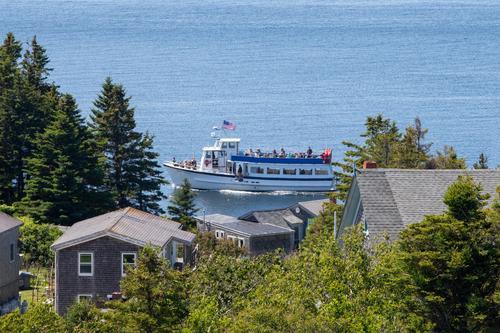
August on Monhegan Island introduced me to the “Monhegan shuffle.” Well-known by longtime residents and newcomers alike, this is the burden of many who call the island home: to move between temporary living situations until longer-term housing becomes available. The shuffle is particularly pronounced in the summer, when seasonal renters and summer residents return to enjoy the island. Even in the winter, however, the lack of adequate winterized housing can inspire multiple moves.
This situation is not unique to Monhegan. Many of Maine’s island and coastal communities battle with housing shortages, a problem intensified by the rural shift during the COVID-19 pandemic and the ever-widening wealth gap. Housing organizations, such as North Haven Sustainable Housing, Isle au Haut Community Development Corp., and Cranberry Isles Realty Trust, have arisen to tackle affordable housing on their islands. Each takes a catered approach to address housing gaps in their communities based on their mix of zoning, housing stock, need, and community capacity. Some of their solutions can be replicated by the Monhegan Island Sustainable Community Association (MISCA), our housing nonprofit that was founded in the early 2000s. However, we have one element that is unique among these islands mentioned: Monhegan is a plantation.
Maine’s plantations are a holdout from the Massachusetts Bay Colony, a vestige of language since fallen out-of-use. These municipalities are an in-between: not quite a town, but more than an unincorporated area. Plantations do not have their own planning boards, nor do they have control over zoning or ordinances. That power lies with Maine’s Land Use Planning Commission (LUPC), a state body that holds planning and zoning authority for unorganized and de-organized areas. LUPC must approve amendments to Monhegan’s zoning, whereas other towns hold this authority themselves. Having to look to a state commission to approve changes for their own community can leave Monhegan islanders wanting more agency, especially for rules impacting something felt so acutely as housing.
I have been privileged to work with LUPC to identify opportunities in our regulatory space and with MISCA to research and apply for funding opportunities to advance development projects. I have also volunteered at MISCA fundraising events. This work is grounded in the everyday experiences I share with my fellow islanders, and I have been fortunate in my experience with the Monhegan shuffle. Nevertheless, I have relocated four times so far in 2026; I will move once more into winter housing come November. Throughout this process, my mental health has suffered, and my capacity to do my job has waned. Thankfully, I have had the support to weather these transitions while gaining insight into the reality of housing for those who wish to make Monhegan their home.
Because of my fixed term, much of my work on Monhegan feels abstract: applying for funding I will not administer, supporting community-led renovations I will not see, setting up the dominoes of project management such that the work can continue when my fellowship concludes. And yet, this season of moving is a reminder that the work I do here is deeply personal, and perhaps none of it is more so than my collaboration with MISCA. My work on Monhegan is, ultimately, trying to help this community answer one question: how can it better determine for itself what is best for its future and how to achieve it? I do not have the answer—no one person does. It can only be identified through careful, inclusive, and intentional dreaming with the policymaking and project planning to back it up. For now, I will keep moving my luggage—thankful for the extra hands to help carry it—and working with my neighbors towards that shared future.
Elizabeth Dudley is assisting Monhegan Plantation with a working waterfront resiliency project as it redesigns the public wharf and breakwater. She also works to create more year-round affordable housing on the island.