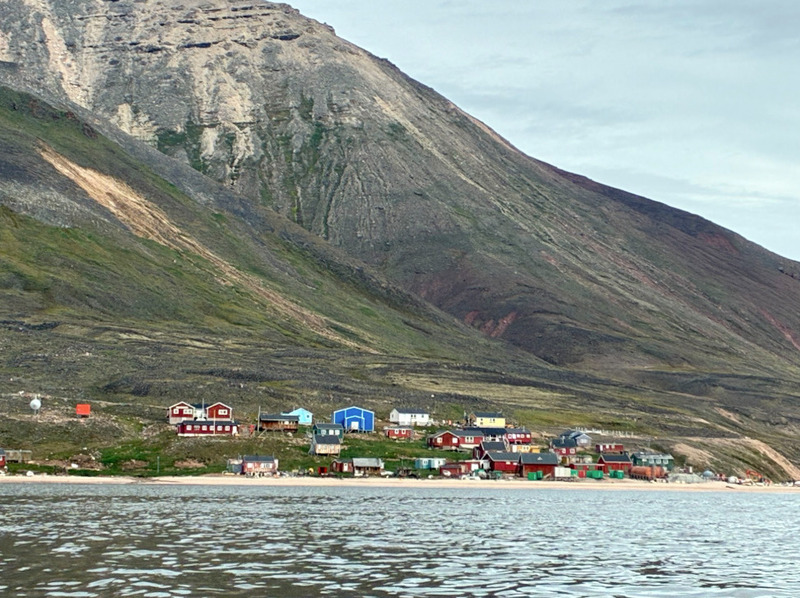
I recently visited the village of Siorapaluk, in northwest Greenland. At about 77 1/2 degrees north latitude, it’s the northernmost human settlement in Greenland and one of the world’s northernmost working waterfronts.
I arrived by kayak, paddling north across the calm late-July waters of Robertson Fjord. The shore included a broad sandy beach leading to tussocky grass between ramshackle boat sheds and the bare dirt circles where pairs of huge, wooly sled dogs are chained for their brief but boring summer. Some colorful, Danish-style buildings climb a grass and boulder slope nestled at the base of the 2,000-foot glacial scree cliffs looming behind the town. These towering rock piles were cut from the exposed bones of the world’s northernmost landmass and ground to roughly uniform size by a glacier flowing relentlessly off the inland ice sheet. Gaps between the rocks are perfect for the nests of the little auk, or dovekie as the Brits call them, a tubby, black-and-white bird that looks like a less-flamboyant puffin. One of the bird researchers who also flock to the area told me there are 60 million nesting pairs within a 100-kilometer radius. I saw perhaps half a million as they poured off the scree hills and circled and eddied in great clouds, looking from a distance exactly like a swarm of North Woods gnats.
We beached our kayaks and were greeted by the town’s most enthusiastic ambassador, a boy of about 10 wearing a battered puffy jacket and wraparound sunglasses. He helped us set up tents in the town’s grassiest spot, a small clearing beside the municipal water pipe, putting us right in the middle of the main street. Siorapaluk has long had a population of about 50, but it’s down to just 29 right now. I was told that the boy, named Romy, was currently the only child in town. Later I saw him fetch a bicycle from a beached boat and ride it up and down the main street, alone.
Siorapaluk has been inhabited for many hundreds of years by Greenlanders who hunt birds, seals, and walrus, but above all narwhals. The so-called unicorn of the sea is small by whale standards, with a long tusk protruding from the left side of its face. For Greenlanders a whale was a cornucopia of food, energy, and the raw materials to create tools, clothing fasteners, dog sleds and harnesses, and even the kayaks and harpoons for hunting them. Today, most goods come on one of the two Royal Arctic container ships that arrive every year, and the hunters travel in 19-foot outboard powerboats. But they still hunt the narwhal right up close, harpooning them by hand from handmade kayaks.
At the top of the hill overlooking the village, we visited a hunter named Maassannguac. His father caught what is probably the finest two-tusked narwhal in the world, and its skull sat in pride of place on his porch railing, the two symmetrical tusks each standing at least four feet high. All narwhals are born with two tusks in their head, but typically only one erupts and develops into the spiraling lance they’re known for.
Maassannguac told us the sea ice arrives one or two months later than it used to. He also said that with the ice sheet melting, the land has rebounded so much that now, from his perch above town, he can see over the hills across the fjord to the south, and “it’s light all winter now.” I’m pretty sure he was joking about that part. Before we left, we got Maassannguac’s email address, which ends in “outlook.com.”
In July the sun never gets lower than a fist’s width off the horizon. As I tossed and turned on my air mattress that night, trying to sleep in the hot midnight sun, I heard the ever-present howl of the sled dogs. Then several children laughed and screamed in delight in the school playground up the hill. Eventually the kids all trooped down the path between our tents, shushing each other with comical seriousness but limited success when they realized we were sleeping. Obviously Romy was not alone, and I was happy to have been misinformed. I did put in my earplugs, though.
Rusty Foster lives on Peaks Island and writes the email newsletter Today in Tabs. He can be reached at rusty@kuro5hin.org.