Over its long relationship with its nearby human inhabitants, the Passamaquoddy Bay—located between Downeast Maine and southwest New Brunswick—has traditionally served as an international connection point.
Even in recent years, it has continued to do so despite broader political and economic tensions that have flared up between the U.S. and Canada.
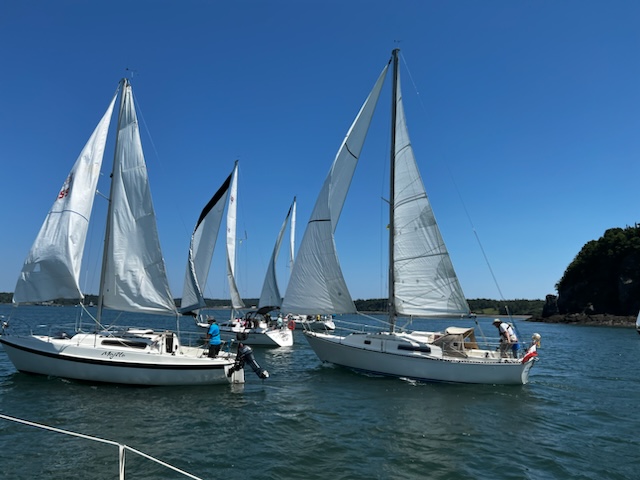
The Eastport-based Passamaquoddy Yacht Club (PYC), in particular, exemplifies the bay’s intertwined history. It closely collaborates with a Canadian counterpart, the New Brunswick-based St. Andrews Yacht Club, sharing racing schedules and other resources.
“It’s been such an important connection for us here in Passamaquoddy Bay,” says Roger McNabb, commodore of the New Brunswick club, who adds that the international component has been in place since long before he joined in 2006. “Regardless of geopolitical stuff, we’re all friends here. We all have relatives on both sides of the border.”
It’s an appropriate evolution for the Eastport club, which counts former President Franklin D. Roosevelt among its first members. Originally founded on Campobello Island during the post-Depression era when a summer colony of affluent families took root, the then-named Campobello Yacht Club embraced the natural beauty of the area—still among its strongest attractions.
“It’s what you see when you go out there,” says Robin Gautier, commodore of the PYC, who joined in 1988 after she and her partner Phillippe crossed the Atlantic in a steel boat and has experience sailing in various locales around the world. “This place has the Mediterranean beat, as far as I’m concerned. It’s just gorgeous out there.”
“It’s the wildlife, specifically the marine-connected wildlife,” adds Dean Pike, a club member and instructor of boatbuilding at Eastport’s closely connected Boat School. “There’s nothing like it. We used to do these sailings over in Federal Harbor—oh my God, it’s a blessed place on Earth.”
It wasn’t always smooth sailing. The club’s membership waned after its original founding. It then crossed the bridge to become the Lubec Campobello Yacht Club and “started to build,” says Gautier. “It was important to ensure we were representing the bay.”
The club’s representation expanded even further when it moved to Eastport and changed its name to the Passamaquoddy Yacht Club around the late 1980s.
“Adding ‘Passamaquoddy’ opened it to more people,” says Pike, noting that their members now include people from Deer Island, Calais, Robbinston, and Perry.
State officials once asked the club to change the name, because it’s not a tribal group. But according to Gautier, it kept the moniker after Melvin Francis, then governor of the Passamaquoddy Tribe at Sipayik, said it would be acceptable if the club allowed four tribal youths to join its programs at no cost, an arrangement that continues today. Gautier noted that the club continues to consider updating its name.
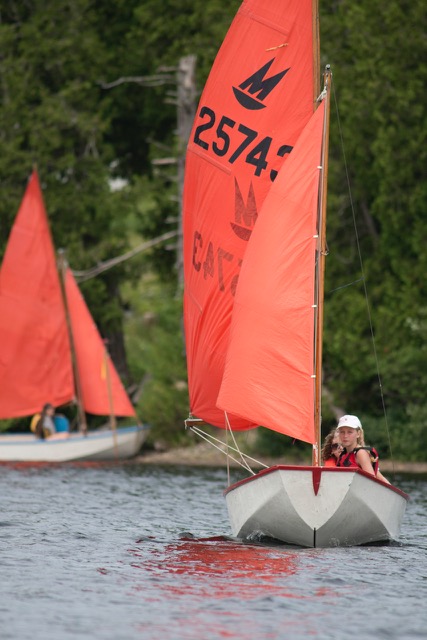
Perhaps the most effective way the PYC has grown is through its youth program—which, in turn, had its start with the St. Andrews Yacht Club. After St. Andrews experienced an aging out and its youth sailing program dwindled, it donated three Mirror dinghies to the Eastport club to start its own led by then-Commodore Davis Pike (no relation to Dean).
Seven club members got certified as instructors, and three more Mirrors were purchased. The program immediately took off, helping the club to expand its membership.
“We wanted to make sure sailing was accessible to local families,” Gautier says.
The impact was soon clear. Gautier vividly recalls one student who, at 10 or 11 years old, was “not very athletic, wanting to be involved in stuff but not good at things.” But, “Did he take to sailing!” By the end of the program, he couldn’t wait to take his grandparents sailing. Within short order, he bought his own boat. “He just loved it. All of a sudden something clicked in him. That’s what you hope for.”
Given the older age of both the club and its membership, Gautier went on, “Having the sailing program was—and is—critical to succession and keeping the spirit and legacy of sailing in the bay alive. There’s no other way to do it except teaching kids how to sail.”
While the club’s own instructors eventually aged out of teaching, the program was quickly taken up by outdoor recreation instructor Scott Fraser at Washington County Community College in Calais under PYC’s guidance. The college eased the way by offering an online registration system, insurance, and scholarship management.
For five years, the program flourished, but with administration changes it once again faced closure. A reprieve arrived in the form of Cobscook Institute, where club board member Damon Weston is also an instructor. For the past five years, the program has been under Cobscook’s watch with the club’s continued support.
“This support has been crucial in keeping the program going and making it affordable to kids from any economic background,” Weston says. “From what I have seen, it is one of the most affordable options for learning to sail in New England.”
For Weston, it’s a rewarding task. “I personally love teaching sailing since it gives kids the freedom to steer their own vessel even at a young age. It is always magical when a kid grasps the concept for the first time.”
“There’s a tradition, a legacy of seafaring here that one has to remember and celebrate,” Gautier says. “I think that’s also a big part of it.”
In keeping with recognizing its roots, the PYC recently loaned a selection of documents along with the Yacht Club Cup and a plaque of brass nameplates of the annual race winners to Roosevelt Campobello International Park, the only park in the world jointly managed by two countries. Gautier recalls a recent “nice email” from Christopher Roosevelt—a member of the park’s commission and grandson of the former president and his wife Eleanor—about the contribution. “I find it kind of fun that there’s been this connection maintained.”
Sailors of all stripes can take part in the PYC and St. Andrews races, which are advertised on their websites. “It is just a wonderful area to sail,” McNabe says. “You do have to learn how to plan with the tides and the currents, but we have so much local knowledge, and all of the members are so willing to mentor anyone coming to the region. We’ll pass on as much information as we can.”