Lobster fishing is a blend of strategy, hard work, and good fortune. The right gear, the right timing, and the right places to set strings of traps can be no match for the weather, or the whims of the market, but fisherfolk persevere, and often end a season in the black.
This mixture of luck and skill made lobster fishing an obvious source of inspiration for Searsport-based game designers Gregory Birgfeld and Cindy Wren, the co-creators of Corker, a table-top strategy game currently in play tests.
“I had a lot of experience with friends whose parents were lobstering,” Birgfeld said. “It’s a culture within a culture. I was familiar with the weather, having sailed on Penobscot Bay, the perniciousness. The market and how the season changes quickly between prices and stuff. We fully built that into the game.”
They named the game after “a corker,” an old term that can refer to a great catch.
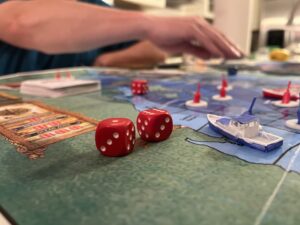
It takes about 20 turns, spanning the time from post-winter hard shell season, through the warmer soft shell season, and back to hard shell. A tide card, pulled at the start of each turn, defines the conditions on Penobscot Bay for that turn, including the weather and the market. Action points are quantified through a die roll, and include setting traps, hauling them, and moving from location to location within the bay.
“A lot of the game play involved tangling ropes, stacking traps improperly, changing weather around the islands, ledges, open ocean. Key mechanics is that if you stay in-shore where it’s safer you haul fewer lobsters, but if you gamble for deeper water or lobsters where fewer people fish, you run the risk of the weather changing or the buoys being washed away by whitecaps or some other event,” Birgfeld said. “You’re thinking every turn how much risk you’re willing to take on. People start feeling the pressure to bring in more money.”
Although gear sabotage is a harsh reality of fishing culture, that element was carefully kept out of the game play. “You gamble with your own boats and own traps. People will receive cards that you can play on other people, but no sabotage cards,” said Birgfeld.
Play testing is an essential element of game design. “All our friends know if they come over they are automatically paying a play test of Corker,” Wren said.
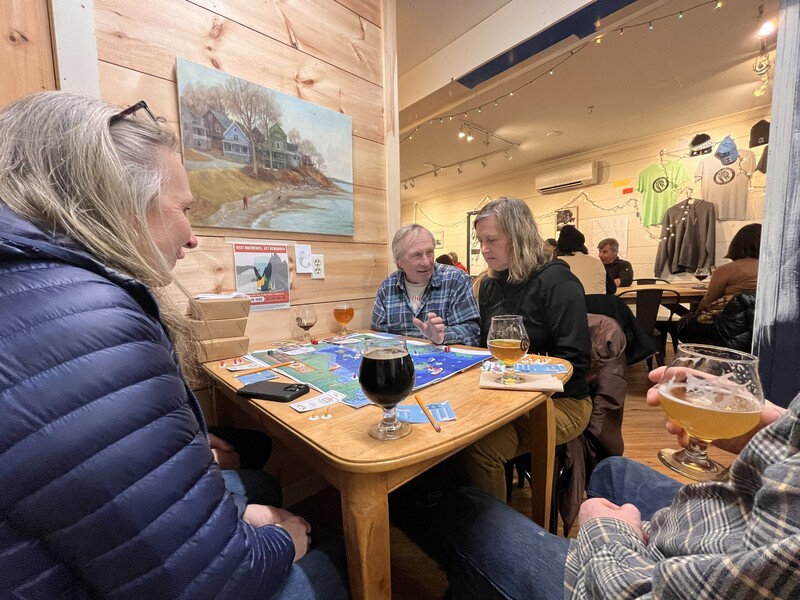
The first public play test was held in late March on Vinalhaven, after a serendipitous connection was made with Go Fish store owner Rachel Noyes.
“I think it was an email I got … I’m always trying to find something new and when I saw it was a game with lobster boats and there’s North Haven and Vinalhaven right in the middle, I thought, this is so fun, I want this in my store,” Noyes said.
The email was to gauge interest for carrying the game, but Noyes saw a perfect opportunity. “I said, would you ever consider coming out to do a test out here on Vinalhaven? And it turned out that was their dream,” she said. Noyes asked the Vinalhaven Community Brewery to host, which they were happy to do following a successful cribbage tournament earlier in the month.
Despite some nervousness about the potential turnout, all agree that the play test was a success. “We had two full days of three games, three to four players per table going, and then again on Saturday afternoon,” Wren said. “People were planning their Saturday afternoon around going to play.”
The crowd, which included several lobster fishers, was enthusiastic. “When I saw people smiling and laughing and groaning, ‘aw man,’ ‘oh yay,’ seeing that emotion of them being involved in the game was the most rewarding part,” Wren said.
“My favorite feedback was a guy telling another person, ‘Oh my God, that happened to me last year,’” said Birgfeld.
Praise was mixed with constructive feedback, Wren said, primarily focused on the rulebook and instructions. She and Birgfeld immediately began work on simplifying and streamlining that element of the game, and will schedule additional play tests in the near future.
From there, finalizing the design and launching a crowdfunding campaign will bring Corker closer to store shelves. The developers are currently exploring Maine manufacturing options, including doing some of it in-house since Birgfeld already has equipment to produce game components.
Once it’s completed, Noyes is eager to carry it. “I think it will be a fun thing to support, and it’s local,” she said. The Penobscot Marine Museum, and several other local businesses, have expressed enthusiasm as well.
For Noyes, the appeal is obvious. “The board is just so familiar,” she said. “It’s home.”
More information about Corker can be found at corkerthegame.com.
Courtney Naliboff teaches, writes, and plays music on North Haven. She may be reached at courtney.naliboff@gmail.com.