Big Jim isn’t what he once was. At least for now.
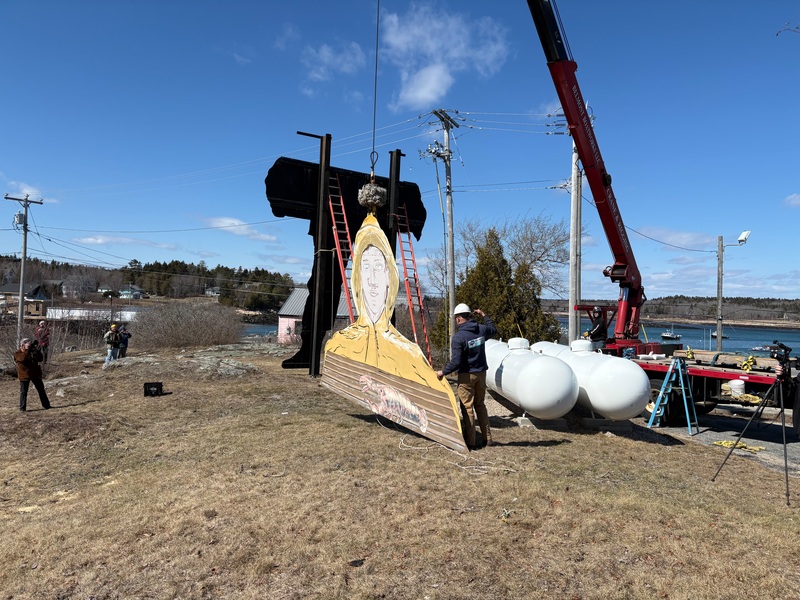
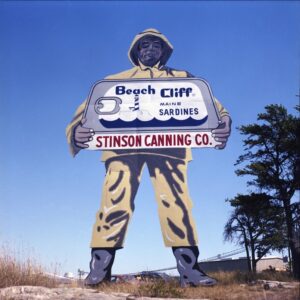
The iconic 40-foot tall sign that once welcomed visitors to Maine in the late 1950s and early 1960s, and later towered over the Stinson Canning plant in Prospect Harbor, is lying in a paint shed at Belmont Boatworks this spring.
“We call him ‘Flat Jimmy,’” jokes Dan Miller, founder of the boatyard just outside of Belfast, showing the dozen quarter-inch-thick aluminum panels that most recently made up Big Jim, lying on pallets. Those panels have been sandblasted and painted a dull gray, further diminishing Jim’s once-commanding presence
But Big Jim will rise again, this time along Route 1 in Searsport at the entrance to the Penobscot Marine Museum’s campus, temporarily welcoming visitors to its Sardineland exhibit, which is entering its second year. The sign is then set to head back to Prospect Harbor in the fall.
The sign and character are intertwined with Maine’s fishing heritage. The museum’s executive director, Karen Smith, shared the story with supporters earlier this year, including how the unlikely quest to restore and host Big Jim took shape.
“We’re right along heavily traveled Route 1,” she said, “but we tend to get overlooked.” In what Smith admitted was a “wild idea,” staff suggested that “we need something like Big Jim, the big sardine man, that will just stop people and make them see that we’re here.”
Jim made his debut on Route 1 in Kittery in 1959, courtesy of the Maine Sardine Council, welcoming visitors “to both sardineland and vacationland,” Smith said. He originally was made of plywood, with the image of an oilskin-clad fisherman painted on both sides.
It’s believed, Smith said, that Jim was named for James Warren, the director of the sardine council, who was also associated with Eastport’s R.J. Peacock Canning Co.
As more visitors chose the interstate over Route 1, and tourism promotion became more sophisticated, Big Jim seems to have fallen out of favor. But he reappeared in Prospect Harbor in Hancock County at the Stinson Canning plant, this time made of aluminum, with the image painted on just one side.
Smith noted that through his nearly 70 years, Big Jim has been painted different colors, had different facial expressions, and held different placards. His last incarnation had him holding a lobster trap.
In 2010, the Prospect Harbor plant closed, the last sardine cannery in the country to be shuttered.
“It was an industry that was along our coast for nearly two centuries,” Smith said. The demise impacted “so many communities.”
As the plan to restore, repaint, and replant Jim took shape, museum staff turned to Miller, of Belmont Boatworks.
“Dan has been a great friend to the museum and the community,” Smith said. “He has a creative spirit. So when we talked to Dan, he got very excited about this idea,” she said.
“I do as much volunteer stuff as I can for the museum,” Miller said. “I think they’re fantastic.”
Miller traveled to Prospect Harbor and climbed over the sign to learn how it might be dismantled. David Wyman, a naval architect, also pitched in to determine how it might be reassembled. Plans were even developed to lower Jim to the ground if a hurricane was bearing down on the coast.
Moving Jim was less of an ordeal than thought. Miller said when it became clear that dismantling it was the best method, the sign was easily transported on a trailer. Though perhaps not needed, Gouldsboro police escorted the vehicles out of town, an expression of community pride, Miller believes.
Repainting Big Jim will be completed by the WOW (Women On Walls) Collective, a group of local artists. It’s appropriate, Smith notes, that women will do this work, given how cannery workforces were mostly women.
Bold Coast Seafood, which now owns the Prospect Harbor plant, was onboard with loaning the sign to the museum, and the Gouldsboro Historical Society also has been supportive, Smith said.
Not only is the sign entirely appropriate for the museum’s Sardineland exhibit, but Smith argues it will provide “a fun way to welcome people back to the community” after two years of extensive work on Route 1 through town.
The museum’s opening day is May 22.
Tom Groening is a former editor of The Working Waterfront. He may be contacted at thomasjgroening@gmail.com.