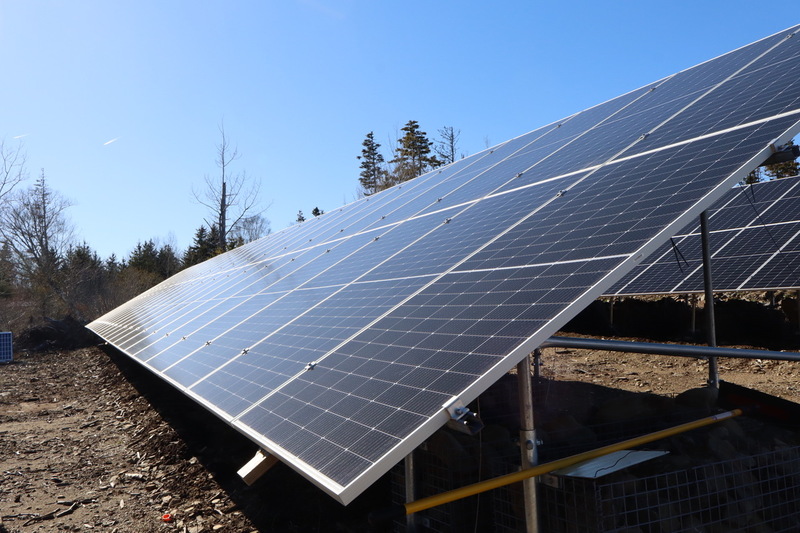
Since summer 2025, Matinicus Island’s municipally owned electric utility has powered homes and businesses using a 160kW solar array, two new Perkins diesel generators, and a “hybrid supercapacitor” battery energy storage system.
Matinicus, easily 20 miles offshore from Rockland, first offered grid-style electricity to homeowners in the mid-1960s, when our earliest rudimentary power company was built using secondhand equipment. This paralleled the start of residential telephone service to island customers. Prior to that, anybody who wanted electrical appliances (or the latest gimmick, television) had a personal generator in their backyard.
The independent utility first called Matinicus Light and Power, then Matinicus Plantation Electric, went through several improvements over the decades. In 1983, with a Community Development Block Grant and the extensive knowledge of island residents Page and Betsy Burr—he an electrical engineer, she with considerable financial acumen—a new generation system was installed, designed for efficiency. This included three Detroit diesels, with generators, and automated switchgear to bring engines on and offline as electrical demand changed seasonally and daily. Maintained by Billings Diesel in Stonington, the old powerhouse engines chugged away 24 hours a day for decades, providing reliable electricity.
(Well—except for summer nights during a stretch of the 1970s. An experiment was briefly undertaken to shut the system down nightly at 10 p.m. during warm weather to save fuel. That was only done for a short time, but even now we still encounter people who think Matinicus shuts the electricity off at night. It does not.)
These days, we don’t hear those engines run all the time (certainly an improvement!), but the new storage capacity ensures the electricity stays on. The old Detroits are gone, having worked for years beyond their expected lifespans, and the 1980s-era switchgear had begun to fail by the time the new system went online last July. The island also replaced its aging fuel storage facilities, accounting for a substantial chunk of the expense and complexity of the project.
With just over 100 ratepayers—many seasonal—our modern “microgrid” stands alone.
The financing for this million-plus dollar project was a public-private partnership.
For the most part, island ratepayers and taxpayers bear the cost of the new system. A municipal bond was obtained for roughly $900,000. First, Matinicus Isle Plantation had to hold a special town meeting for voters to approve seeking a “bridge loan” from Camden National Bank, repaid when the bond came through. While the town was busy raising funds through bond issuance, an islander (with more faith in solar power and energy storage systems than some of the “old timers” had) formed a company and was out applying for grants that would not be available to a municipality.
One struggle has been that Matinicus didn’t have time to wait for certainty about grant funding or have time for the slow wheels of municipal financing to secure the bond. Everyone from engineers to “old guys who turn wrenches” agreed in 2024 that our power plant wouldn’t handle another summer. The old system was failing fast; the island did not have the luxury of time, but necessary system components required many months of lead time prior to delivery. This project involved constant pivoting, an exasperating administrative burden, and much explanation to people in various positions who could scarcely envision this remote island.
On top of everything, our municipal treasurer, administrative assistant, power company bookkeeper, and the project’s coordinator were all new at their (supposedly part-time) jobs.
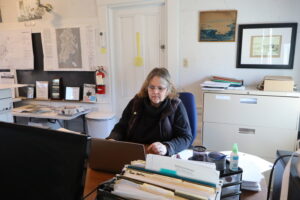
Tremendous thanks are due to many who helped Matinicus with the administrative, financial, and grant application side of acquiring the new equipment—difficult work done largely behind the scenes—not to mention the engineering and logistics. Planning consultant Gabrian McPhail’s knowledge was critical. “Alex Zipparo [with Island Institute at the time] was wonderful and really cared about what was going on,” observed assessor—in effect, a selectperson for the plantation—and power company bookkeeper Laurie Webber. “Alex gave us the kickstart,” added Phil Davies, who coordinated the project.
Island Institute helped the island apply for a renewable power/community action grant through the Community Resilience Partnership and the Governor’s Office of Policy Innovation and the Future—now called the Maine Office of Community Affairs. This grant of about $50,000 for design work helped bring on board electrical engineer Spencer Egan of RLC Engineering, who continues to be indispensable to our power company. “Egan drew the short straw,” in the words of Davies, “and got to fly out to Matinicus to inspect our aging system. He had no idea what he was getting into, but he rolled up his sleeves, put on his ear protectors … and provided a roadmap for a replacement system.”
“A big break was an award in excess of $350,000 from the USDA Rural Energy for America Program, which would match up to 50% for solar installations and battery storage in rural areas,” according to Davies.
Island Institute also provided a grant for $20,000 for some specialized equipment on the transmission lines that will help minimize outages and reduce fire risk, and a $10,000 grant for administrative assistance compiling the larger applications.
Matinicus would like to thank Camden National Bank, in particular Steve Matteo, Jody Landrith, and Donnaleen DiNapoli. “They may have thought we were crazy at first,” commented one municipal staff member, “but they were great. They made it work.”
Davies noted, “The Maine USDA team up in Bangor were fantastic. They were a big help navigating the application process” for the federal matching grant.
Webber reiterated that a community without electricity would lose telephone, internet, postal service, small businesses, and more. “Hopefully not in my lifetime,” asserted Webber. “Not without a fight.”
Eva Murray is a writer and year-round Matinicus resident with multiples roles on the island, including municipal clerk, EMT, waste and recycling coordinator, and winter meter reader for the power company.