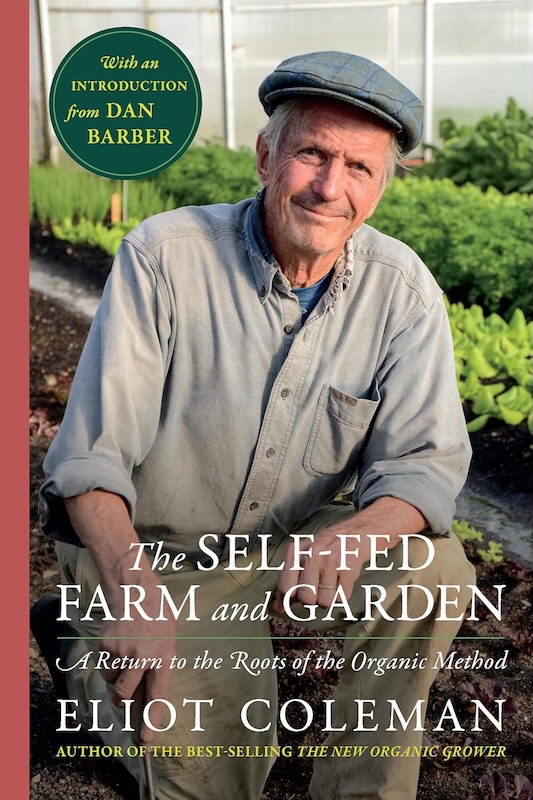
The Self-Fed Farm and Garden: A Return to the Roots of the Organic Method
By Eliot Coleman (2025, Chelsea Green Publishing)
Eliot Coleman may be familiar to you because you’ve read other books by him: The New Organic Gardener, Four-Season Harvest, The Winter Harvest Handbook. Each covers aspects of organic gardening, whether its focus is tools and techniques, year-round harvests, or using unheated greenhouses.
You may also know Coleman along with his wife, Barbara Damrosch, as owners of Four Season Farm, located in Harborside, Maine. (Since 2024, they’ve had a leasing agreement with Little Red Flower Truck, owned by Molly Friedland and Caleb Hawkins.) As well, Four Season Farm is built on 60 acres of land once owned by Helen and Scott Nearing, whose book Living the Good Life is a classic in the “back to the land” genre—and whose home is now called the Good Life Center.
Coleman was responsible for transforming the Nearings’ rocky, acidic soil into his organic 20-acre farm. He explains in his preface why he now questions the word “organic” being applied so widely.
He writes that organic farmers used to grow crops for green manure and shallowly till them into the soil. They also used manure from their own farm animals, creating “an exceptionally clean, safe, self-contained production system. Nowadays it is a different world. Those traditional, farmer-managed, soil-improving processes have been replaced by products—purchased products from off the farm.”
He reminds us about “composts” made of ingredients from municipal waste. (Just a few years ago, some Maine farms were ruined by PFAS introduced into their soil in the guise of “enrichment.”) Commercially-sold composts can incidentally now include contaminants such as “pesticides, herbicides, antibiotics, veterinary drugs, hormones, heavy metals, and the like.”
He considers it a defining principle of Four Season Farm to grow in organic soil that provides food “free of the chemical pollution and industrial toxins that pervade our world.” As the title indicates, a self-fed farm does not use the industrially influenced, inadequate shortcuts so many organic farmers now rely on. “The aim of this book is to detail the simple and productive methods we use to … produce clean and nourishing food in perpetuity.” Coleman advises his farm stand customers that organic farming is best defined by its “embrace of the soil’s biological systems,” and the book’s preface delineates its seven components.
Packaged guano was the beginning of an unfortunate trend starting in the 1830s, probably the first major fertilizer collected en masse and sold to farmers. (Guano—dried seabird droppings—covered rocky islands off Peru to depths of hundreds of feet). Coleman laments, after citing another example—nitrate mined from Chilean deposits—that “product” replaced a “process.” He writes, “In this way, purchased fertilizers eventually took over agriculture.”
Not only is packaged pre-made compost anathema, but chemicals can also kill insects. The “healthy plant theory” sees insects and diseases not as enemies but as indicators that the growing conditions are inadequate for the physiological needs of the plant. “Pests bring a message that the plants are under stress. When we use pesticides, we are basically shooting the messenger and ignoring the message.”
This book has enlightened me, and in my view, definitely complicated the word “organic.” For me to use it now as a descriptor, it would first need to be followed by a lot of clarifying questions. Coleman put painstaking research into this book, and notably it includes footnotes, a comprehensive bibliography, charts, and color photographs. Coleman isn’t trying to boggle us as much as to explicate; he gives us the what, the why, the history, and the how-to.
Tina Cohen has gardened since the early 1980s at her home on the rocky island of Vinalhaven, with only incidental help from seabirds.