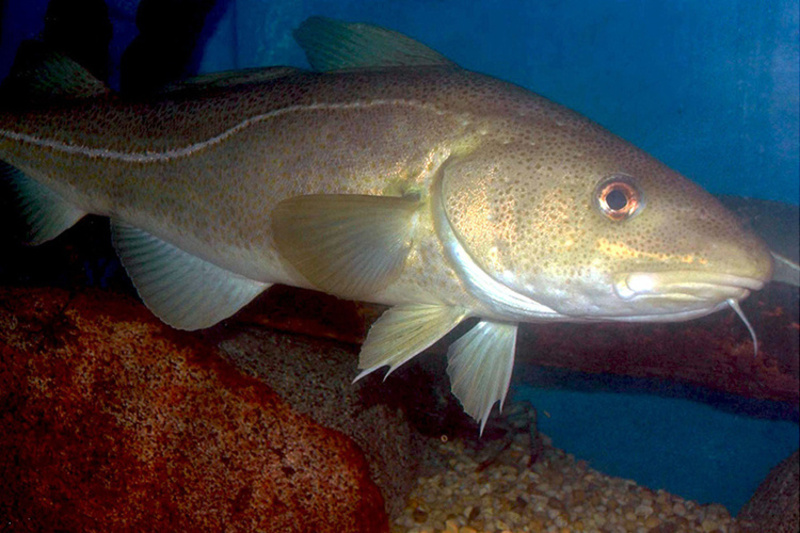
For the first time, federal regulators have set catch limits for the Atlantic cod fishing season based on new rules that group the fish into four populations.
The revised catch limits bulletin, which NOAA Fisheries published in early August, is the culmination of a long regulatory process to shift cod management from two populations to four. The populations are now grouped as eastern Gulf of Maine, western Gulf of Maine, Georges Bank, and southern New England cod. Previously, the cod were divided only into Gulf of Maine and Georges Bank populations.
Ben Martens, executive director of Maine Coast Fishermen’s Association, said the shift should better align with what fishermen have long observed about cod behavior in the Gulf of Maine.
“The cod stock structures that we have existed in for a long time, that wasn’t how they saw fish moving around,” Martens said. “A lot of energy was put into looking at genetics, talking to fishermen, trying to understand what the appropriate stock structures were, are, and should be moving forward.”
Researchers and fishermen have long known there were more than two populations of cod off the coast of New England and Canada. A federal fisheries scientist published a study dividing the fish into four different populations in 1963, but regulators in 1972 elected to manage the fish as two populations.
The Atlantic cod numbers have collapsed in the last few decades and failed to recover despite restrictions to prevent overfishing.
In Maine, annual cod landings peaked in 1991, reaching 21 million pounds before plummeting over the next decade and then more gradually declining, according to state data. Maine fishermen hauled in just 57,596 pounds last year, preliminary data show.
Gib Brogan, fishery campaign director for Oceana, an ocean conservation advocacy organization, welcomes the shift to a four-population management system. He hopes it will give regulators the tools needed to manage the cod fishery on a more granular level.
“We’re optimistic that these changes are going to make things better for cod up and down the coast,” Brogan said.
The shift in management comes during a cod fishing season already in progress.
The New England Fishery Management Council submitted its final draft of the change to the National Marine Fisheries Service in March 2025, but the Department of Commerce rejected it on procedural grounds and kept the two-population management system in place in the interim. NMFS finally approved the plan in late June.
Jackie Odell, the executive director of the Northeast Seafood Coalition (NSC), was part of the NEFMC’s groundfish committee which agreed to move forward with the four-stock management plan in 2024. The committee said that the plan represented the best available science, and that the plan had support from fishermen.
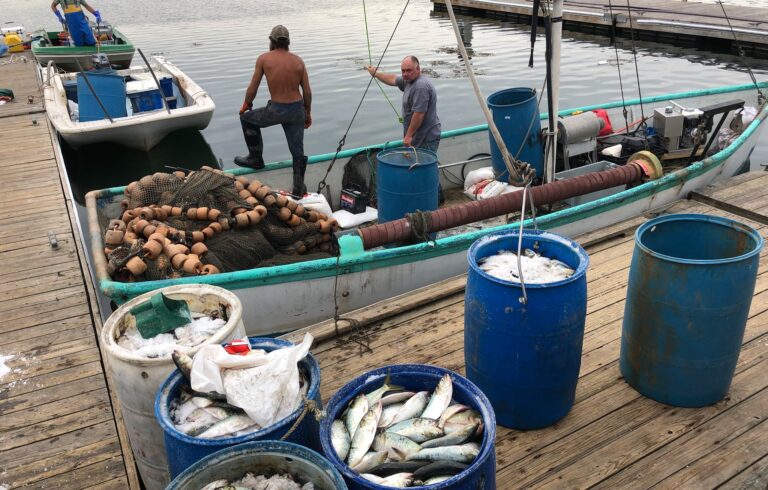
However, Odell also has heard concerns from many fishermen about the plan’s implementation. The plan is being overlaid onto the existing sector management plan, where cod is mainly a bycatch to manage or avoid while they are pursuing other types of fish. This will create new quota and bycatch constraints for fishermen with fishing plans built around the two-stock system, Odell said.
“It’s a multi-species fishery, and guys are constantly trying to stay within their bycatch limits so that they don’t have to purchase or lease more cod to cover catch of other stocks that then would make their trips potentially be economically not profitable,” she said.
Odell believes that this shift in cod management may be the beginning step of a strategic rethinking of how to manage groundfish as a whole. She hopes any new plan can help New England’s beleaguered fishing industry stay viable.
“There are always opportunities at crossroads for thinking it through strategically and trying to help the industry through this time and having a stronger fishery on the other side,” she said. “I am hopeful that that’s where we’re at, but we’ve lost a lot of people through the years.”